
Eucharistic Miracle of Amsterdam
The Miracle of Amsterdam is one of the most historically significant Eucharistic miracles in the life of the Church — not because of a visible transformation into flesh and blood, but because of what refused to be destroyed. It is a miracle of indestructibility: a consecrated Host cast into fire, and yet found wholly intact. The founding and growth of Amsterdam are deeply linked to the Catholic faith, and a key moment in the city's history is the Eucharistic miracle that took place in 1345. It reshaped the spiritual identity of an entire city — and its witness endures to this day.
Plan a trip here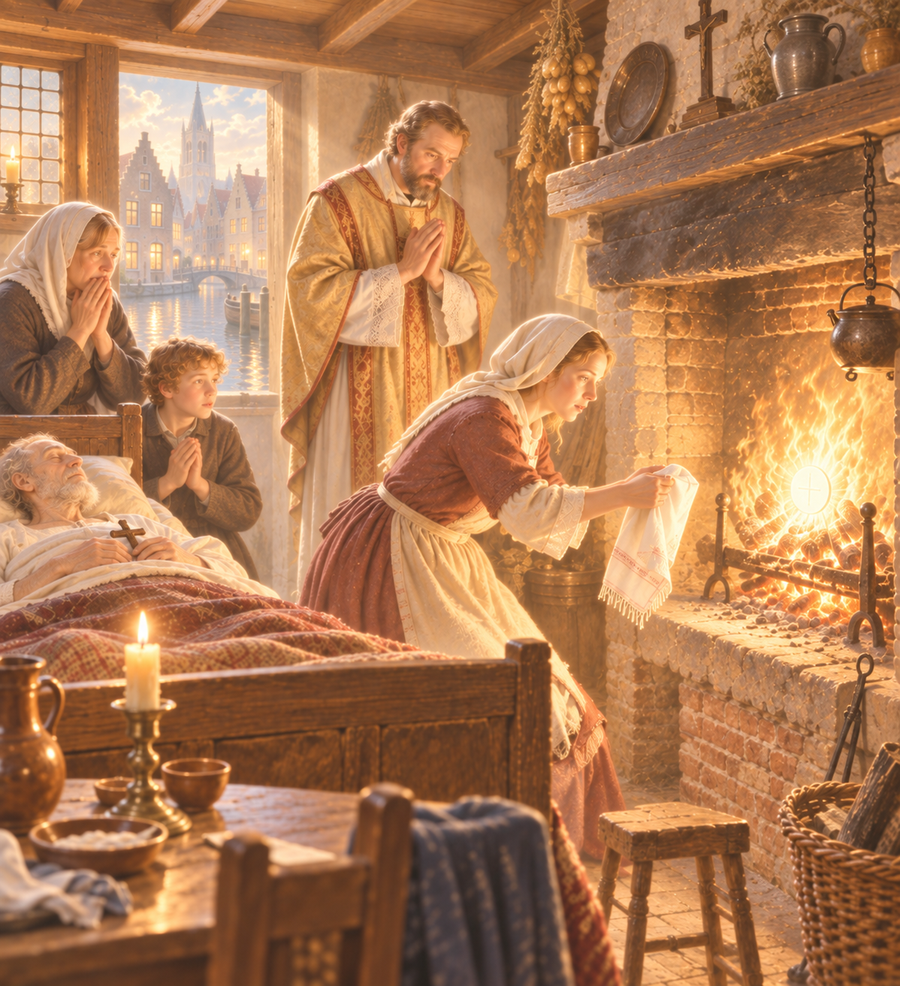
The Story
The Night of the Miracle — March 15, 1345
In the middle of the fourteenth century, a dying man in Amsterdam received the last rites, including Holy Viaticum, the consecrated Host given to the dying as spiritual provision for the journey into eternity. Shortly after receiving the Eucharist, the man became violently ill and vomited. The contents, including the sacred Host, were cast into the fireplace to be disposed of.
The next morning, a woman tending the fire reached in to clean the hearth and made an astonishing discovery: the Host was sitting perfectly intact in the flames, entirely unharmed. She removed it reverently and placed it in a linen cloth.
The miracle did not stop there. The Host was taken to the local parish, but it returned, inexplicably and on multiple occasions, to the home where the miracle had occurred. The repetition of the miracle was understood as a divine sign: God was choosing this place. The house was subsequently converted into a chapel, known as the "Holy Stede" the Holy Place, which became one of the most visited pilgrimage sites in all of Northern Europe.
The Holy Stede & Pilgrimage
Of the churches and chapels of Amsterdam, the so-called "Holy Room" is the most famous, as the scene of a great sacramental miracle, the "Miracle of Amsterdam." It was a place resorted to by countless pilgrims, among others by the Emperor Maximilian, and the street which led to it is still known as the "Holy Way."
Emperor Maximilian I, Holy Roman Emperor, made a pilgrimage to the Holy Stede in 1484 after experiencing a miraculous recovery from illness, which he attributed to the intercession associated with this Eucharistic miracle. In gratitude, he granted Amsterdam the right to display the imperial crown in its coat of arms, a distinction the city bears to this day.
At the end of the fifteenth century, Amsterdam boasted more than twenty monasteries, only one of which (the Beguinage) has survived the storm of the Reformation in its original form. The Holy Stede itself was eventually seized by Protestant authorities during the Reformation and converted to secular use, stripping Amsterdam of one of its greatest sacred treasures.
Church Recognition
Unlike Lanciano or Buenos Aires, the Miracle of Amsterdam did not produce physical tissue or blood available for scientific analysis. Its miraculous character is of a different order, one of indestructibility. Fire, by its very nature, consumes. Bread, by its very nature, burns. And yet the consecrated Host emerged from the flames without a mark.
This is consistent with the Church's broader understanding of Eucharistic miracles. The Church has recognized over one hundred Eucharistic miracles, many of which occurred during times of weakened faith. The Amsterdam miracle falls into the category of those that resist natural destruction, testifying not through scientific instruments, but through the plain witness of human eyes and the persistent movement of grace over centuries.
Catholic Teaching
The Miracle of Amsterdam speaks with particular power to a culture that has largely abandoned the faith. A Host thrown into fire and found unburned is a parable written in the language of nature itself: what belongs to God cannot be destroyed by the world.
The Catechism teaches that Christ is "truly, really, and substantially" present in the Eucharist (CCC 1374), and that this presence endures as long as the Eucharistic species remain (CCC 1377). What fire could not consume in 1345 is the same Lord who descends upon every altar at every Mass, the same Body broken for the life of the world, the same Blood poured out for the forgiveness of sins.
The founding and growth of Amsterdam are linked to the Catholic faith, and this miracle remains a key moment in the city's history, a reminder that no amount of secularization, Reformation, or cultural drift can extinguish the Real Presence of Christ, either in the Eucharist or in the hearts of His faithful.
The Silent Procession endures. The Host endured the fire. And the Truth it proclaims endures still.
Plan Your Visit
The Pilgrim’s Quick Card
- Ideal stay
- 1 Day 1 day is recommended
- Best months
- March Traditionally commemorated in mid-March
- Nearest airport
- Amsterdam Schiphol (AMS) One of Europe's easiest international airports
- Language & currency
- Dutch English is spoken extremely widely in Amsterdam
- Accessibility
- Fair Close together, but can present mobility challenges
Plan the trip
How Long Should I Stay?
The principal miracle sites are concentrated in Amsterdam's historic center and can be visited in one day. Staying overnight, however, gives you time for Mass, Eucharistic Adoration, Confession and a prayerful walk along the traditional pilgrimage route.
- One day — Begijnhof Chapel, original miracle site, Mirakelkolom and historic route.
- One night (recommended) — adds Mass, Confession, Eucharistic Adoration and a quieter visit to the Begijnhof.
- Two nights — allows a relaxed pilgrimage plus Amsterdam's other historic Catholic churches.
Pilgrim Tip: Amsterdam is busy and energetic. The quiet of the Begijnhof Chapel provides a striking contrast and is worth experiencing more than once.
Best Time to Visit
March is the most meaningful time for a Eucharistic pilgrimage because of the annual commemoration of the Miracle.
Best Pilgrimage Experience: March
The Miracle of Amsterdam is traditionally commemorated in mid-March.
Each year, the Begijnhof Chapel holds Miracle Week, including Eucharistic celebrations and extended Adoration.
Stille Omgang
The annual Silent Walk takes place on a Saturday night in March around the anniversary of the miracle.
Pilgrims traditionally attend Mass and then walk the historic route silently during the night. The route itself takes approximately one hour.
Best Weather
For comfortable sightseeing outside the annual pilgrimage:
April–May and September–October are excellent choices.
For a Quieter Pilgrimage
Visit on a weekday outside the busiest summer months.
Pilgrim Tip: If you want to experience the living tradition of the Miracle rather than only its historic locations, plan around Miracle Week and the Stille Omgang.
Getting There From the United States
Best and Primary Airport: Amsterdam Schiphol (AMS)
Schiphol is Amsterdam's major international airport and offers extensive transatlantic connections.
The railway station is located directly beneath the airport terminal.
Trains run approximately eight times per hour to Amsterdam Centraal, with the journey taking about 14–17 minutes.
From Amsterdam Centraal
From Central Station, continue toward the Begijnhof by:
- Tram
- Metro plus walking
- Taxi
- Approximately 20–25 minutes on foot
Typical U.S. Routing
United States → Amsterdam Schiphol (AMS) → Amsterdam Centraal → Begijnhof
Our recommendation: There is little reason to rent a car. Take the train from Schiphol and stay in central Amsterdam.
On the ground
Getting Around
The Begijnhof, original miracle site, Rokin and Oude Kerk are all located within Amsterdam's historic center.
Amsterdam's network includes:
- Trams
- Metro
- Buses
- Trains
- Ferries
Visitors can use OVpay to check in and out with a compatible contactless credit card, bank card, phone or smartwatch.
A rental car is unnecessary and generally inconvenient in central Amsterdam.
Good to Know: Amsterdam is exceptionally walkable, but bridges, bicycles, narrow sidewalks and cobblestones require attention while walking.
Where to Stay
Good areas include:
- Spui / Begijnhof
- Canal Belt
- Jordaan
- Dam Square area
- Amsterdam Centraal area
Best for Pilgrims
The Spui and Begijnhof area is the most convenient because it allows you to walk to Mass, Adoration and the principal miracle sites.
Pilgrim Tip: Amsterdam accommodations can become expensive quickly. Book early, particularly during spring, summer and major events.
Accessibility
Amsterdam has increasingly accessible public transportation:
- All metro stations are designated wheelchair accessible.
- Buses include low-floor areas and ramps.
- Modern trams provide improved wheelchair access.
- Some older tram stops and vehicles remain more difficult to navigate.
The historic center itself includes:
- Cobblestones
- Narrow sidewalks
- Steep bridges
- Busy bicycle lanes
The Begijnhof is also a historic complex, so visitors with significant mobility needs should contact the chapel in advance regarding current access.
Pilgrim Tip: The GVB Travel App can plan routes using its "Accessible Journey" and "Less walking" options.
What to do
Most Important Things to Do
Pray at the Begijnhof Chapel
The Begijnhof Chapel of Saints John and Ursula is the principal Catholic center preserving devotion to the Miracle of Amsterdam today.
After Amsterdam became Protestant in 1578, Catholic remembrance of the miracle eventually became closely associated with the Begijnhof. Today the chapel is devoted especially to the Eucharist, prayer and Adoration.
Allow: 30–60 minutes
Best time: During Eucharistic Adoration or early in the day.
Visit the Original Miracle Site
According to the traditional account, the miracle occurred in 1345 in a house on Kalverstraat.
A gravely ill man received Holy Communion, became sick, and the consecrated Host was thrown into a fire. The Host was later found unharmed. When it was carried to St. Nicholas Church, now the Oude Kerk, tradition says it repeatedly returned to the house.
A major pilgrimage chapel, the Heilige Stede, was later constructed over the site.
Allow: 15–30 minutes.
See the Mirakelkolom
Near the former Heilige Stede site on the Rokin stands the Mirakelkolom, a monument recalling the medieval pilgrimage shrine and Miracle of Amsterdam.
The original medieval chapel was demolished in 1908.
Allow: 10–15 minutes.
Walk the Stille Omgang Route
The Stille Omgang, or Silent Walk, follows the historic route connected with the miracle and medieval Eucharistic processions.
Pilgrims walk without singing, spoken prayers, banners or religious dress, making the route itself a silent prayer.
The official route takes approximately one hour.
You can walk it independently at any time of year.
Visit the Oude Kerk
Tradition says the priest carried the Host from the miracle house to St. Nicholas Church, today's Oude Kerk, before it inexplicably returned to the house on Kalverstraat.
The Oude Kerk has been Protestant since the Reformation, but it remains historically important to understanding the story.
Spend Time in Eucharistic Adoration
The Begijnhof Chapel offers Eucharistic Adoration throughout the week, with extended hours on Thursdays and selected Fridays.
For a Eucharistic pilgrimage, this should be one of the most important parts of the visit.
Suggested Pilgrimage Itinerary
Day One
- Begin at the Begijnhof Chapel
- Attend Mass
- Spend time in Eucharistic Adoration
- Go to Confession
- Walk to the original miracle site near Kalverstraat and Rokin
- Visit the Mirakelkolom
- Follow the historic Stille Omgang route
- Visit the Oude Kerk
- Return to the Begijnhof for evening prayer or Adoration
Day Two
- Return to the Begijnhof Chapel for morning Mass or prayer
- Spend a final period in Eucharistic Adoration
- Continue to another Catholic site in Amsterdam or your next pilgrimage destination
Have another day? Consider visiting Amsterdam's Basilica of St. Nicholas or other historic Catholic churches connected with the city's post-Reformation Catholic history.
Mass, Confession & Prayer
The current regular schedule includes:
Holy Mass
Monday–Friday: 9:00 AM and 5:00 PM
Saturday: 9:00 AM
Sunday: 10:00 AM in Dutch and 11:15 AM in French.
Eucharistic Adoration
Adoration is offered throughout the week, with particularly extended periods on Thursdays.
Confession
The current schedule includes regular Confession:
- Monday–Friday
- Saturday
- Sunday afternoon
Appointments can also be arranged with the priests.
Morning and Evening Prayer
The Community of the Blessed Sacrament also prays Lauds and Vespers daily in Dutch.
Important: Verify schedules before traveling because feast days and Miracle Week can alter normal times.
Practical
What to Bring
Pilgrimage Essentials
- Rosary
- Small Bible or prayer book
- Written prayer intentions
- Journal and pen
- Small backpack
Practical Items
- Comfortable walking shoes
- Light rain jacket
- Small umbrella
- Reusable water bottle
- Layers
- Portable phone charger
- European Type C/F power adapter
- Modest clothing for Mass
- Some euros in cash
Pilgrim Tip: Much of this pilgrimage is walked through Amsterdam's historic streets, so prepare for cobblestones, bridges and unpredictable weather.
Before You Go
Amsterdam is a pilgrimage where understanding the history makes the experience much more meaningful.
Before leaving:
- ✓ Check the Begijnhof Chapel Mass schedule
- ✓ Check Eucharistic Adoration times
- ✓ Plan time for Confession
- ✓ Write down your prayer intentions
- ✓ Learn the story of the 1345 miracle
- ✓ Visit both the Begijnhof and original miracle site
- ✓ Locate the Mirakelkolom
- ✓ Download 9292 or the GVB app
- ✓ Pack comfortable walking shoes and rain gear
- ✓ Consider walking the Stille Omgang route yourself
- ✓ If possible, visit during Miracle Week in March
- ✓ Leave time simply for Eucharistic Adoration
Most Important: There is no relic of the miraculous Host displayed today. The enduring pilgrimage is found in the place where the event was remembered, the Eucharistic spirituality of the Begijnhof Chapel, and the Stille Omgang, which continues to carry the memory of the Miracle of Amsterdam through the city's streets more than six centuries later.
Additional Information
What Happened to the Miracle Host?
Unlike Lanciano or Siena, there is no original miraculous Host preserved for pilgrims to venerate today.
Catholic public worship associated with the miracle ended after Amsterdam's Protestant Alteration of 1578. The Heilige Stede passed into Protestant hands, and the historic shrine was eventually demolished in 1908.
The pilgrimage today therefore centers on Eucharistic prayer, the historic site and the continued tradition of the Stille Omgang.
Begijnhof Chapel
The Catholic Begijnhof Chapel was constructed in the 17th century as a discreet Catholic church. After the old Heilige Stede was demolished, it became especially associated with preserving the memory of the Miracle of Amsterdam.
Useful Apps
For navigating Amsterdam, consider:
9292 — public transportation planning throughout the Netherlands.
GVB Travel App — trams, metro and buses within Amsterdam, including accessibility features.
Currency
The Netherlands uses the Euro (€).
Amsterdam is highly card-oriented, and contactless payments are common.
Local Language
Dutch is the official language, but English is spoken extremely widely in Amsterdam.
Useful phrases:
- Hello — Hallo
- Good morning — Goedemorgen
- Thank you — Dank u wel
- Please — Alstublieft
- Where is the Begijnhof? — Waar is het Begijnhof?
- Where is the chapel? — Waar is de kapel?
- What time is Mass? — Hoe laat is de Mis?
You should have virtually no difficulty visiting Amsterdam using English.
Go Deeper
The Gezelschap van de Stille Omgang maintains the official website of the Silent Procession at https://www.stille-omgang.nl; for history, see Charles Caspers and Peter Jan Margry, The Miracle of Amsterdam: Biography of a Contested Devotion, and CCC 1373–1381 on the Real Presence.
Location
Visit the official website ↗ See it on the interactive map →Pilgrim Photos
No pilgrim photos yet — be the first to share one from Eucharistic Miracle of Amsterdam.
In the Area
Other sacred sites within 40 miles.