
Eucharistic Miracle of Lanciano
The Miracle of Lanciano is the first, and many believe the greatest, Eucharistic Miracle of the Catholic Church. Perhaps the most famous — or at least often considered the quintessential — Eucharistic miracle, it occurred in Lanciano, Italy in the eighth century.
Plan a trip here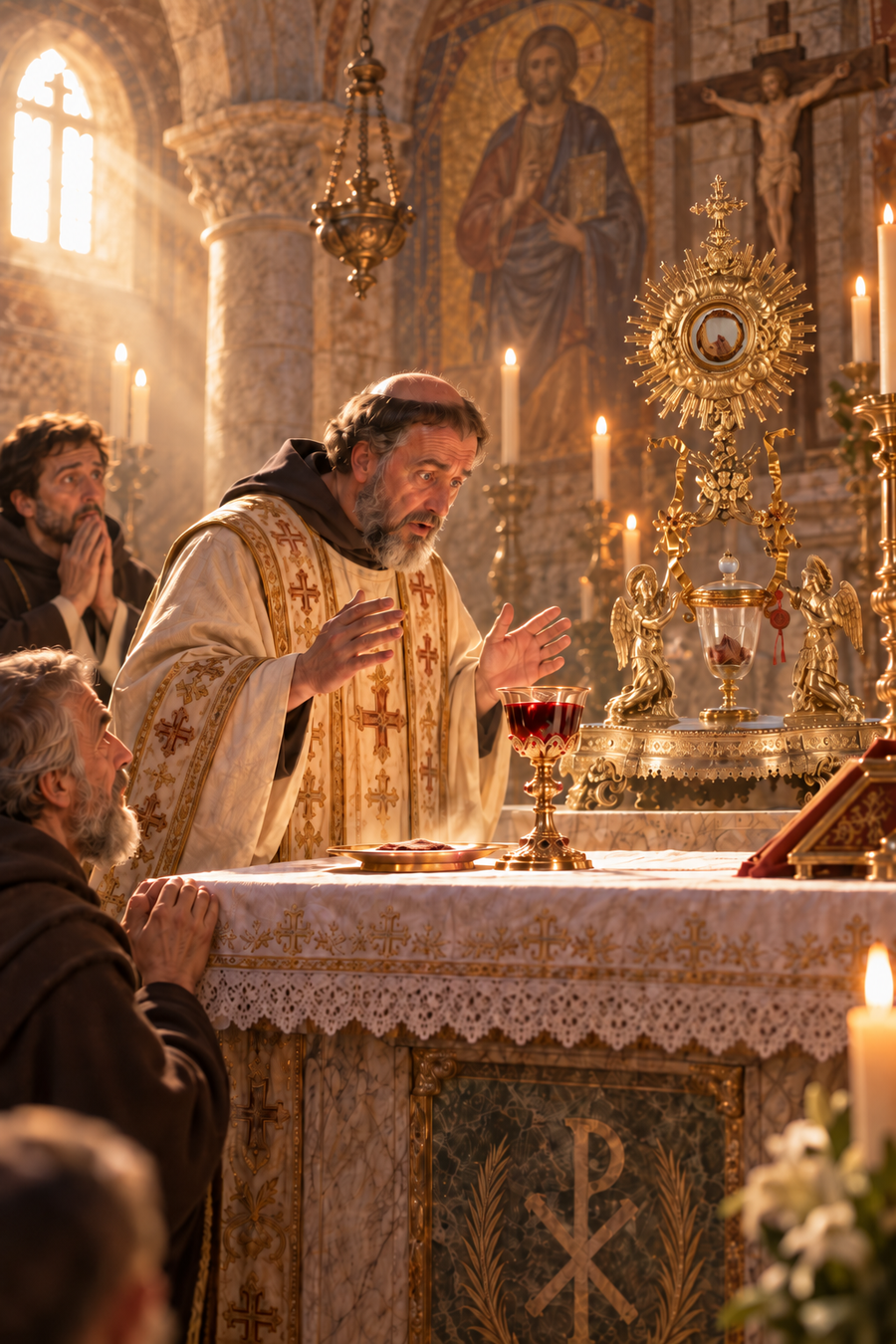
The Story
Around A.D. 700, at the Monastery of St. Longinus in Lanciano, Italy, a priest-monk whose name is unknown to us today was celebrating the Holy Eucharist. He had been struggling with his faith in the Real Presence when our Lord granted to this priest and to the world a miracle that even to this day continues to be visible proof of the truth of the Eucharist.
Although we do not know his identity, an ancient document described him as "versed in the sciences of the world but ignorant in that of God." Apparently, he had been plagued by doubts about transubstantiation, he agonized over whether the bread and wine changed substantially into the Body and Blood of our Lord at the words of consecration, and whether our Lord was truly present in the Holy Eucharist.
A Basilian monk who had doubts about the Real Presence of Christ in the sacred species was offering Mass in a church dedicated to St. Legontian in the town of Lanciano. When he pronounced the words of consecration, the host was miraculously changed into physical flesh and the wine into physical blood. Later the blood coagulated and the flesh remained the same.
More specifically, the Host visibly turned into Flesh, and the Consecrated Wine into Blood, which later coagulated into five globules.
The monk was awestruck. Weeping joyously, he regained his composure. He called the congregation around the altar and said: "O fortunate witnesses, to whom the Blessed God, to confound my unbelief, has wished to reveal Himself visible to our eyes! Come, brethren, and marvel at our God, so close to us. Behold the Flesh and Blood of our Most Beloved Christ."
Church Recognition
The Flesh is displayed in a monstrance just like the Sacred Host, and the globules of Blood are in a crystal chalice, which some believe is the actual chalice used by the monk for Mass. Today, tens of thousands of annual pilgrims visit Lanciano, where the Eucharistic miracle is preserved, to view the flesh, which maintains a pinkish hue, blood vessels remaining visible as a sign of the truth of the Real Presence of Christ in the sacrament.
Catholic Teaching
This miracle speaks directly to the heart of Catholic faith: the Real Presence of Jesus Christ — Body, Blood, Soul, and Divinity — in the Holy Eucharist. The Catechism teaches that "the body and blood, together with the soul and divinity, of our Lord Jesus Christ and, therefore, the whole Christ is truly, really, and substantially contained" in the Eucharist (CCC 1374). Lanciano is not merely a curiosity of history — it is God's own answer, in flesh and blood, to the doubting hearts of every age.
Science, with all its tools, "has come to a halt, face to face with the impossibility of giving an explanation." What reason cannot fully contain, faith receives with joy.
Plan Your Visit
The Pilgrim’s Quick Card
- Ideal stay
- 1 Day Half day to full day recommended
- Best months
- April - June Provides pleasant conditions for walking through Lanciano
- Nearest airport
- Rome Fiumicino (FCO) Closest Airport: Abruzzo Airport, Pescara (PSR)
- Language & currency
- Italian
- Feast day
- Corpus Christi
- Accessibility
- Good Main sanctuary is easily accessible. Other areas may not be.
Plan the trip
How Long Should I Stay?
The Sanctuary of the Eucharistic Miracle can be visited in a few hours, but staying overnight allows you to attend Mass, spend time before the relics, explore the archaeological area beneath the church, and experience Lanciano without rushing.
- Half day — see the relics, visit the church and pray before the Eucharistic Miracle.
- One night (recommended) — adds Mass, Confession, archaeological areas and quiet prayer.
- Two nights — allows a relaxed pilgrimage plus additional churches in Lanciano or a visit to nearby Ortona.
Pilgrim Tip: Lanciano works especially well as part of a larger Catholic pilgrimage through Italy rather than as a long standalone stay.
Best Time to Visit
Best Overall
April–June and September–October
These periods generally provide pleasant conditions for walking through Lanciano and exploring Abruzzo without the peak summer heat.
April & May
These can be particularly busy with parish and First Communion pilgrimages. The sanctuary specifically asks organized First Communion groups to consider other months because April and May can become crowded.
July & August
Expect warmer temperatures and more summer travelers.
Holy Week
Lanciano has longstanding Holy Week traditions, including processions on Holy Thursday and Good Friday.
For a Quieter Pilgrimage
Consider late September or October, particularly on weekdays.
Getting There From the United States
Best Overall: Rome Fiumicino (FCO)
For most travelers from the United States, Rome Fiumicino Airport offers the easiest combination of transatlantic flights and onward transportation.
Lanciano is approximately 245 km from Rome.
From Rome, the easiest options are generally:
- Rental car
- Private transfer
- Bus toward Abruzzo
- Train toward Pescara, followed by regional transportation to Lanciano
Fiumicino Airport connects directly with Roma Termini by the Leonardo Express in approximately 32 minutes.
Closest Airport: Abruzzo Airport, Pescara (PSR)
Pescara's Abruzzo Airport is approximately 48 km from Lanciano, making it the closest commercial airport.
Its international network is much smaller than Rome's, so American travelers will generally need a European connection.
Airport buses connect the terminal with Pescara Centrale railway station.
Typical U.S. Routing
United States → Rome Fiumicino → Lanciano
or
United States → European hub → Pescara → Lanciano
Our recommendation: For most first-time pilgrims, fly into Rome, then travel east to Lanciano by rental car, private transfer or a combination of rail and local transportation.
On the ground
Getting Around
The Eucharistic Miracle Sanctuary is just steps from Piazza Plebiscito in the historic center, and Lanciano's old town is easily explored on foot.
For travelers arriving by rail, the regional network connects Lanciano with San Vito-Lanciano, which sits on the main Adriatic railway line and provides connections toward Pescara and other coastal cities.
A rental car becomes more useful if you plan to visit:
- Ortona
- The Adriatic coast
- Other Abruzzo pilgrimage sites
- The Maiella region
Good to Know: Lanciano's historic center includes slopes, stone streets and older paving, so comfortable shoes are worthwhile.
Where to Stay
Look for accommodation near:
Piazza Plebiscito / Church of San Francesco
This allows you to walk to the sanctuary and return for additional periods of prayer without arranging transportation.
Best For Pilgrims
- Small hotels in central Lanciano
- Bed-and-breakfasts
- Family-run accommodations
- Religious or pilgrimage lodging when available
The official sanctuary also lists Casa San Francesco at the sanctuary complex as its contact address.
Pilgrim Tip: Lanciano is small enough that location should take priority over luxury.
Accessibility
The main sanctuary is relatively easy to visit, but parts of historic Lanciano and the archaeological route may require additional care.
The Church of San Francesco is in the center of town, but the surrounding historic district includes older streets and uneven surfaces.
The underground archaeological areas may involve stairs or conditions that are more difficult for someone with significant mobility limitations.
Public-transportation accessibility also varies. For example, the main San Vito-Lanciano station is currently listed as not offering dedicated reduced-mobility assistance, so travelers requiring assistance should plan transportation carefully.
Pilgrim Tip: If traveling with a wheelchair user or someone with significant mobility limitations, contact the sanctuary before arriving to confirm current access to the archaeological areas.
What to do
Most Important Things to Do
Venerate the Relics of the Eucharistic Miracle
The relics are displayed above the high altar inside the Sanctuary of the Eucharistic Miracle in the Church of San Francesco.
According to the sanctuary's tradition, around the eighth century a Basilian monk celebrating Mass experienced doubts about the Real Presence. At the consecration, the bread and wine visibly changed into flesh and blood.
Allow: 30–60 minutes
Best time: When the church is quiet, allowing time for prayer rather than simply viewing the relics.
Visit the Site of the Original Miracle
The miracle did not originally take place in the present Church of San Francesco.
It occurred in the earlier Church of San Legonziano, which stood on this site. Archaeological remains of the ancient place of worship survive beneath the current sanctuary. The Franciscans rebuilt the church in 1258 and dedicated it to St. Francis.
Allow: 30–45 minutes.
Explore the Archaeological Route
The sanctuary preserves remains associated with San Legonziano and the earlier Christian structures beneath the present complex, including archaeological finds and portions of the ancient oratory.
This is especially worthwhile because it connects the modern shrine directly with the location traditionally associated with the miracle.
Visit the Eucharistic Miracle Exhibit
The sanctuary maintains displays containing documents, photographs and material relating to examinations of the relics, including microscopic photographs and documentation connected with the 1970–71 investigation.
Allow: 30–45 minutes.
Spend Time in Eucharistic Adoration
The sanctuary includes a chapel dedicated to Eucharistic reservation and Adoration. The Franciscans describe this area as an important place for prayer within the historic sanctuary complex.
Rather than treating Lanciano as a historical curiosity, make time simply to pray before the Blessed Sacrament.
Attend Mass
Celebrating Mass in the place associated with one of Catholicism's best-known Eucharistic miracle traditions gives the pilgrimage its proper focus.
Pilgrim Tip: If possible, attend Mass before spending extended time studying the historical and scientific material.
Suggested Pilgrimage Itinerary
Day One
- Arrive in Lanciano and walk through the historic center
- Visit the Church of San Francesco
- Pray before the relics of the Eucharistic Miracle
- Attend Mass
- Explore the archaeological remains of San Legonziano
- Visit the Eucharistic Miracle exhibit
- Spend time in Eucharistic Adoration
- Go to Confession when available
- Return to the relics for quiet prayer before leaving the sanctuary
Day Two
- Attend morning Mass if available
- Make a final visit to the sanctuary
- Walk through Piazza Plebiscito and historic Lanciano
- Continue to your next pilgrimage destination
Have another day? Consider visiting Ortona, approximately 15 km away, where the Cathedral of St. Thomas the Apostle preserves relics traditionally associated with the Apostle Thomas.
Mass, Confession & Prayer
Depending on the current sanctuary schedule, pilgrims may participate in:
- Holy Mass
- Confession
- Eucharistic Adoration
- Personal prayer before the relics
- Group pilgrimages and catechesis
- Eucharistic devotions
The sanctuary is staffed by Franciscan Friars Minor Conventual, whose presence in Lanciano dates to the 13th century.
Because Mass and Confession schedules can change by season, feast day and pilgrimage groups, check directly with the sanctuary shortly before visiting.
Practical
What to Bring
Pilgrimage Essentials
- Rosary
- Small Bible or prayer book
- Written prayer intentions
- Journal and pen
- Small backpack
Practical Items
- Comfortable walking shoes
- Reusable water bottle
- Light rain jacket
- Sunscreen during warmer months
- Portable phone charger
- European Type C/F power adapter
- Modest clothing for churches
- Some euros in cash
Pilgrim Tip: Bring a journal. Lanciano is a particularly fitting place to spend time reflecting on the Eucharist and John 6.
Before You Go
Lanciano is most meaningful when approached as a Eucharistic pilgrimage rather than simply a place to see an unusual relic.
Before leaving:
- ✓ Check the sanctuary's current opening hours
- ✓ Confirm Mass and Confession times
- ✓ Write down your prayer intentions
- ✓ Read John 6 before your pilgrimage
- ✓ Pack comfortable walking shoes
- ✓ Arrange transportation from Rome or Pescara
- ✓ Leave time for Eucharistic Adoration
- ✓ Visit the archaeological remains of San Legonziano
- ✓ Explore the Eucharistic Miracle exhibit
- ✓ Spend time praying before the relics
- ✓ Consider attending Mass before leaving
Most Important: Remember the distinction between the two churches. The miracle is traditionally said to have occurred around the eighth century in the Church of San Legonziano. The present Church of San Francesco, built on the same site in the 13th century, now houses the relics above its high altar.
Additional Information
Official Pilgrimage Information
Use the official Santuario del Miracolo Eucaristico di Lanciano website for:
- Sanctuary information
- History of the miracle
- Pilgrim notices
- Contact information
- Events
- Videos and educational material
The sanctuary can currently be contacted at [email protected].
The Scientific Examination
In 1970–71, the sanctuary authorized examinations of samples from the relics by physician Edoardo Linoli, assisted by Ruggero Bertelli. The sanctuary reports that Linoli identified the flesh sample as striated myocardial tissue.
For the website, I would present this as the sanctuary's account of the examination and its conclusions, rather than implying that modern science independently establishes the miracle's supernatural origin.
St. Carlo Acutis Connection
The sanctuary has a permanent exhibition inspired by St. Carlo Acutis' work documenting Eucharistic miracles. The sanctuary says Carlo had a particular devotion to Lanciano and that portions of his Eucharistic-miracle exhibition were installed there.
Currency
Italy uses the Euro (€).
Credit cards are widely accepted, but carrying some cash is useful for smaller cafés, offerings and local businesses.
Local Language
Italian is the primary language. English may be available at the sanctuary and in tourism-related businesses, but it is less universal than at major international shrines such as Lourdes or Fátima.
Useful phrases:
- Hello — Buongiorno
- Thank you — Grazie
- Please — Per favore
- Where is the church? — Dov'è la chiesa?
- What time is Mass? — A che ora è la Messa?
- Where are the relics? — Dove sono le reliquie?
- Do you speak English? — Parla inglese?
Pilgrim Tip: A few basic Italian phrases are particularly useful in smaller Abruzzo towns.
Go Deeper
Visit the official website of the Sanctuary of the Eucharistic Miracle of Lanciano (https://www.miracoloeucaristico.eu), read Odoardo Linoli's published histological study of the relics, see the Lanciano panel in St. Carlo Acutis's International Exhibition of Eucharistic Miracles, and consult the Catechism of the Catholic Church 1373–1381 on the Real Presence.
Location
Visit the official website ↗ See it on the interactive map →Pilgrim Photos
No pilgrim photos yet — be the first to share one from Eucharistic Miracle of Lanciano.