
Our Lady of Guadalupe
Mary appeared to St. Juan Diego on Tepeyac hill and left her image on his tilma, still venerated today.
St. Juan Diego → Plan a trip here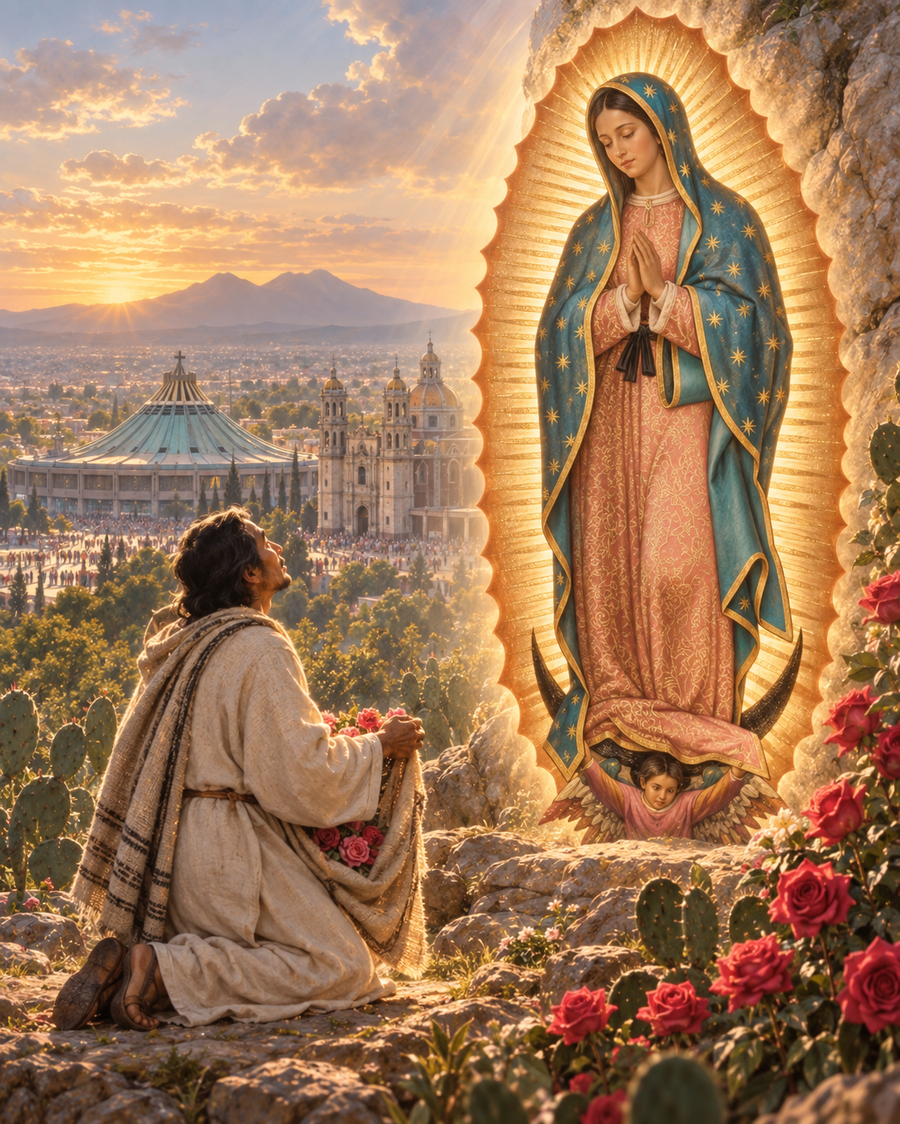
The Story
Our Lady of Guadalupe is the title given to the Blessed Virgin Mary in connection with a series of apparitions reported by Saint Juan Diego Cuauhtlatoatzin at Tepeyac Hill, near present-day Mexico City, in December 1531.
According to the traditional account preserved by the Basilica of Guadalupe, Mary appeared as a young woman with Indigenous features, spoke to Juan Diego in his native language, and asked that a church be built at Tepeyac where she could make God’s love, mercy and compassion known to all who sought her help.
When the local bishop requested a sign confirming Juan Diego’s account, Mary directed him to gather flowers growing unexpectedly on the normally barren hilltop. Juan Diego carried the flowers to the bishop inside his tilma, or cloak. When he opened it, the flowers fell to the ground and an image of Mary appeared on the fabric.
The tilma and its image are preserved today in the Basilica of Our Lady of Guadalupe in Mexico City. The Guadalupe event became one of the most influential expressions of Catholic faith in the Americas. Saint John Paul II described it as a model of evangelization that communicated the Gospel through elements familiar to the Indigenous peoples while respecting their identity and culture.
Our Lady of Guadalupe is honored as the Patroness of the Americas, the Queen of Mexico, and the Mother and Evangelizer of America. Her feast is celebrated on December 12.
Church Recognition
Longstanding, Church-sanctioned devotion with a major basilica. Our Lady of Guadalupe is honored as Patroness of the Americas.
Catholic Teaching
Speaks of Mary's motherly care and her role in leading hearts to Christ; a foundation of Marian devotion across the Americas.
Plan Your Visit
The Pilgrim’s Quick Card
- Ideal stay
- 2 Days Two nights is the recommended minimum.
- Best months
- October - April The Feast of Our Lady of Guadalupe is December 12th
- Nearest airport
- Mexico City International (MEX) Alternative: Felipe Ángeles International Airport (NLU/AIFA)
- Language & currency
- Spanish English is common in major hotels and tourist areas
- Feast day
- December 12
- Accessibility
- Good Basilica complex is accessible, while Tepeyac Hill is not.
Plan the trip
How Long Should I Stay?
The Basilica complex can be visited in one full day, but staying overnight gives you time to attend Mass, pray before the tilma without rushing, climb Tepeyac Hill, visit the historic chapels, and return when the crowds are lighter.
- One day — Basilica, tilma, Tepeyac Hill, Old Basilica and principal chapels.
- Two nights (recommended) — adds Confession, additional Mass, museum and quiet prayer.
- Three nights — allows a more relaxed pilgrimage plus other Catholic and historic sites in Mexico City.
Pilgrim Tip: Visit the tilma more than once. Early morning is especially good for a quieter experience.
Best Time to Visit
Best Overall
October–November and January–April
These months generally offer cooler weather and less rain than the summer season.
December 12
The Feast of Our Lady of Guadalupe is the most important pilgrimage celebration of the year.
It draws enormous numbers of pilgrims to Tepeyac and provides an extraordinary atmosphere of prayer and devotion.
Should You Visit December 12?
Visit during the feast if experiencing the great Guadalupan pilgrimage is part of your goal.
Choose another date if you prefer quiet prayer and easier access to the Basilica.
For a Quieter Pilgrimage
Choose a weekday outside major Marian feast days.
Getting There From the United States
Best Overall: Mexico City International Airport (MEX)
Benito Juárez International Airport offers extensive service from cities throughout the United States.
From the airport, continue to the Basilica by authorized taxi or arranged transfer. The airport maintains an official list of authorized taxi providers.
Alternative: Felipe Ángeles International Airport (NLU/AIFA)
AIFA is another airport serving the Mexico City metropolitan area. It has ground transportation connections to numerous locations throughout Mexico City.
Typical U.S. Routing
U.S. city → Mexico City (MEX) → hotel or Basilica by taxi/private transfer
Our recommendation: Use MEX for most first-time pilgrimages unless airfare or your itinerary strongly favors AIFA.
On the ground
Getting Around
For the rest of Mexico City, travelers can use:
- Authorized taxis
- Hotel-arranged transportation
- Metro
- Metrobús
- Private transfers
A rental car is generally more trouble than it is worth for a Basilica-focused visit.
Good to Know: Mexico City traffic can significantly increase travel times, so leave extra time when traveling to the airport or other parts of the city.
Where to Stay
Choose between staying near the Basilica for convenience or central Mexico City for a broader trip.
Best for a Pilgrimage-Focused Visit
Stay near La Villa de Guadalupe if your main purpose is the shrine.
This makes early morning prayer and repeat visits to the tilma much easier.
Best for a Longer Mexico City Visit
Popular areas with more hotel and dining choices include:
- Paseo de la Reforma
- Polanco
- Roma
- Condesa
- Historic Center
From these areas, arrange reliable transportation to the Basilica.
Pilgrim Tip: If Guadalupe is the main purpose of the trip, consider staying near the Basilica for at least one night.
Accessibility
The modern Basilica and large plaza accommodate very large numbers of pilgrims, and the tilma can be viewed from the moving walkway beneath the main altar.
The climb toward the Capilla del Cerrito involves stairs and uphill walking and may be difficult for pilgrims with limited mobility.
Pilgrims who cannot climb the hill can still experience:
- The tilma
- Mass
- Confession
- Old Basilica
- Blessed Sacrament Chapel
- Plaza
- Lower chapels
Pilgrim Tip: If traveling with someone with significant mobility needs, ask shrine staff for the easiest route through the complex.
What to do
Most Important Things to Do
See the Tilma of St. Juan Diego
The original tilma bearing the image of Our Lady of Guadalupe is displayed above the main altar of the modern Basilica.
A moving walkway beneath the image allows pilgrims to view it closely while keeping visitors moving.
Allow: 20–30 minutes, plus time for prayer
Best time: Early morning before the largest crowds.
Attend Mass in the Basilica
Mass is celebrated throughout the day. The Basilica is currently open daily from 6:00 AM to 9:00 PM, with multiple Masses from morning through evening.
Allow: About 1 hour.
Climb Tepeyac Hill
Walk the hill traditionally associated with the apparitions of Our Lady to St. Juan Diego in December 1531.
At the summit is the Capilla del Cerrito, associated with the apparition and the miracle of the roses.
Allow: 45–60 minutes
Difficulty: Moderate, with stairs and uphill walking.
Visit the Old Basilica
The former Basilica, now known as the Templo Expiatorio a Cristo Rey, housed the image of Our Lady of Guadalupe before the modern Basilica opened.
Allow: 20–30 minutes.
Visit the Capilla del Pocito
This historic chapel sits on the slopes of Tepeyac Hill and is built around a spring traditionally associated with the Guadalupe site.
Allow: 15–20 minutes.
Visit the Chapel of the Indians
The Capilla de Indios preserves an important connection to the earliest Guadalupan devotion and the first sanctuary structures at Tepeyac.
Allow: 15–20 minutes.
Basilica Museum
The museum contains paintings, devotional objects and historic works connected with Our Lady of Guadalupe and Mexican Catholic history.
Allow: 45–60 minutes.
Suggested Pilgrimage Itinerary
Day One
- Arrive at the Basilica complex
- Attend Mass
- Pray before the tilma
- Visit the Old Basilica
- Go to Confession
- Visit the Blessed Sacrament Chapel
- Return to the tilma for quiet prayer
- Attend Rosary or evening devotions when scheduled
Day Two
- Return early in the morning
- Climb Tepeyac Hill
- Visit the Capilla del Cerrito
- Walk through the gardens
- Visit the Capilla del Pocito
- Visit the Chapel of the Indians
- Explore the Basilica Museum
- Attend another Mass before departing
Have another day? Consider visiting additional Catholic sites in Mexico City, including the Metropolitan Cathedral or churches associated with Mexican saints and martyrs.
Mass, Confession & Prayer
The current schedule includes:
- Daily Mass
- Lauds
- Rosary
- Novena prayers
- Confession
- Eucharistic prayer and devotions
- Special celebrations on feast days
The Basilica currently opens from 6:00 AM to 9:00 PM, with main-altar Masses scheduled throughout the day.
Important: Always check the official Basilica schedule before visiting, particularly around December 12 and other major celebrations.
Practical
What to Bring
Pilgrimage Essentials
- Rosary
- Small Bible or prayer book
- Written prayer intentions
- Journal and pen
- Small backpack
- Reusable water bottle
Practical Items
- Comfortable walking shoes
- Sunscreen
- Hat and sunglasses
- Light layers
- Rain jacket during rainy season
- Portable phone charger
- Modest clothing for churches
- Small amount of Mexican pesos
Mexico uses the same Type A/B electrical plug style commonly used in the United States.
Pilgrim Tip: Mexico City sits at high elevation. Stay hydrated and give yourself time to adjust.
Before You Go
Before leaving:
- ✓ Check the official Basilica Mass schedule
- ✓ Write down your prayer intentions
- ✓ Plan to attend Mass
- ✓ Make time for Confession
- ✓ Visit the tilma more than once
- ✓ Pack comfortable walking shoes
- ✓ Bring sunscreen and water
- ✓ Arrange reliable airport transportation
- ✓ Carry some Mexican pesos
- ✓ Leave time for Tepeyac Hill
- ✓ Learn a few basic Spanish phrases
- ✓ Leave room for quiet prayer
Most Important: Do not visit only the modern Basilica and leave. Walk through the larger Tepeyac sanctuary, visiting the tilma, hill, Old Basilica and historic chapels. Together they provide a much fuller understanding of the story and devotion of Our Lady of Guadalupe.
Additional Information
Official Pilgrimage Information
Use the official Basilica of Guadalupe website as your main source for current information.
It provides:
- Mass schedules
- Opening hours
- Live-streamed liturgies
- Visitor information
- Shrine news and events
Currency
Mexico uses the Mexican Peso (MXN).
Credit cards are widely accepted in Mexico City, but carrying some pesos is useful for smaller purchases, food and offerings.
Local Language
Spanish is the primary language. English is common in major hotels and tourist areas but may be less consistently spoken around the shrine.
Useful phrases:
- Hello — Hola
- Good morning — Buenos días
- Thank you — Gracias
- Please — Por favor
- Where is the Basilica? — ¿Dónde está la Basílica?
- Where is Mass? — ¿Dónde es la Misa?
- Do you speak English? — ¿Habla inglés?
Religious Etiquette
Dress respectfully. The Basilica specifically asks visitors to observe modest dress and respectful behavior in churches, chapels, museums and other sacred spaces.
Go Deeper
The Basilica of Guadalupe's official website (virgendeguadalupe.org.mx) offers pilgrim information; read the Nican Mopohua, the classic Nahuatl account of the apparitions, Pope St. John Paul II's apostolic exhortation Ecclesia in America, and the Catechism of the Catholic Church on private revelation (CCC 67).
Location
Visit the official website ↗ See it on the interactive map →Pilgrim Photos
No pilgrim photos yet — be the first to share one from Our Lady of Guadalupe.