
Shrine of St. Carlo Acutis (Assisi)
The remains of St. Carlo Acutis rest in the Church of Santa Maria Maggiore at the Sanctuary of Spogliazione in Assisi, the home of St. Francis and St. Clare. This is not merely a tomb. It is a living pilgrimage site, a place where the 800-year-old tradition of holiness rooted in Assisi continues to bear new fruit for a new generation. For centuries, pilgrims came to Assisi to walk in the footsteps of a saint who preached to birds, embraced poverty, and wandered the hills barefoot. But today, many arrive in search of a different model of holiness: that of a teenager in Nike sneakers who built websites and coded for Christ.
St. Carlo Acutis → Plan a trip here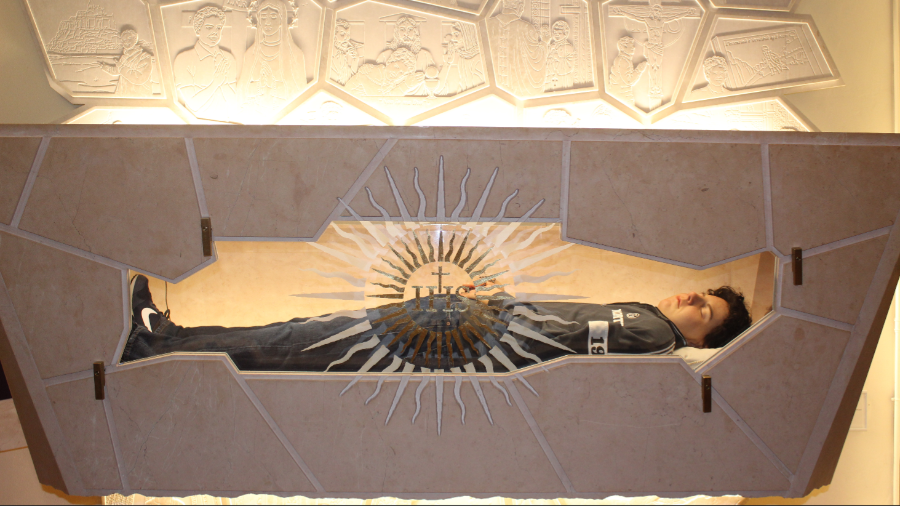
The Story
Why Assisi
Born in London in 1991 and raised in Milan, Carlo spent most of his vacation time in Assisi, where his family owned another home. Just as he was very active in his parish and Jesuit-run high school in Milan, he also dedicated himself to the church community in Assisi, learning about St. Francis and being inspired by the saint's respect for creation and dedication to the poor.
Carlo chose to be buried in Assisi because of his strong attraction and connection to St. Francis.
The Shrine of the Renunciation
Carlo is buried in a room — now a shrine — dedicated to remembering St. Francis's renunciation, when he publicly disrobed and renounced his family's wealth to live in poverty and humble service to God. Just as the 13th-century saint stripped himself of his earthly possessions, the teen was stripped of his health when he fell ill with leukemia, and he offered his life to God.
This is the profound spiritual poetry of the location: in the very room that honors the ultimate act of Franciscan self-emptying, now rests the body of a 21st-century teenager who chose God over the world with equal totality, just through a different path.
The Journey of His Remains
His mortal remains were moved to the municipal cemetery in Assisi in 2007 to fulfill his wish to be in the city of St. Francis. Then his remains were moved to the Shrine of the Renunciation at the Church of St. Mary Major in Assisi in 2019.
He was buried wearing Nike sneakers, black jeans, and an athletic warmup jacket — clothes he was used to wearing every day.
A New Heart of Pilgrimage
In the cobbled streets leading to the shrine, souvenir shops that once featured only tau crosses and rustic Franciscan statues now prominently display Carlo's face on refrigerator magnets and figurines — often in his signature red polo shirt. Listings on AirBnB even advertise their proximity to his tomb, signaling just how quickly Carlo's presence has become part of the fabric of Assisi.
Hundreds of thousands of pilgrims from around the world have visited Carlo's tomb since his canonization was announced.
A Miracle at the Tomb
A decree approved a miraculous healing of a 21-year-old girl from Costa Rica named Valeria Valverde, who was near death after seriously injuring her head in a bicycle accident while studying in Florence in 2022. After the girl underwent an emergency craniotomy to reduce intracranial pressure, the family was told her situation was very critical and that she could die at any moment. Six days after the accident, Valeria's mother went on a pilgrimage to Assisi to pray for the healing of her daughter at the tomb of Blessed Carlo Acutis, leaving a written note. On that same day, Valeria began to breathe on her own, and on the following day she recovered the use of her upper limbs and partly recovered her speech.
Contrary to medical predictions, Valeria spent only one week in physical therapy and on September 2, 2022 — two months after her accident — she went on a pilgrimage to Carlo Acutis's tomb in Assisi with her mother to celebrate her complete healing.
Church Recognition
Beatification and Canonization
In February 2020, the pope formally recognized a miracle attributed to Carlo's intercession, and in October of that year, the teen was beatified during a Mass at the Basilica of St. Francis.
On September 7, 2025, Pope Leo XIV canonized Blessed Carlo Acutis together with Blessed Pier Giorgio Frassati as the first new saints of his pontificate.
Words of the Church's Shepherds
Archbishop Domenico Sorrentino of Assisi declared: "Carlo is a boy of our time. A boy of the internet age, and a model of holiness of the digital age, as Pope Francis presented him in his letter to young people around the world. The computer has become a way of going through the streets of the world, like the first disciples of Jesus, to bring to hearts and homes the announcement of true peace, that which quenches the thirst for the infinite that inhabits the human heart."
Pope Francis held up Carlo as a model for the digital generation. In his 2019 exhortation "Christus Vivit," published after the Synod of Bishops on young people, the pope wrote that Carlo "knew how to use the new communications technology to transmit the Gospel, to communicate values and beauty," even while resisting the "consumerism and distraction" that often dominate online life.d 2020; canonized September 2025.
Catholic Teaching
The Shrine of St. Carlo Acutis is not merely a beautiful place to visit. It is a living classroom in the deepest truths of the Catholic faith.
On the Communion of Saints: The Catechism teaches that the faithful who are pilgrims on earth, the souls being purified, and the blessed in heaven are all in communion, forming one Church (CCC 954). The pilgrims who flock to Assisi are not visiting a museum. They are encountering a living member of the Body of Christ, one who intercedes for them before the throne of God right now. The verified miraculous healing of Valeria Valverde is not a curiosity of medieval history. It is the Communion of Saints in action, here and now, in the 21st century.
On the Real Presence: Carlo's entire life was ordered toward the Eucharist, and his shrine is inseparable from that conviction. Shortly after his first Communion at age seven, Carlo told his mother his life plan was to always be united to Jesus. The Catechism teaches that "the Eucharist is the source and summit of the Christian life" (CCC 1324). Carlo did not merely believe this proposition. He organized his entire existence around it, and now his tomb draws millions to the same conviction.
On Holiness in Ordinary Life: Lumen Gentium, the Second Vatican Council's Dogmatic Constitution on the Church, teaches that "all the faithful of Christ of whatever rank or status, are called to the fullness of the Christian life and to the perfection of charity" (LG 40). Carlo's shrine makes this truth visible and tangible. He was not a monk, a priest, or a martyr in the traditional sense. He was a boy who loved soccer, video games, and pasta. And he became a saint. There is no state of life, no age, no cultural moment that places holiness out of reach.
On Evangelization in the Digital Age: Pope Leo XIV, speaking to communicators early in his pontificate, emphasized the importance of using every available means to spread the Gospel. Carlo lived this long before it was a papal theme. His exhibition of Eucharistic miracles has been displayed at thousands of parishes on five continents, and his life continues to draw souls toward the Eucharist through the very digital tools he used so faithfully. The shrine in Assisi is the physical anchor of a global digital apostolate that continues to grow long after his death.
On Offering Suffering to God: Before his death, Carlo offered his suffering for Pope Benedict XVI and for the Church, saying he offered all of his suffering to the Lord for the pope and for the Church in order not to go to purgatory but to go straight to heaven. This is the Catholic understanding of redemptive suffering, rooted in Colossians 1:24, where St. Paul writes of filling up in his flesh what is lacking in the afflictions of Christ for the sake of His body, the Church. Carlo did not waste his pain. He consecrated it.
Plan Your Visit
The Pilgrim’s Quick Card
- Ideal stay
- 2 Days The shrine itself can be experienced in a few hours
- Best months
- April–June Spring and fall generally offer the most comfortable weather
- Nearest airport
- Rome Fiumicino (FCO) Perugia San Francesco d’Assisi Airport (PEG) is the closest
- Language & currency
- Italian Assisi is accustomed to international pilgrims
- Feast day
- October 12
- Accessibility
- Fair Interior is level, but the entrance includes uneven paving
Plan the trip
How Long Should I Stay?
If your only goal is to visit St. Carlo’s tomb, you could comfortably do so in half a day. But Assisi deserves a slower pilgrimage.
- Half day — St. Carlo’s tomb, Sanctuary of the Spoliation and Eucharistic Miracles exhibit.
- Two nights (recommended) — adds Mass, Confession, Adoration, Basilica of St. Francis and Basilica of St. Clare.
- Three nights — allows San Damiano, the Porziuncola, Eremo delle Carceri and a much more prayerful pace.
Pilgrim Tip: Do not make Carlo’s tomb a quick photo stop. Build your visit around the Eucharist, which was at the center of his spiritual life.
Best Time to Visit
Best Overall
April–June & September–October
Temperatures are generally comfortable for walking Assisi’s hills.
October 12
The Church celebrates the liturgical memorial of St. Carlo Acutis on October 12, the anniversary of his death. Expect special celebrations and more pilgrims around this date.
September 7
Carlo was canonized on September 7, 2025, and the Sanctuary marked the first anniversary with a special Mass in 2026.
October 4
The Feast of St. Francis of Assisi draws substantial pilgrimage activity to the city.
July & August
Expect warmer weather and large tourist crowds.
For a Quieter Pilgrimage
Try a weekday in May, late September or early October, avoiding major feast days.
Getting There From the United States
Best Overall: Rome Fiumicino (FCO)
For most American pilgrims, Rome offers the broadest selection of nonstop transatlantic flights.
Train journeys from Fiumicino Airport to Assisi can take as little as about 3 hours, usually requiring at least one change.
Closest: Perugia San Francesco d’Assisi Airport (PEG)
Perugia’s airport is located between Perugia and Assisi and is by far the closest airport.
The Umbria Airlink connects the airport with Assisi and Perugia, with the airport reporting approximately 20-minute connections to the railway stations.
Its smaller flight network means travelers from the United States normally need a European connection.
Alternative: Florence (FLR)
Florence can be a good option if your pilgrimage also includes Tuscany.
Typical U.S. Routing
United States → Rome Fiumicino → Assisi by train
or
United States → European hub → Perugia Airport → Assisi
Our recommendation: For a first pilgrimage, compare Rome and Perugia. Rome will usually provide easier airfare; Perugia provides a dramatically shorter final transfer.
On the ground
Getting Around
The railway station is actually located downhill in Santa Maria degli Angeli, not inside the medieval hill town.
Local buses connect the station with Assisi’s historic center. In 2026, the Assisi Link service has been increased to every 15–20 minutes during daytime hours because of the Franciscan centenary celebrations.
Once inside historic Assisi, walking is usually easiest.
Use local buses or taxis for places such as:
- Santa Maria degli Angeli
- San Damiano
- Eremo delle Carceri
- Assisi railway station
Good to Know: Assisi’s limited-traffic zones make driving inside the historic center inconvenient.
Where to Stay
For easy access to Carlo’s tomb, look around:
- Piazza del Comune
- Santa Maria Maggiore
- Basilica of St. Clare
- Central historic Assisi
This allows you to walk to the Sanctuary early in the morning and return during the day.
Alternative: Santa Maria degli Angeli
Staying near the railway station can offer:
- Easier train access
- Flatter terrain
- Often more modern accommodations
- Easy access to the Porziuncola
You will then take a bus or taxi uphill to Assisi.
Pilgrim Tip: If mobility is not an issue, staying within the medieval center creates a much richer pilgrimage experience after the day-trip crowds leave.
Accessibility
The City of Assisi reports that the route immediately outside Santa Maria Maggiore includes approximately 3 meters of uneven paving, and the entrance includes a 14 cm step with a wooden ramp at about a 17% incline.
Once inside, the church floor is level. The city notes that wheelchair users may need assistance entering and exiting.
Assisi itself presents additional challenges:
- Steep hills
- Cobblestones
- Uneven medieval streets
- Numerous stairs
The city has accessibility programs and information specifically designed to help mobility-limited visitors reach major pilgrimage sites.
What to do
Most Important Things to Do
Pray at the Tomb of St. Carlo Acutis
St. Carlo’s remains are housed inside the Church of Santa Maria Maggiore – Sanctuary of the Spoliation.
The shrine is currently open daily, generally until 7:00 PM, with seasonal opening times. On Sundays and holidays, visits to Carlo’s tomb are suspended from 10:30 AM–12:30 PM because of Mass.
Allow: 30–60 minutes
Best time: Early morning or later afternoon.
Visit the Eucharistic Miracles Exhibition
Carlo famously used his computer skills to document Eucharistic miracles around the world.
A version of his Eucharistic Miracles exhibition is displayed at the Sanctuary in the Sala dei Vescovi, making this especially fitting for anyone following Eucharistic Miracle locations through SitesOfGrace.
Allow: 30–60 minutes.
Experience the Sanctuary of the Spoliation
The church is important independently of Carlo.
The sanctuary commemorates the place associated with St. Francis renouncing his wealth and worldly possessions before the bishop of Assisi. Carlo’s presence here intentionally connects two young saints separated by roughly eight centuries.
Spend time understanding both stories rather than visiting only the tomb.
Attend Mass
The current weekday schedule includes:
5:30 PM Rosary
6:00 PM Mass
Sunday and feast-day Masses are currently celebrated at 9:30 AM and 11:00 AM, with an additional English Mass Sundays at 4:00 PM.
Eucharistic Adoration
The Sanctuary currently offers Adoration:
Tuesday: 6:30–7:30 PM
Saturday: 9:00–10:00 PM.
For a Carlo Acutis pilgrimage, this should be a priority.
Go to Confession
The Sanctuary significantly expanded Confession availability in September 2026, with priests currently available every day during multiple morning and afternoon periods.
Suggested Pilgrimage Itinerary
Day One
- Visit the Sanctuary of the Spoliation
- Pray at St. Carlo’s tomb
- See the Eucharistic Miracles exhibition
- Go to Confession
- Visit the Basilica of St. Clare
- Attend Rosary and Mass at the Sanctuary
- Participate in Eucharistic Adoration if scheduled
Day Two
- Attend morning Mass
- Visit the Basilica of St. Francis and his tomb
- Spend time at San Damiano
- Return to St. Carlo’s tomb for final prayer
- Attend the Sunday English Mass if your visit falls on Sunday
Have another day? Visit the Porziuncola at Santa Maria degli Angeli and the Eremo delle Carceri on Mount Subasio.
Mass, Confession & Prayer
Current Mass Schedule
Weekdays:
5:30 PM Rosary
6:00 PM Mass
Sundays & Holy Days:
9:30 AM Mass
11:00 AM Mass
Sunday English Mass:
4:00 PM.
Eucharistic Adoration
Tuesday: 6:30–7:30 PM
Saturday: 9:00–10:00 PM.
Confession
As of September 2026, priests are available for Confession daily, with morning and afternoon periods throughout the week. Saturday also includes an evening period during Adoration.
Important Sunday Note
On Sundays and holidays, visits to the tomb are suspended from 10:30 AM–12:30 PM. Anyone attending the 11:00 AM Mass must enter by 10:30 AM.
Practical
What to Bring
Pilgrimage Essentials
- Rosary
- Small Bible or prayer book
- Written prayer intentions
- Journal and pen
- Small backpack
Practical Items
- Comfortable shoes with good grip
- Reusable water bottle
- Sunscreen and hat
- Light rain jacket
- Layers for mornings and evenings
- Portable phone charger
- European Type C/F/L power adapter
- Modest clothing for churches
- Some euros in cash
Pilgrim Tip: Assisi involves significantly more hills than the map suggests. Expect stone paving, stairs and steep streets.
Before You Go
Before leaving:
- ✓ Check the Sanctuary’s current opening hours
- ✓ Check Mass and Adoration schedules
- ✓ Remember the Sunday tomb closure from 10:30 AM–12:30 PM
- ✓ Write down your prayer intentions
- ✓ Plan time for Confession
- ✓ Visit Carlo’s Eucharistic Miracles exhibition
- ✓ Pack excellent walking shoes
- ✓ Arrange transportation from Rome or Perugia
- ✓ Visit the Basilica of St. Francis and St. Clare
- ✓ Leave time simply to pray at Carlo’s tomb
- ✓ Attend Eucharistic Adoration if possible
- ✓ Avoid overloading your itinerary
Most Important: St. Carlo’s pilgrimage site is particularly meaningful because his tomb is located within the Sanctuary of the Spoliation, linking his simple, Eucharist-centered life with the radical simplicity of St. Francis. Carlo called the Eucharist his “highway to Heaven,” and the strongest way to experience his shrine is therefore not merely to see his tomb, but to attend Mass, receive the Eucharist, go to Confession and spend time in Adoration. The Sanctuary itself continues to organize its pilgrimage life around exactly those practices.
Additional Information
Official Sanctuary Website
Use the official Santuario della Spogliazione website for:
- Current opening hours
- Mass schedules
- Confession
- Eucharistic Adoration
- Carlo celebrations
- Group pilgrimage reservations
- Shrine news.
Opening Hours
Current general hours are:
November 1–March 31: 8:00 AM–7:00 PM
April 1–October 30: generally 7:00 AM–7:00 PM, although Mondays and Thursdays currently open at 8:00 AM.
Bookshop
The Sanctuary bookshop currently operates from 9:00 AM–6:00 PM, carrying books on Carlo Acutis and St. Francis, rosaries, medals and other devotional items.
Carlo’s Eucharistic Miracles Exhibition
A version of Carlo’s famous exhibition on Eucharistic miracles is housed within the Sanctuary complex.
For SitesOfGrace visitors already traveling to Eucharistic Miracle sites, this is particularly worth highlighting.
Assisi Tourism App
The official Visit Assisi tourism program promotes “Assisi, The Stones Speak,” a digital experience for exploring stories and locations throughout the city.
Currency
Italy uses the Euro (€).
Credit cards are widely accepted, but carrying some cash is useful for cafés, offerings and smaller businesses.
Local Language
Italian is the primary language.
Useful phrases:
- Hello / Good morning — Buongiorno
- Thank you — Grazie
- Please — Per favore
- Where is St. Carlo’s tomb? — Dov'è la tomba di San Carlo?
- What time is Mass? — A che ora è la Messa?
- Where is Confession? — Dove posso confessarmi?
- Do you speak English? — Parla inglese?
English is common around major pilgrimage sites, and the Sanctuary's Sunday English Mass makes it especially welcoming to international pilgrims.
Go Deeper
The sanctuary's official website, https://www.assisisantuariospogliazione.it, provides visitor information; Carlo's own Eucharistic miracles exhibition can be explored at miracolieucaristici.org, and the Catechism's teaching on the Eucharist (CCC 1373-1381) illuminates the devotion at the heart of his life.
Location
Visit the official website ↗ See it on the interactive map →Pilgrim Photos
No pilgrim photos yet — be the first to share one from Shrine of St. Carlo Acutis (Assisi).
In the Area
Other sacred sites within 40 miles.