
St. Catherine Labouré
"The Silent Mystic" & Visionary of the Miraculous Medal
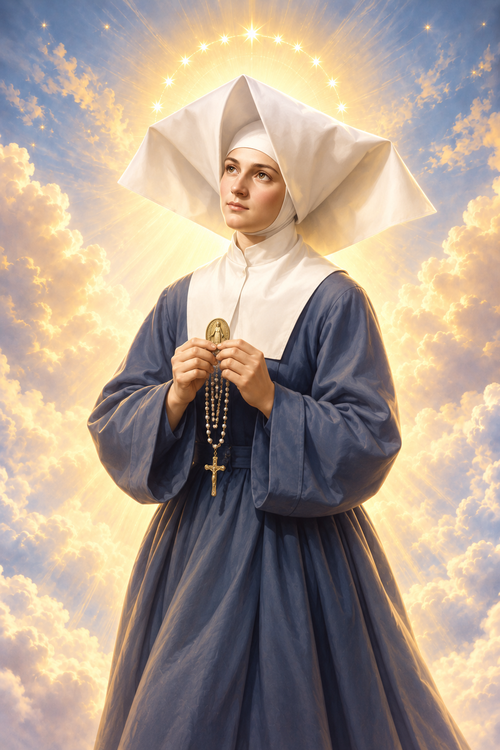
- Born
- 1806
- Died
- 1876
- Canonized
- 1947-07-28
- Burial place
- Chapel of Our Lady of The Miraculous Medal (Rue de Bac)
- Patronage
- Those who work with the sick and elderly, Daughters of Charity and religious sisters, Those who serve the poor with humble, hidden charity, Those called to a hidden vocation or interior life, Promoters of Marian devotion and the Miraculous Medal, Social workers and caregivers, Those who struggle with doubt or spiritual dryness,
Birth and Early Life
St. Catherine Laboure was born on the 2nd of May 1806 at Fain-les-Moutiers, a picturesque village of Burgundy, France. She was the ninth child in a happy family of eleven. God made known the choice of this soul by marking her at an early age with the seal of suffering, for when she was only nine years old she lost her mother.
It was not merely coincidence that Catherine was born at the ringing of the Angelus. It was God's charming touch, this heralding by the bells of Mary of the saint who was to usher in the Marian Age.
At the death of her mother, the young girl went to the statue of the Blessed Virgin in the family home, took it down from its place, and pressed it to her heart, choosing Mary as her new mother. This silent, childlike act of total entrustment to Our Lady became the defining orientation of her entire life.
Her Father's Iron Rule and Her Call to Religious Life
Pierre Laboure was a gruff, silent man, a devout and good Catholic, an able father, but one who ruled his children with a rod of iron. In all things a perfectionist, he saw to it that his farm and his household ran smoothly or he knew the reason why. It was this quality of management that made his land prosper and his children grow in courtesy and character.
They were a wonderful combination for the making of a saint, this father and mother, and Zoe took the best qualities from each. She had her father's iron will and capable hand, her mother's gentleness and deep piety.
Catherine's father opposed her desire to enter religious life, going so far as to send her to work as a waitress in his brother's restaurant in Paris to discourage the vocation. It did not work. God was not dissuaded by an earthly father's plans.
The Dream of St. Vincent de Paul
Perhaps the most renowned of Vincent's disciples, though, is St. Catherine Laboure, a Daughter of Charity who, at age nineteen, had a dream in which an elderly priest spoke to her. She saw herself praying during the sacrifice of the Mass in the church of her native hamlet, Fain-les-Moutiers. After Mass, the priest celebrant, an elderly gentleman, motioned to Catherine to come forward.
She said nothing of this strange experience until about a year later, when she entered a house of the Sisters of Charity for the first time. She saw on the wall a picture of St. Vincent de Paul and recognized him as the priest of her dream. She confided this to Father Henry, a confessor, who assured her that she believed correctly that God was calling her to be a Sister of Charity.
Entry into the Daughters of Charity
Catherine was a Burgundy farm girl who, after a prophetic dream of St. Vincent de Paul, became a Sister of Charity in Paris and later in Enghien, where she cooked and mended and cared for the inmates of a home for elderly men.
She entered the novitiate of the Daughters of Charity at the Rue du Bac in Paris in 1830. From almost the first days of her novitiate, extraordinary mystical graces began. Almost every day of her novitiate, Sister Laboure had seen visibly Christ in the Blessed Sacrament. He appeared on Trinity Sunday crowned and in the robes of a king. At the Gospel of the Mass, the crown fell from His head and rolled away. Catherine understood this to mean that the kings of France would lose their crowns and their dignity. History would prove her right.
This extraordinary Eucharistic vision was not the only mystical grace of her novitiate days. Catherine also received a vision of the heart of St. Vincent de Paul, the founder of the Daughters of Charity, which she understood as a sign of the spiritual health and mission of the congregation she was entering.
The Apparitions of Our Lady
On the night of July 18 to 19, 1830, Catherine was awakened by what she described as a shining child who led her to the chapel of the motherhouse. There, the Blessed Virgin Mary appeared to her, seated in the director's chair at the side altar, and spoke to her for two hours about the trials that were coming upon France and the world. Mary warned of grave dangers, of revolution, of suffering, and of the urgent need for prayer and trust in God.
On November 27, 1830, Our Lady appeared again, this time standing upon a globe, crushing a serpent beneath her feet, her hands radiating brilliant rays of light representing the graces she obtains for those who ask for them. Around the image appeared the words: "O Mary, conceived without sin, pray for us who have recourse to thee." Then the image rotated to show the reverse: the letter M surmounted by a cross, beneath it the Sacred Heart of Jesus crowned with thorns and the Immaculate Heart of Mary pierced by a sword, surrounded by twelve stars.
Mary instructed Catherine to have a medal struck according to this design, with the promise that those who wore it with confidence would receive great graces.
A third apparition followed, in which Our Lady elaborated on the meaning of the medal and its design. The rays of light, Mary explained, were the symbol of the graces she obtains for all who ask for them, while the darkened stones on her rings represented the graces that go unasked for and therefore unreceived.
Forty-Six Years of Hidden Obedience
After the apparitions, Catherine returned to the utterly ordinary life of a Daughter of Charity. She was assigned to the hospice of Enghien, on the outskirts of Paris, where she spent 46 years caring for elderly and infirm men. She cooked, cleaned, tended chickens, answered the door, and helped the dying pass from this world to the next.
No one around her knew. The sisters who lived with her for decades considered her capable and kind but entirely unremarkable. Catherine had been commanded by Our Lady to tell no one but her confessor, Father Aladel, and she obeyed absolutely. Even when the Miraculous Medal began to spread across the world, working conversions and cures that astonished the Church, Catherine said nothing and claimed nothing.
She was known to have a particular tenderness toward the poor and the marginalized. She stood up for the dignity of the elderly men in her care, once opposing her own superiors when she believed the men were not being treated with sufficient respect. She also had a special devotion to a statue of Our Lady in the hospice garden that she felt had been improperly placed, and spent years quietly petitioning for it to be moved to a more honored position. It was. Shortly before her death.
The Revelation and Death
A few months before her death, sensing that her hour was near, Catherine broke her 46 years of silence and revealed herself to her superior, Sister Dufes, as the woman to whom Our Lady had appeared. She did so not out of pride or spiritual vanity but because Our Lady had entrusted her with tasks she feared would be left unfulfilled, including the proper honoring of the statue in the garden.
Catherine Laboure died peacefully on December 31, 1876, at the age of 70, surrounded by her sisters. Her expression in death was described as one of deep peace and joy.
Incorruption and Beatification
When her body was exhumed in 1933, 57 years after her death, it was found to be perfectly incorrupt. Her limbs were flexible, her eyes retained their blue color, her face bore an expression of serenity. The Church recognized this as a sign of God's favor upon a soul of extraordinary holiness.
She was beatified by Pope Pius XI on May 28, 1933, and canonized by Pope Pius XII on July 27, 1947. Her incorrupt body was then transferred to the glass reliquary beneath the side altar of the Chapel of the Rue du Bac, where it remains today, visible to all who come to pray.
Saintly Accomplishments
The scope of what God accomplished through Catherine Laboure's obedience is staggering in its reach:
The Miraculous Medal, struck at Our Lady's request and distributed beginning in 1832, has been given to hundreds of millions of people across the world and remains one of the most widely used sacramentals in the history of the Church.
The conversion of Alphonse Ratisbonne in 1842, formally recognized by the Church as miraculous, was directly attributed to his wearing of the Miraculous Medal, a dramatic sign of the power of the sacramental Our Lady had requested.
The apparitions at the Rue du Bac anticipated and helped prepare the faithful for the dogmatic definition of the Immaculate Conception in 1854, confirmed four years later when Our Lady identified herself to St. Bernadette at Lourdes as "the Immaculate Conception."
The Rue du Bac shrine, which houses both the chapel of the apparitions and Catherine's incorrupt body, receives millions of pilgrims every year, and the devotion she was asked to spread shows no sign of diminishing more than a century and a half after her death.
She accomplished all of this in total hiddenness, from a small room in a Paris suburb, while tending chickens and caring for the elderly.
St. Catherine Laboure spent 46 years carrying the weight of heaven's greatest modern Marian mission in total silence, never seeking recognition, never claiming credit, and never wavering in obedience. In a culture that prizes visibility, platform, and recognition above almost everything else, what does her hidden life challenge you to reconsider about how you measure a life well lived for God?