
Our Lady of Medjugorje (Queen of Peace)
On June 24, 1981, six children in the town of Medjugorje, Yugoslavia (today, Bosnia-Herzegovina), began to experience phenomena which they alleged to be apparitions of the Blessed Virgin Mary. The apparitions carried a message of peace for the world, as well as a call to conversion, prayer, and fasting, and entrusted to the children secret messages about events to be fulfilled in the future.
Blessed Virgin Mary → Plan a trip here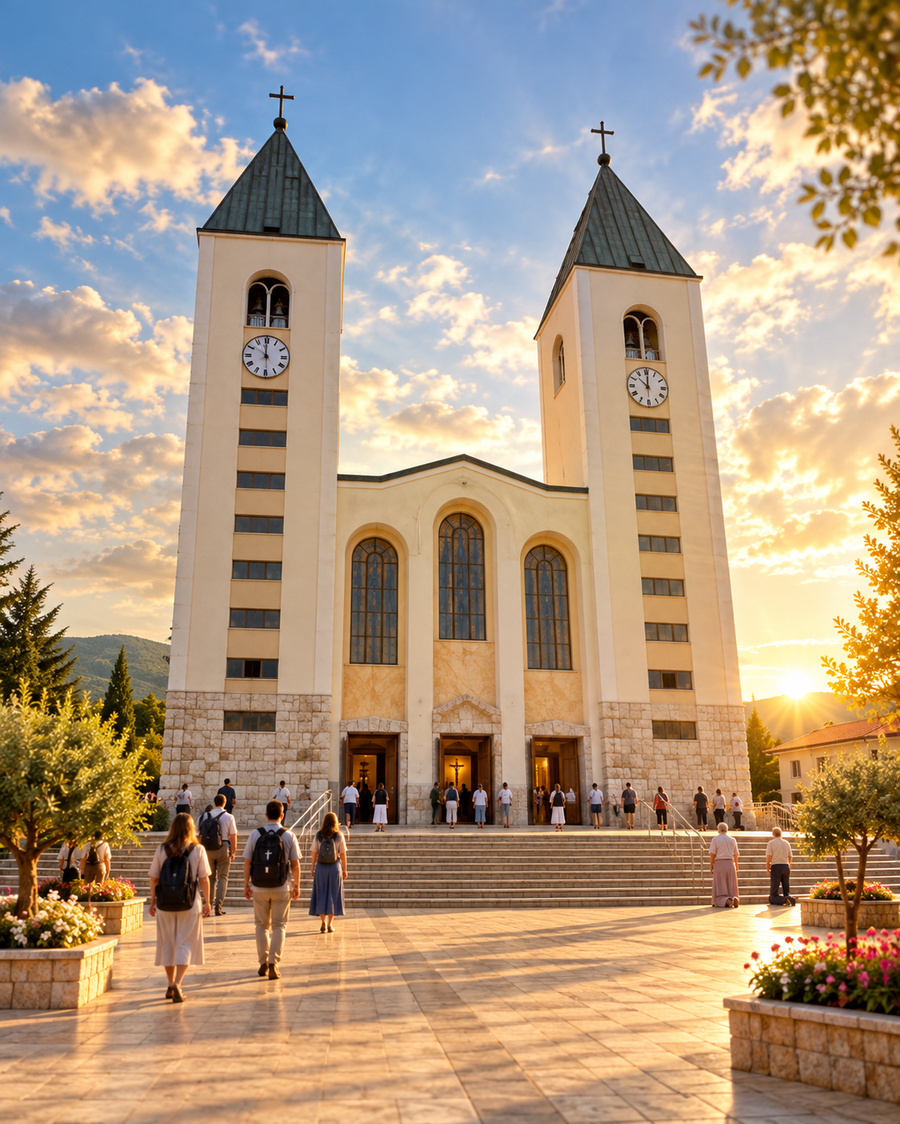
The Story
The Setting: A Communist Village in Former Yugoslavia
To understand what happened in Medjugorje in the summer of 1981, it is necessary to understand where it happened. Medjugorje was a small, predominantly Catholic Croatian village in the mountainous region of Herzegovina, situated within a communist Yugoslavia that actively suppressed religious practice. The faith of the local people had survived centuries of Ottoman occupation and decades of communist oppression. Franciscan priests had administered to the needs of the souls of the Croatian people in the parish and region since the 13th century, and they have been closely involved with the visionaries and pilgrims from the start of the apparitions.
Into this world of enforced silence, heaven, if the visionaries are to be believed, chose to speak.
June 24, 1981: The First Apparition
On June 24, 1981, six children in the town of Medjugorje, Yugoslavia (today, Bosnia-Herzegovina), began to experience phenomena which they alleged to be apparitions of the Blessed Virgin Mary. The devotions in Medjugorje began after six young people, aged 10 to 16, said Mary began appearing to them in June 1981.
The six visionaries are Marija Pavlovic-Lunetti, Ivan Dragicevic, Vicka Ivankovic-Mijatovic, Jakov Colo, Mirjana Dragicevic-Soldo, and Ivanka Ivankovic-Elez.
Originally, the apparitions occurred on a hilltop near the town where a large Cross commemorating the Redemption exists. This rocky hill, known as Podbrdo, would become what pilgrims now call Apparition Hill, one of the most visited sites in the whole of Catholic Europe.
The Message: Conversion, Prayer, Fasting, Peace
Our Lady came to Medjugorje, according to the visionaries, to show the faithful the way to peace and help convert lives so as to return to God, including to bring people to her Son, Jesus. Early in the apparitions, she reportedly identified herself as the "Queen of Peace."
Mary's true message from Medjugorje, as her supporters summarize it, can be captured in seven words: God, faith, conversion, prayer, fasting, peace, and reconciliation, words which were repeated during the first six days of apparitions.
The Secrets
Each of the visionaries is said to have been given 10 "secrets" concerning events in the world in the near future. None can be revealed yet, except for the so-called "Third Secret." Our Lady promised to leave a supernatural, indestructible sign on the mountain of her first appearance.
These "secrets," confided individually to different visionaries, have not been revealed to the public.
The Visionaries Under Scientific Scrutiny
Clergy and theologians, as well as experts from the physical and medical sciences, testified to some kind of phenomenon taking place when the apparition was said to be occurring. The private judgment of these early visitors did much to bolster people's belief in the events at Medjugorje.
In addition, some pilgrims reported seeing the sun spin and being able to look at it without pain or eye damage, others that their rosaries turned gold colored, still others that remarkable physical or spiritual and moral healings had taken place.
The most notable aspect of the Medjugorje phenomenon is that, at a significant distance of years, the six visionaries remain simple, healthy, and joyous individuals without neurotic symptoms. This is especially surprising since they have been subjected to interrogations, interviews, psychological and medical analyses, and pressure from both the State and the Church.
When an apparition was occurring, the children would wait, reciting the rosary, then enter prayer. Suddenly, they would kneel down simultaneously, look upward in the same direction with hopeful, tranquil expressions. Their lips would move as if they were speaking, but they would make no sounds. In general, the apparitions lasted from one to three minutes, and then the visionaries would report the Virgin's words to the assembled pilgrims.
The Ongoing Apparitions
Three of the original six visionaries say they still have apparitions of Mary each day, while the other three have them only on special occasions.
The Pilgrimage Destination
Pilgrims attend Masses at Medjugorje's St. James Church during the day, and the evening Mass is celebrated outdoors to accommodate huge crowds. They climb rocky Podbrdo, Apparition Hill, bearing a statue of Our Lady, marking where she allegedly appeared. Pilgrims also climb up Mount Križevac, praying the Stations of the Cross, journeying to the huge cross nearly 40 feet tall built by villagers in the early 20th century.
More confessions are heard in Medjugorje than in any other parish in the entire world, with more than 150 confessors working without interruption there every day.
The 2024 Declaration: A Solomonic Decision
On September 19, 2024, the Dicastery for the Doctrine of the Faith, with the approval of Pope Francis, issued a declaration granting a "nihil obstat" — meaning no objection — to the devotion associated with Medjugorje, while carefully not declaring that the apparitions themselves are of supernatural origin.
The DDF, with the approval of Pope Francis, has made what can be termed a Solomonic decision: affirming that Jesus Christ and his Blessed Mother have wrought great fruit in the lives of more than forty million pilgrims over forty years, without deciding on whether the Virgin Mary has actually been daily appearing to six reported visionaries during that same period.
The declaration noted that the spiritual fruits of Medjugorje, the conversions, the return to the sacraments, the extraordinary number of confessions, and the renewed prayer lives of millions of pilgrims, are real, abundant, and worthy of recognition. It did not, however, affirm the supernatural origin of the apparitions themselves, and it expressed particular caution about the claim that apparitions are still occurring daily to some of the visionaries decades later.
The Fruits: What Cannot Be Disputed
Whatever the final judgment of the Church on the supernatural origin of the apparitions, the fruits of Medjugorje are extraordinary by any measure.
More than 40 million pilgrims from around the world have made the journey to this remote Bosnian village since 1981. More confessions are heard in Medjugorje than in any other parish in the entire world, with more than 150 confessors working without interruption every day. Priests and religious have reported their vocations were born or confirmed by pilgrimages to Medjugorje. Countless conversions have been documented, including former atheists, fallen-away Catholics, and people of other faiths. Lives marked by addiction, despair, and estrangement from God have been turned completely around after visits to the site.
By the measure Christ himself proposed in the Gospel, "by their fruits you will know them" (Matthew 7:16), Medjugorje's record is impossible to ignore.
The Messages and Their Continuity with the Gospel
Whatever one ultimately concludes about the supernatural origin of the alleged apparitions, the messages associated with Medjugorje are entirely consistent with the Gospel and with the calls of the Church across centuries. They call the faithful to daily prayer, especially the Rosary; to fasting, particularly on Wednesdays and Fridays; to Scripture reading; to monthly Confession; and to the Mass as the center of Christian life. There is nothing in the messages that contradicts Catholic teaching. Everything in them points back to Christ.
Our Lady came to Medjugorje, according to the visionaries, to show the faithful the way to peace and help convert lives so as to return to God, including to bring people to her Son, Jesus.
Medjugorje has drawn forty million pilgrims, more confessions than any other parish on earth, and an outpouring of conversions spanning four decades — and the Church has affirmed its fruits while leaving the question of the apparitions themselves open. What does it say about the nature of faith that God can work such extraordinary grace in a place where the Church has not yet rendered a definitive verdict, and what does that invite you to consider about how you discern the movements of grace in your own life?
Church Recognition
On Sept. 19, 2024 the Dicastery for the Doctrine of the Faith granted a 'nihil obstat' to the spiritual experience of Medjugorje, authorizing public devotion without declaring the alleged apparitions supernatural.
Catholic Teaching
Messages center on peace, prayer, fasting, conversion, and return to the sacraments.
Plan Your Visit
The Pilgrim’s Quick Card
- Ideal stay
- 3+ days Medjugorje is best experienced slowly.
- Best months
- May - June Provide comfortable conditions for hiking.
- Nearest airport
- Split, Croatia (SPU) 2 Hour drive from airport
- Language & currency
- Croatian English is also widely understood.
- Accessibility
- Moderate Medjugorje is relatively accessible, excluding the hikes
Plan the trip
How Long Should I Stay?
Medjugorje is best experienced slowly. While the main sites can technically be visited in a day or two, the heart of the pilgrimage is participating in the rhythm of prayer, Mass, Confession, Adoration and time on the hills.
- Two nights - St. James Church, Apparition Hill, Confession and the evening prayer program.
- Three nights (recommended) - adds Cross Mountain, Eucharistic Adoration and more time for quiet prayer.
- Four or five nights - allows a much more relaxed pilgrimage, repeat visits to favorite prayer sites and possible excursions to Mostar or nearby locations.
Pilgrim Tip: Do not try to schedule every hour. Medjugorje is especially rewarding when you leave time simply to pray and be still.
Best Time to Visit
Best Overall
May–June and September–early October
These months generally provide comfortable conditions for climbing the hills while still offering a very active pilgrimage atmosphere.
July & August
Expect hot weather and larger crowds. If traveling during summer, climb Apparition Hill and Cross Mountain early in the morning.
June 24–25
The anniversary period associated with the reported apparitions is one of the busiest and most significant times of the year. The annual Peace Walk traditionally takes place on June 24.
Youth Festival
Medjugorje's annual Mladifest Youth Festival attracts large numbers of young Catholic pilgrims each summer. Dates change annually, so check the official parish calendar before planning your trip.
For a Quieter Pilgrimage
Consider May, late September or early October.
Getting There From the United States
Medjugorje does not have its own airport, so your final portion of the journey will be by road.
Best Overall: Split, Croatia (SPU)
Split has a much larger flight network than Mostar and is one of the most common gateways for international pilgrims.
Medjugorje is approximately 2–3 hours by road, depending heavily on traffic and the Croatia-Bosnia border crossing.
Closest: Mostar, Bosnia and Herzegovina (OMO)
Mostar Airport is only about 27 km from Medjugorje, approximately 30 minutes by road.
The downside is its smaller and more seasonal flight schedule, so American travelers will generally need a European connection.
Good Alternative: Dubrovnik, Croatia (DBV)
Dubrovnik is approximately 2½–3 hours away under normal conditions.
It can be a particularly good option if you want to combine your pilgrimage with time in Dubrovnik.
Another Option: Sarajevo (SJJ)
Sarajevo is roughly 2½–3 hours away by road. Because both Sarajevo and Medjugorje are in Bosnia and Herzegovina, this route avoids the Croatia-Bosnia border crossing.
Our recommendation: For most travelers from the United States, compare flights into Split, Dubrovnik and Sarajevo, then arrange a private or shared pilgrimage transfer.
On the ground
Getting Around
St. James Church, restaurants, shops and many accommodations are easily reached on foot. Apparition Hill can also be approached from the village on foot, although some pilgrims use taxis to reach the trail area.
Local taxis and private drivers are readily used for:
- Airport transfers
- Mostar
- Surrounding villages
- Kravica Waterfalls
- Other regional pilgrimage sites
A rental car is most useful if Medjugorje is part of a larger Croatia or Bosnia and Herzegovina trip.
Good to Know: If flying into Split or Dubrovnik, you will cross an international border between Croatia and Bosnia and Herzegovina. Allow extra travel time during busy summer periods.
Where to Stay
Medjugorje has many hotels, family-run pensions and pilgrimage guesthouses.
For a pilgrimage, location is generally more valuable than luxury. Staying near St. James makes it easy to attend early Mass, return to your room during the afternoon and walk back after evening Adoration.
Best For Pilgrims
- Hotels near St. James Church
- Family-run pensions and guesthouses
- Pilgrimage houses offering meals
- Hotels with elevators for elderly travelers
- Quiet accommodations slightly removed from the main commercial streets
Pilgrim Tip: If someone in your group has limited mobility, ask about the actual walking distance and terrain between the hotel and St. James before booking.
Accessibility
St. James Church, the outdoor altar area, confessionals, Risen Christ and much of the village can be experienced by pilgrims with limited mobility.
However:
Apparition Hill has exposed, uneven limestone.
Cross Mountain is steeper, longer and significantly more demanding.
Neither should be considered wheelchair accessible.
Pilgrims unable to climb the hills can still have a complete pilgrimage centered on Mass, Confession, Rosary, Eucharistic Adoration and prayer around St. James.
Pilgrim Tip: The Blue Cross near Apparition Hill provides a more accessible Marian prayer location for those unable to make the full climb.
What to do
Most Important Things to Do
St. James Church
Church of Saint James the Greater (Apostle) is the spiritual center of Medjugorje and the center of its daily prayer life.
Attend Mass, pray the Rosary, go to Confession and participate in the evening prayer program. The large outdoor altar behind the church is used when pilgrimage crowds exceed the church's capacity.
Allow: Return throughout your pilgrimage
Best time: During the evening prayer program and during quieter morning hours.
Apparition Hill
Apparition Hill, known locally as Podbrdo, is associated with the beginning of the reported apparitions in June 1981.
Pilgrims traditionally climb the rocky hill while praying the Rosary. Near the main prayer area stands the statue of Mary, Queen of Peace.
Allow: 1½–2 hours
Difficulty: Moderate, with very uneven natural limestone
Best time: Early morning before the heat and larger groups arrive.
Blue Cross
Located near the base of Apparition Hill, the Blue Cross is another popular place for quiet Marian prayer.
It is easier to reach than the top of Apparition Hill and is a good alternative for pilgrims who cannot manage the full climb.
Allow: 20–30 minutes
Best time: Early morning or evening.
Cross Mountain
Brdo Križevac, or Križevac, is the more demanding of Medjugorje's two major climbs.
Pilgrims ascend the rocky mountain while praying the Stations of the Cross, ending at the large white cross at the summit.
Allow: 2–3 hours
Difficulty: Moderate to difficult; steep, rocky and uneven
Best time: Early morning, especially during summer.
Risen Christ
Behind St. James Church stands the large bronze statue of the Risen Christ.
It is a peaceful place for personal prayer and provides a beautiful connection between the Cross experienced on Križevac and the Resurrection of Christ.
Allow: 15–30 minutes.
Go to Confession
Confession is central to the Medjugorje pilgrimage experience. Numerous confessionals surround the St. James complex, and the evening program includes time for the Sacrament of Reconciliation.
Suggested Pilgrimage Itinerary
Day One
- Visit St. James Church
- Explore the parish and outdoor altar area
- Visit the Risen Christ
- Go to Confession
- Attend the evening Rosary and Mass
- Participate in Eucharistic Adoration when scheduled
Day Two
- Climb Apparition Hill early in the morning
- Pray the Rosary during the climb
- Spend quiet time at the statue of Mary, Queen of Peace
- Visit the Blue Cross
- Rest during the afternoon
- Return for the evening prayer program
Day Three
- Climb Cross Mountain
- Pray the Stations of the Cross
- Spend time beneath the cross at the summit
- Rest after descending
- Attend Mass and the evening prayer program
- End your pilgrimage with Adoration or quiet prayer
Have another day? Return to the place that affected you most rather than automatically adding more sightseeing.
Mass, Confession & Prayer
The official schedule currently follows two seasonal patterns.
September through May
- 5:00 PM — Rosary
- 6:00 PM — Holy Mass
- Evening Adoration or other devotions on selected days
June through August
- 6:00 PM — Rosary
- 7:00 PM — Holy Mass
- Evening Adoration or other devotions on selected days
The parish also schedules:
- Eucharistic Adoration
- Confession
- Prayer for healing of body and soul
- Friday Veneration of the Cross
- Friday Stations of the Cross on Križevac
- Sunday Rosary on Apparition Hill
Morning Masses are celebrated in various languages, and the evening prayer program is translated for international pilgrims, including English.
Important: Schedules change for seasons and major events, so always check the official parish schedule shortly before your visit.
Practical
What to Bring
Pilgrimage Essentials
- Rosary
- Small Bible or prayer book
- Written prayer intentions
- Journal and pen
- Small backpack
- Reusable water bottle
Practical Items
- Walking or lightweight hiking shoes with good traction
- Sunscreen
- Hat and sunglasses
- Lightweight rain jacket
- Portable phone charger
- European power adapter
- Blister treatment
- Small first-aid kit
- Modest clothing for churches and prayer sites
- Walking pole if you have knee or balance concerns
Pilgrim Tip: The rocks on Apparition Hill and Cross Mountain are much rougher than normal walking paths. Shoes with good traction make a significant difference.
Before You Go
Before leaving:
- ✓ Check the official Medjugorje prayer schedule
- ✓ Arrange your airport transfer
- ✓ Confirm passport requirements
- ✓ Write down your prayer intentions
- ✓ Pack shoes with excellent traction
- ✓ Check the weather before climbing the hills
- ✓ Bring modest clothing for prayer sites
- ✓ Plan time for Confession
- ✓ Participate in the evening prayer program
- ✓ Leave room for silence and unscheduled prayer
Most Important: Do not go to Medjugorje looking for extraordinary signs or trying to fit every possible activity into your trip. Build the pilgrimage around Christ, the Eucharist, Confession, prayer and conversion, and allow Mary, Queen of Peace, to point you toward her Son.
Additional Information
Official Information
Unlike Lourdes, Medjugorje does not currently have a parish app that I would recommend relying on as the primary source for schedules.
Instead, use the official Medjugorje parish website, which provides:
- Current prayer schedules
- Mass information
- Upcoming events
- Pilgrim instructions
- Live broadcasts from St. James Church
- Youth Festival information
- Official Church documents concerning Medjugorje
The Mir Medjugorje Information Center also broadcasts the evening prayer program online in multiple languages.
There are third-party Medjugorje apps available for iPhone and Android, including the Medjugorje app from The Medjugorje Web, which contains pilgrimage information and Church documents, but use the parish website for current schedules.
Currency
Bosnia and Herzegovina uses the Convertible Mark (BAM or KM). It is fixed to the euro at €1 = 1.95583 KM.
Credit cards are increasingly accepted, but carrying some local cash is useful.
Entry From the United States
U.S. citizens currently do not need a visa for short tourist visits of up to 90 days within a six-month period. Always verify current requirements before traveling.
Religious Etiquette
The parish asks pilgrims to keep shoulders and knees covered around the church, Apparition Hill and Cross Mountain. Photography is not permitted during Mass or Eucharistic Adoration.
Go Deeper
Read the Dicastery for the Doctrine of the Faith's note "The Queen of Peace" (September 19, 2024), which explains the Church's judgment, and visit the official parish website, medjugorje.hr, for information on the sanctuary's liturgical life.
Location
Visit the official website ↗ See it on the interactive map →Pilgrim Photos
No pilgrim photos yet — be the first to share one from Our Lady of Medjugorje (Queen of Peace).