
Blessed Virgin Mary
Queen of Heaven and Earth, Mother of God, Mother of the Church
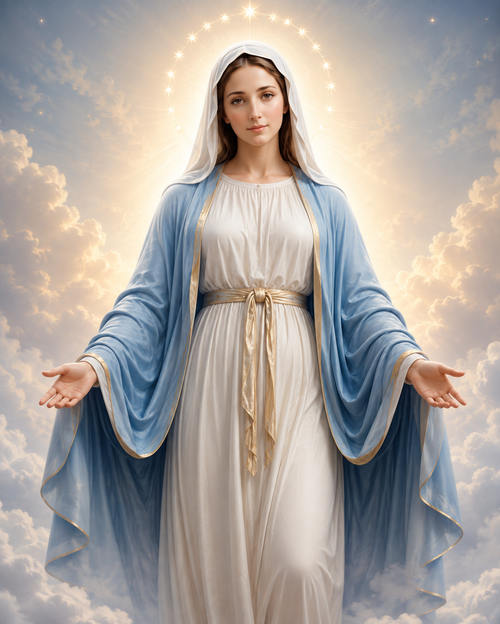
- Patronage
- Mother of God (Theotokos), Mother of the Church, Mother of Disciples, Mother of the Faithful, Mother of Believers, Advocate, Helper, Benefactress, Mediatrix, New Eve, Full of Grace, Our Lady, Blessed Virgin Mary, Queen of Heaven, Queen of Peace, Our Lady of Guadalupe (Patroness of the Americas and of the unborn), Our Lady of Fatima (Our Lady of the Rosary), Our Lady of Lourdes (Patroness of the sick), Our Lady of Sorrows (Patroness of those who suffer), Our Lady of the Rosary, Our Lady of the Miraculous Medal, Our Lady, Undoer of Knots, Our Lady of Peace, and many more...
Her Origins and Preparation
Mary was a young Jewish woman of Nazareth, of the tribe of Judah and the line of David, chosen from all eternity by God to be the mother of the Incarnate Word. Sacred Tradition, drawing from ancient sources, holds that she was the daughter of Sts. Joachim and Anne, who consecrated her to God from her earliest years. The Catechism teaches that from the first instant of her conception she was enriched by a unique grace, God preparing within her a worthy dwelling place for the Incarnate Word.
The Annunciation: Her Perfect Yes
The defining moment of Mary's earthly mission came in the humble town of Nazareth. The Angel Gabriel appeared to her and announced that she had been chosen to bear the Son of God. Her response, recorded in Luke 1:38, was total, unconditional, and immediate: "Behold, I am the handmaid of the Lord. May it be done to me according to your word." With those words, the Second Person of the Blessed Trinity took flesh in her womb. Where Eve had said no to God, Mary said yes. Heaven and earth were reconciled in that single act of surrender.
The Visitation
Immediately after the Annunciation, Mary traveled in haste to visit her kinswoman Elizabeth, who was also with child. At the sound of Mary's greeting, the child in Elizabeth's womb, John the Baptist, leaped for joy, filled with the Holy Spirit. Elizabeth then cried out: "Most blessed are you among women, and blessed is the fruit of your womb" (Luke 1:42). Mary responded with the Magnificat, one of the most beautiful canticles in all of Scripture, a song of total praise and abandonment to God that the Church prays to this day at Evening Prayer every day throughout the world.
The Birth of Christ and the Hidden Years
Mary brought forth the Son of God in a stable in Bethlehem, wrapped Him in swaddling clothes, and laid Him in a manger. She was present for the visit of the shepherds and the Magi, pondering all these things in her heart. On the fortieth day, she presented the Christ child in the Temple, where Simeon prophesied that a sword would pierce her own soul, foretelling the suffering she would endure at the foot of the Cross. She and Joseph then fled with the child into Egypt to protect Him from Herod's murderous decree. Upon returning, the family settled in Nazareth
Significance
Redeemed by reason of the merits of her Son and united to Him by a close and indissoluble tie, she is endowed with the high office and dignity of being the Mother of the Son of God, by which account she is also the beloved daughter of the Father and the temple of the Holy Spirit. Because of this gift of sublime grace she far surpasses all creatures, both in heaven and on earth.
Mary's significance in salvation history cannot be overstated. From the very first pages of Scripture to its last book, her role is woven through the whole of God's plan of redemption. In Genesis 3:15, the Protoevangelium or "first gospel," God places enmity between the serpent and the woman, and between his seed and hers. This passage is the first announcement of the Messiah, and it points directly to Mary.
Among Mary's ancient titles is that of New Eve, taught by the Fathers from both East and West. Just as Eve's disobedience brought death into the world, Mary's total obedience brought Life itself into the world.
The Four Marian Dogmas:
Over the centuries the Catholic Church has formally proclaimed four Marian dogmas: her Immaculate Conception, divine motherhood, perpetual virginity, and Assumption into heaven.
- Immaculate Conception: The dogma of the Immaculate Conception states that the Blessed Virgin Mary was preserved by a singular grace of God and in view of the merits of Jesus Christ from all stain of original sin from the very first moment of her conception. This dogma was defined by Pope Pius IX on December 8, 1854, through the papal bull Ineffabilis Deus.
- Divine Motherhood (Theotokos): Mary is truly the Mother of God, because Jesus Christ, her Son, is one divine person with two natures, human and divine. This truth was solemnly defined by the Council of Ephesus in 431 A.D., a proclamation met by the faithful of Ephesus with joyful celebration in the streets.
- Perpetual Virginity: The dogma of perpetual virginity affirms that Mary was a virgin before, during, and after the birth of Jesus. This truth has been part of the Catholic faith since the early centuries. It is not merely a matter of noting that Mary remained a virgin up to a certain point but of professing that her virginity was perpetual.
- Assumption: The Immaculate Virgin, preserved free from all stain of original sin, when the course of her earthly life was finished, was taken up body and soul into heavenly glory, and exalted by the Lord as Queen over all things, so that she might be more fully conformed to her Son, the Lord of lords and conqueror of sin and death. This dogma was defined by Pope Pius XII on November 1, 1950, in the apostolic constitution Munificentissimus Deus.
Mary as the Church's Model:
By her complete adherence to the Father's will, to her Son's redemptive work, and to every prompting of the Holy Spirit, the Virgin Mary is the Church's model of faith and charity. She is what the Church hopes to become.