
Notre Dame Cathedral Paris
The Cathedral of Our Lady of Paris started construction in 1163, but its origins go back to the seventh century and even before the Christian era. The cathedral is one of the world's most recognizable landmarks and has been immortalized in literary works such as Victor Hugo's "The Hunchback of Notre-Dame." It stands as the mother church of the Archdiocese of Paris and a monument not merely to French cultural pride but to the Catholic civilization that built it: stone by stone, century by century, as an act of praise to God and a home for the Body of Christ on earth.
Blessed Virgin Mary → Plan a trip here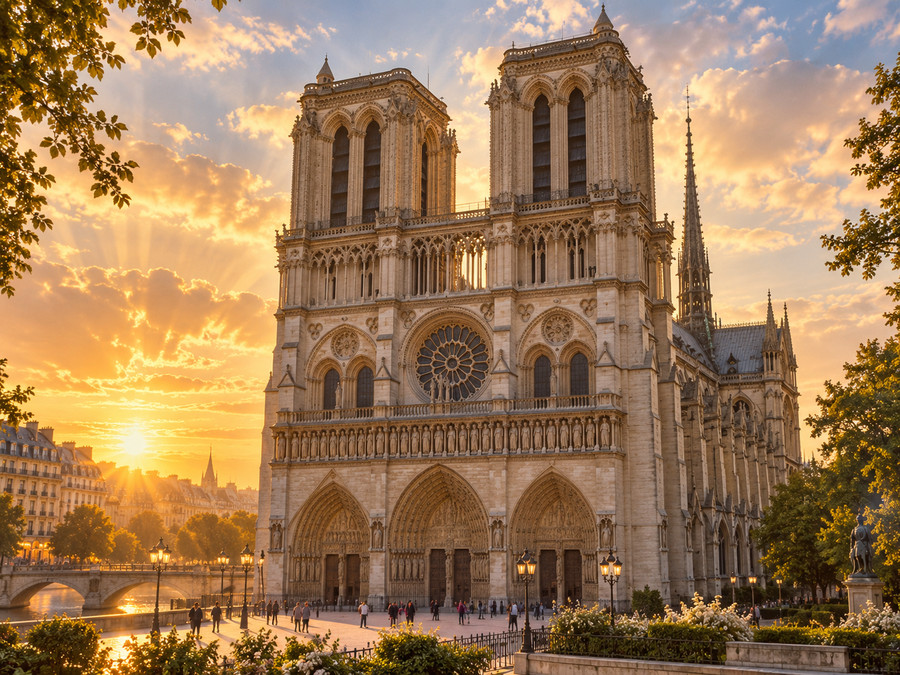
The Story
Ancient Roots and Sacred Ground
Notre Dame was built on the ruins of two earlier churches which were themselves built over a temple dedicated to the Roman God Jupiter. The Ile de la Cité, the island in the heart of the Seine River upon which Notre Dame sits, has been a place of worship for millennia. The Christian faith did not displace this sacred instinct; it fulfilled it, redirecting toward the living God the deep human longing for transcendence that had always gathered at this place.
The Norman invasions destroyed the earlier Notre Dame, but St. Etienne remained standing and for a time served as the cathedral. At the end of the ninth century Notre Dame was rebuilt, and the two churches continued to exist side by side until the eleventh century when St. Etienne fell to ruin. Maurice de Sully resolved to erect a magnificent cathedral on the ruins of St. Etienne and the site of Notre Dame.
The Construction: 1163 Onward
Pope Alexander III laid the foundation stone for the cathedral in 1163, and the high altar was consecrated 26 years later. Henri de Chateau-Marcay, papal legate, consecrated the high altar in 1182; the Patriarch of Jerusalem officiated in 1185 in the completed choir; the facade was finished in 1218, the towers in 1235. Construction on the Gothic-style cathedral began over 850 years ago and took nearly 200 years to fully complete.
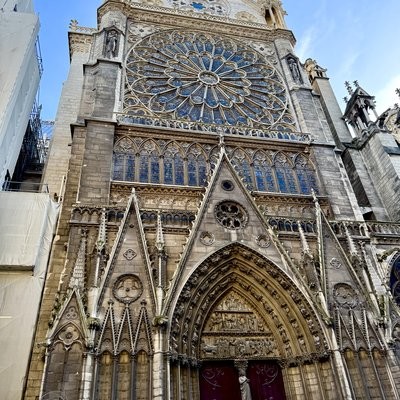
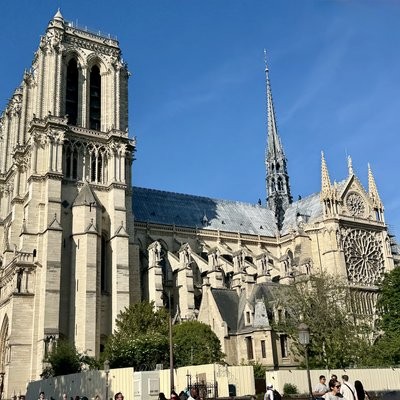
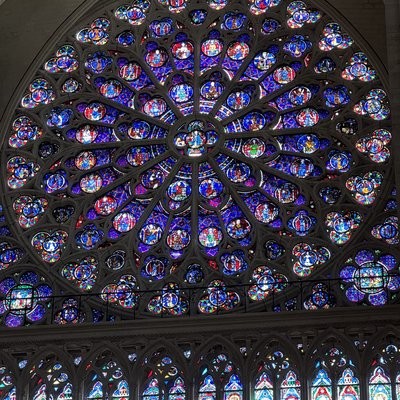
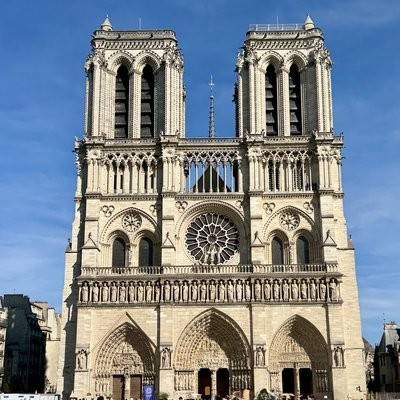
The cathedral is one of the finest examples of French Gothic architecture in the world, featuring soaring stone vaults, flying buttresses, magnificent rose windows, and the forest of stone that draws every eye upward toward heaven. This was not mere aesthetic choice. The architects and builders of Notre Dame understood that architecture is theology made visible, that beauty is an argument for God.
A Cathedral at the Center of History
Notre Dame has stood at the center of French and Western history for over eight centuries:
King Henry VI of England was crowned in the cathedral in 1431.
Though it suffered damage, the cathedral escaped possible destruction during the French Revolution, when Napoleon crowned himself king of France in 1804.
The feast of Reason was celebrated in Notre Dame in November 1793, a deliberate act of revolutionary desecration, as the forces of the French Revolution attempted to replace Christian worship with a secular substitute. Notre Dame was briefly converted into a Temple of Reason, its altars stripped and its sacred purpose mocked. And yet it endured.
Catholic worship was resumed on April 18, 1802, and the coronation of Napoleon took place there on December 2, 1804.
Pope Pius X beatified Joan of Arc, perhaps France's most famous Catholic martyr, in Notre Dame cathedral in 1909.
It survived two world wars largely unscathed.
The Sacred Relics
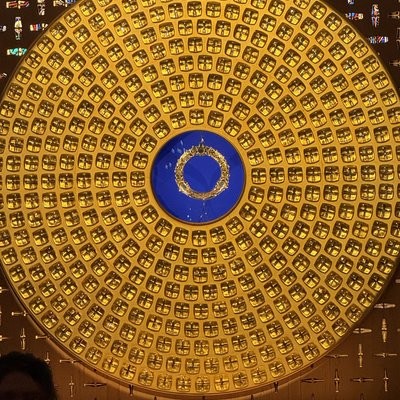
Relics in the cathedral include a crown of thorns believed to have been worn by Christ before his crucifixion and a piece of wood believed to be part of the cross on which Christ was crucified. These relics were acquired by St. Louis IX of France, the same royal saint for whom Mission San Luis Rey was named, who built the Sainte-Chapelle to house them. Their presence at Notre Dame is a reminder that this cathedral was never merely a cultural monument. It was always first and foremost a house of prayer, a custodian of the sacred, a dwelling place of the living God.
The 2019 Fire
On the evening of April 15, 2019, fire broke out at Notre Dame of Paris, sending flames and smoke billowing into the sky above the French capital and transfixing the world. The cathedral had been closed ever since a devastating fire on April 15, 2019, saw the spire crash through the centuries-old timber roof.
Major religious and artistic treasures of the cathedral were removed as the fire began, including a relic of Christ's crown of thorns.
The fire weakened the remaining structure of the basilica, raising questions about whether the ancient walls might collapse. The lead that had lined the roof fell inside the building, coating the interior with toxic dust that had to be painstakingly removed before restoration efforts could safely proceed.
The fire sparked a wave of emotion around the world, including in the United States, which has the largest number of foreign contributors to the restoration and reconstruction work, amounting to almost 700 million euros. Financial pledges totaling nearly 1 billion euros were secured, funds that made the reconstruction possible and left resources for future conservation work.
The Restoration
Almost immediately after the disaster, debate began as to whether the cathedral would be restored as it looked before the fire or if it would be updated with modern architectural designs and flourishes atop the ancient portion of the church. The French Parliament subsequently enacted a law mandating that the reconstruction must "preserve the historic, artistic, and architectural interest" of the original structure.
Friends of Notre Dame de Paris, a nonprofit supporting the renovation, said the new spire is constructed of an oak framework covered with lead, just as the old one was. The five years of work involved a total of 250 companies and hundreds of craftsmen.
The Reopening: December 2024
The doors of the newly restored Notre Dame of Paris Cathedral were officially reopened to the public during a ceremony just over five years after a blaze ravaged the iconic structure's roof, frame, and spire. The celebration was attended by some 1,500 people, including about 40 heads of state, including U.S. President-elect Donald Trump and Ukrainian President Volodymyr Zelenskyy.
The consecration Mass for the cathedral's new main altar was scheduled for the following day, the Second Sunday of Advent, fittingly celebrated as the Church prepared once again for the coming of Christ.
The reopening ceremony was considered one of the most significant cultural and religious events in Europe in recent years.
The Crown of Thorns
The most famous relic located in Notre Dame is the Crown of Thorns believed to have been placed upon Jesus Christ during his scourging. The cathedral also contains a piece of the true cross and one of the nails used in the crucifixion, plus relics of many French saints.
In 1238, Baldwin II, the Latin Emperor of Constantinople, offered the Crown of Thorns to St. Louis, King of France. It was then in the hands of the Venetians as security for a heavy loan, but it was redeemed and conveyed to Paris where St. Louis built the Sainte-Chapelle for its reception. There the great relic remained until the Revolution, when, after finding a home for a while in the Bibliothèque Nationale, it was eventually restored to the Church and was deposited in the Cathedral of Notre Dame in 1806.
Among the noteworthy events which took place at Notre Dame was the depositing by St. Louis on August 10, 1239, of the Crown of Thorns, a portion of the True Cross, and a nail of the Passion.
During the 2019 fire, Fr. Jean-Marc Fournier, the chaplain of the Paris Fire Department, accompanied firefighters into the cathedral to rescue the Crown of Thorns and the Blessed Sacrament from the tabernacle. That a priest ran into a burning cathedral to save not only the sacred relic but the Blessed Sacrament above all else is itself a testament to what Catholics know and believe: that the Real Presence of Christ in the Eucharist is of greater worth than any treasure of silver or gold.
Notre Dame as a Minor Basilica
Notre Dame has been a minor basilica since February 27, 1805. This designation, granted by the Holy See, formally recognizes the cathedral's singular importance in the life of the universal Church, conferring upon it special liturgical privileges and marking it as a place of particular pilgrimage and spiritual significance.
Words of the Church's Shepherds
When Pope Benedict XVI celebrated Vespers at Notre Dame in 2008, he said: "We are gathered in the Mother Church of the Diocese of Paris, Notre Dame Cathedral, which rises in the heart of the city as a living sign of God's presence in our midst."
Archbishop Michel Aupetit of Paris, celebrating the first Mass in the cathedral after the 2019 fire, made clear the cathedral's irreducible purpose. He said: "Dedication comes from dedicatio which means consecration. The dedication is the consecration of a church to divine worship. What we celebrate by the dedication each year is the profound reason why Notre Dame cathedral was built: to manifest man's inner impulse toward God."
The archbishop also declared: "The cathedral was born of the faith of our ancestors. It shows trust in the goodness of Christ, his love greater than hate, his life stronger than death as well as the tenderness of our forebears for the Virgin Mary, his mother, whom he entrusted to us as his most precious good just before dying on the cross."
The Question of Ownership
Due to France's laws regarding secularization, the French government owns all churches built before 1905, including Notre Dame. The government lets the Archdiocese of Paris use the building for free, and will continue to do so in perpetuity. This arrangement is a standing reminder of what the French Revolution set in motion: the attempt to subordinate the sacred to the state. Notre Dame endures in spite of it, as the living worship of God continues beneath its vaults regardless of who holds the legal title.
Church Recognition
The Cathedral as Mother Church
Notre Dame de Paris is the mother church of the Archdiocese of Paris, one of the oldest and most historically significant archdioceses in the entire Catholic world. The Archbishop of Paris is one of the most prominent figures in the French Catholic Church, and Notre Dame has served as the seat of that episcopal authority for centuries. Every major liturgical event in the life of the French Church — ordinations, beatifications, funerals of state, solemn Masses — has found its natural home beneath those ancient vaulted ceilings.
Catholic Teaching
Notre Dame Cathedral is not merely the cultural crown of France. It is a living proclamation, in stone, glass, and relics, of the deepest truths of the Catholic faith.
On Sacred Architecture as Theology: The Gothic architecture of Notre Dame was never mere aesthetic preference. Every soaring vault, every vertical line, every shaft of colored light through the rose windows was designed with one purpose: to draw the eye, the mind, and the soul upward toward God. The Catechism teaches that "sacred art is true and beautiful when its form corresponds to its particular vocation: evoking and glorifying, in faith and adoration, the transcendent mystery of God" (CCC 2502). Notre Dame is that conviction in stone.
On the Veneration of Relics: The Crown of Thorns and the fragment of the True Cross housed at Notre Dame are not superstitious curiosities. The Catechism teaches that "the Church venerates with great respect the memory of the dead. All Masses for the dead share in this veneration" and that the bodies of the saints and objects closely associated with Christ are worthy of honor because they participated in the life of grace (CCC 1674). When Pope Benedict XVI venerated the Crown of Thorns at Notre Dame in 2008, he was continuing a tradition stretching back through St. Louis IX to the earliest centuries of the Church.
On Beauty as Evangelization: The conversion of the poet Paul Claudel, who encountered God while attending Vespers at Notre Dame on Christmas Day 1886, is one of the most famous literary conversions in modern Catholic history. Notre Dame Cathedral rightly remains one of the most celebrated monuments of France's heritage, having served as the pulpit from which preachers of the Gospel transmitted the flame of their passion to the most varied congregations. Beauty is not an add-on to the Gospel. It is one of the Gospel's primary languages, and Notre Dame speaks it at a level matched by few structures on earth.
On the Indestructibility of the Church: The fire of April 15, 2019 transfixed the world. Catholics wept. Secularists wept. People with no faith at all wept, and many could not explain why. That universal grief is itself a theological datum: even a world that has largely abandoned Christianity knows, at some deep level, that Notre Dame is not just a building. It is a sign. And when that sign was threatened, something in the human heart recognized what was at stake. The Church has survived the French Revolution, the desecration of the Feast of Reason, two world wars, the sexual revolution, and now a devastating fire. She will endure. As Christ promised in Matthew 16:18, the gates of hell shall not prevail against her.
On France as the Eldest Daughter of the Church: France has historically been called the "Eldest Daughter of the Church," a title rooted in its early and deep embrace of Christianity, its warrior saints, its great cathedrals, and its missionary saints who carried the Gospel to every corner of the globe. Notre Dame is the physical heart of that identity. Every Mass celebrated beneath its restored vaults is an act of reclamation: a declaration that France's deepest identity is not Enlightenment secularism but Catholic faith.
Notre Dame has survived revolution, desecration, neglect, war, and fire, and still the bells ring and the Mass is offered. What does the sheer perseverance of this cathedral over nine centuries say to you about the nature of the Church Christ founded, and about the kind of faith it takes to build something meant to outlast yourself?
Plan Your Visit
The Pilgrim’s Quick Card
- Ideal stay
- 1/2 Day Allow 3–4 hours for the cathedral
- Best months
- May - June Spring and fall generally offer the most comfortable weather
- Nearest airport
- Paris Charles de Gaulle (CDG) CDG provides the most nonstop flights from the U.S.
- Language & currency
- French English is widely used around major Paris attractions.
- Accessibility
- Great The cathedral itself is very accessible.
Plan the trip
How Long Should I Stay?
Notre-Dame can technically be visited in about an hour, but that does not leave much room for prayer.
2 hours — cathedral interior and Marian prayer.
3–4 hours (recommended) — adds Mass or Confession, Treasury and time with the Passion relics.
Full day — adds the towers and nearby Catholic sites.
2–3 nights in Paris — allows Notre-Dame, Sainte-Chapelle, St. Geneviève, Sacré-Cœur and other pilgrimage destinations without rushing.
Pilgrim Tip: Visit Notre-Dame once as a visitor and then return for Mass or quiet prayer. The experience is substantially different.
Best Time to Visit
The weather is generally comfortable for walking and days are long.
Best Spiritual Experience
Friday
The Holy Crown of Thorns is displayed each Friday.
August 14–15
The Assumption of the Blessed Virgin Mary is one of Notre-Dame's great annual celebrations, including Marian liturgy and processions.
Advent & Christmas
Beautiful spiritually, but expect very high visitor demand.
For Fewer Crowds
Try:
- January
- February
- Weekday mornings
- Shortly after opening
Pilgrim Tip: Thursday is also attractive because the cathedral remains open late under its normal schedule and Eucharistic Adoration is celebrated at 6:45 PM.
Getting There From the United States
Best Overall: Charles de Gaulle (CDG)
CDG is Paris's primary international airport and offers extensive service to the United States.
The RER B connects the airport with central Paris. Notre-Dame's closest RER options include Saint-Michel–Notre-Dame, served by RER B and C.
Alternative: Paris Orly (ORY)
Orly is closer to central Paris geographically and is now directly connected to the city by Metro Line 14, which reaches central Paris through Châtelet.
Typical U.S. Routing
United States → Paris CDG → RER B / taxi → central Paris
Our recommendation: Choose CDG unless airfare strongly favors Orly.
On the ground
Getting Around
Notre-Dame is in the heart of Paris and is exceptionally well connected.
Closest Transit
Metro Line 4: Cité or Saint-Michel
RER B/C: Saint-Michel–Notre-Dame
Metro 1/11: Hôtel de Ville
Metro 7/11/14: Châtelet.
Walking is often the easiest way to move between Catholic sites in the historic center.
Good to Know: Notre-Dame sits on the Île de la Cité, so many important Paris churches and monuments are within a 10–30 minute walk.
Where to Stay
Best for Pilgrims
Latin Quarter / 5th arrondissement
Excellent walking access and many churches nearby.
Île Saint-Louis
Very close to Notre-Dame with a quieter atmosphere.
Saint-Germain-des-Prés / 6th arrondissement
Good balance of Catholic sites, restaurants and walkability.
Le Marais / 4th arrondissement
Easy access to Notre-Dame from the north side of the Seine.
Closest Possible
Accommodation directly on the Île de la Cité is limited, so staying just across the Seine is generally more practical.
Pilgrim Tip: Staying within a 15-minute walk allows you to attend early Mass and return later in the evening without relying on transportation.
Accessibility
The cathedral offers:
- Wheelchair-accessible main entrance
- Priority access
- Accessible chapels
- Removable and permanent ramps
- Elevator platform to the ambulatory
- Hearing loops
- Tactile and Braille resources
- 3D models
- Accessible Treasury
- Staff trained to assist visitors.
The cathedral does not provide wheelchairs, so visitors must bring their own.
Important Exception: Towers
The towers require 424 stairs and have no elevator, making them unsuitable for wheelchair users and many people with limited mobility.
What to do
Most Important Things to Do
Attend Mass
Notre-Dame is first and foremost an active Catholic cathedral.
Weekday Masses are currently celebrated at 8:00 AM, 12:00 PM and 6:00 PM, with multiple Sunday Masses including a 10:00 AM Gregorian Mass. No reservation is required for Mass; a dedicated worship line opens approximately 20 minutes beforehand.
Allow: About 1 hour.
Pray Before Our Lady of Paris
The 14th-century statue of the Virgin and Child known as Notre-Dame de Paris stands near the choir and has been a major focus of Marian devotion.
The location has been associated with an altar dedicated to Mary since the Middle Ages.
Allow: 15–30 minutes
Best time: Early morning or between major visitor surges.
Venerate the Crown of Thorns
One of Notre-Dame's greatest pilgrimage treasures is the Holy Crown of Thorns, together with a piece of the True Cross and a Nail of the Passion.
The Crown is currently displayed every Friday from 3:00–6:30 PM, with formal veneration on the first Friday of each month from 3:00–5:00 PM. No reservation is required for the veneration.
For a Catholic pilgrim, I would strongly consider planning Notre-Dame around a Friday.
Visit the Treasury
Treasury of Notre-Dame de Paris preserves liturgical vessels, vestments, books and sacred objects connected with the cathedral's history.
Current general admission is €12, with reduced and free categories available.
Allow: 45–60 minutes.
Go to Confession
Confession is available extensively throughout the week:
Monday–Saturday: 10:00 AM–12:00 PM and 2:00–6:00 PM
Sunday: 4:00–6:00 PM.
Visit the Towers
Towers of Notre-Dame Cathedral have reopened as a separately managed visitor experience.
The ascent includes 424 steps and reaches approximately 69 meters. There is no elevator, restroom or water point on the route.
Allow: About 1½ hours
Difficulty: Strenuous.
See the Rose Windows and Restored Interior
Do not move too quickly through the cathedral.
Take time to see:
- The great rose windows
- Choir and sanctuary
- Side chapels
- Pietà
- Baptistery
- Reconstructed roof and restored vaults
- New liturgical furnishings
- Grand organ
Notre-Dame's construction began in 1163 and became one of the defining examples of French Gothic architecture.
Suggested Pilgrimage Itinerary
Morning
Attend the 8:00 AM Mass at Notre-Dame.
After Mass:
- Pray before Our Lady of Paris
- Walk the cathedral prayer route
- Visit the chapels
- Go to Confession
- Visit the Treasury
Midday
Walk across the Île de la Cité to Sainte-Chapelle.
St. Louis built Sainte-Chapelle specifically to house the Passion relics, including the Crown of Thorns, before those relics eventually came to Notre-Dame.
Afternoon
Return to Notre-Dame.
If visiting Friday:
- 3:00 PM — Crown of Thorns
- Spend time in prayer afterward
Or climb the cathedral towers if you have reserved a separate tower visit.
Optional Catholic Extension
Walk across the Seine to Église Saint-Étienne-du-Mont, where the shrine associated with St. Geneviève, patron saint of Paris, is located.
Mass, Confession & Prayer
Monday–Friday
8:00 AM — Mass
12:00 PM — Mass
3:00 PM — Rosary
5:30 PM — Vespers
6:00 PM — Mass
Thursday 6:45 PM — Eucharistic Adoration
Saturday
8:30 AM — Mass
12:00 PM — Mass
3:00 PM — Rosary
5:15 PM — First Vespers
6:00 PM — Vigil Mass
Sunday
8:30 AM — Mass
9:30 AM — Lauds
10:00 AM — Gregorian Mass
11:30 AM — Mass
5:15 PM — Vespers
6:00 PM — Diocesan Mass.
Mass does not require a visitor reservation. Use the dedicated worship line beginning roughly 20 minutes before the service.
Practical
What to Bring
Pilgrimage Essentials
- Rosary
- Written prayer intentions
- Small Bible or prayer book
- Journal and pen
- Headphones for the official app
Practical Items
- Comfortable walking shoes
- Small umbrella
- Light rain jacket
- Reusable water bottle
- Portable phone charger
- European Type C/E adapter
- Modest clothing suitable for church
- Small amount of euros
Notre-Dame asks visitors to cover shoulders, torso, stomach and thighs; men should remove hats inside.
Pilgrim Tip: Bring your own headphones. The official Notre-Dame app is one of the best ways to understand the newly restored interior.
Before You Go
Before leaving:
- ✓ Download the official Notre-Dame app
- ✓ Make a free timed reservation if visiting at a busy time
- ✓ Check current cathedral hours
- ✓ Check Mass and Confession schedules
- ✓ Consider visiting on Friday for the Crown of Thorns
- ✓ Write down your prayer intentions
- ✓ Plan time before Our Lady of Paris
- ✓ Visit the Treasury
- ✓ Reserve the towers separately if you want to climb them
- ✓ Dress appropriately for a church
- ✓ Bring headphones for the app
- ✓ Leave time for silence and prayer
Most Important: The greatest pilgrimage experience at Notre-Dame is not simply seeing the restored architecture. Attend Mass, pray before Our Lady of Paris, receive the Sacrament of Reconciliation, and—if possible—visit on a Friday to encounter the Crown of Thorns and the relics of Christ's Passion. Those elements place Notre-Dame within the living Catholic tradition that has defined the site for more than eight centuries.
Additional Information
A free timed reservation is optional but recommended during busy periods. Never pay a third party for a supposed cathedral "skip-the-line ticket."
Official Notre-Dame App
Download the cathedral's official free mobile app.
It includes:
- Pilgrim and visitor routes
- Prayers
- Liturgical texts
- Cathedral information
- Accessibility tools
- Multiple languages.
Treasury
Current admission:
€12 full price
€6 reduced
Tickets are purchased directly at the Treasury; there is no online Treasury reservation.
Crown of Thorns
Every Friday: display 3:00–6:30 PM
First Friday: veneration 3:00–5:00 PM.
Restrooms
There are no public restrooms inside Notre-Dame.
Free public toilets are available on Rue d'Arcole.
Religious Items
The official cathedral shop sells rosaries, medals, books and devotional objects. Items can be blessed by a priest after Mass or near the confessionals.
Currency
Euro (€)
Cards are widely accepted throughout Paris.
Local Language
French
Useful phrases:
- Hello / Good morning — Bonjour
- Thank you — Merci
- Please — S'il vous plaît
- Where is Notre-Dame? — Où est Notre-Dame ?
- What time is Mass? — À quelle heure est la messe ?
- Where are confessions? — Où sont les confessions ?
- Do you speak English? — Parlez-vous anglais ?
Location
Visit the official website ↗ See it on the interactive map →Pilgrim Photos
In the Area
Other sacred sites within 40 miles.