
The Chapel of Our Lady of the Miraculous Medal
The Miraculous Medal owes its origin to the apparitions of the Blessed Virgin Mary in the Chapel of the Rue du Bac, Paris, in the year 1830, where she appeared as the Immaculata to St. Catherine Laboure, a novice with the Daughters of Charity. Located at 140 Rue du Bac, in the heart of Paris, this humble chapel attached to the motherhouse of the Daughters of Charity is one of the most visited Marian shrines in the entire world. It is not a grand cathedral. It is not an architectural landmark on the scale of Notre Dame. It is something rarer: a small, quiet chapel in a narrow street where heaven broke through to earth in the darkness of a November night, and where the Mother of God gave a peasant girl a mission that would reach every corner of the globe.
Blessed Virgin Mary → Plan a trip here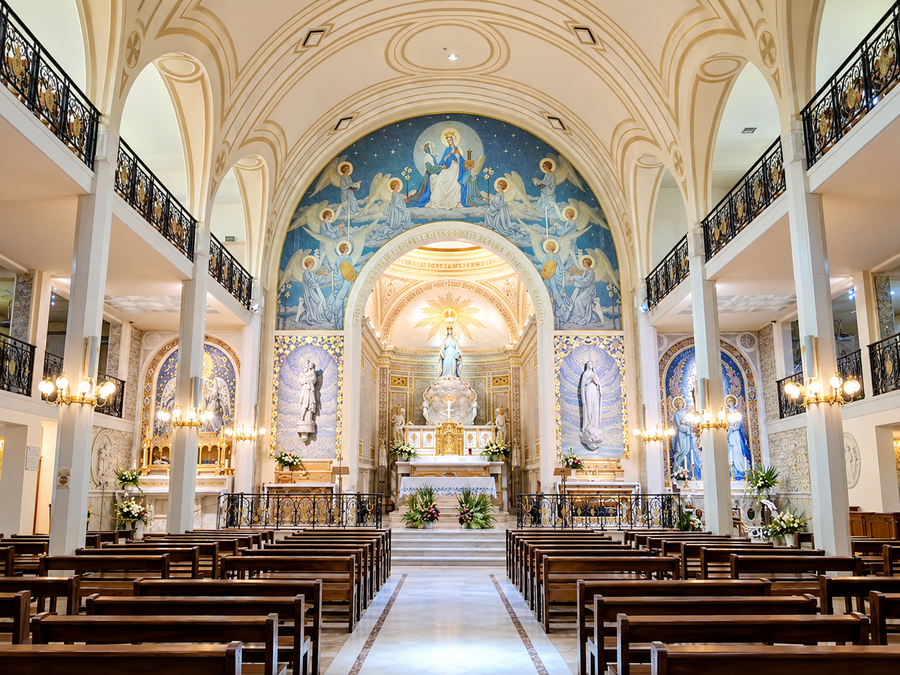
The Story
The World Into Which Heaven Spoke
To understand the apparitions at the Rue du Bac, it is necessary to understand the world into which they came. France in 1830 was a nation in spiritual crisis. The French Revolution had attempted to destroy the Church, altars were overturned, priests were martyred, and the worship of Reason was installed in the great cathedrals. Though Napoleon had restored outward religious practice, the soul of France remained wounded. Anti-clericalism was on the rise, political revolutions were erupting, and the faith of ordinary French men and women was under siege from every direction.
The messages of Our Lady to Catherine pointed to coming upheavals in France and the world. She warned of great troubles, acute dangers, of a time when everyone would believe all to be lost. "The Cross will be trampled on, blood will run in the streets, the world will be plunged into sadness. But grace will be showered upon all who ask for it with faith and fervor."
Into this darkness, God sent His Mother.
St. Catherine Laboure: The Hidden Instrument
Saint Catherine Laboure was born in France on May 2, 1806. She was the ninth of eleven children. Upon her mother's death, when Catherine was eight years old, the young girl assumed the responsibilities of the household. It was said of her that she was very quiet and practical. She became a Daughter of Charity, and when she was a novice, at 24 years of age, the Virgin Mary appeared to her for the first time.
St. Catherine Laboure was a novice with the Daughters of Charity of St. Vincent de Paul when she received three apparitions from the Blessed Virgin Mary, a vision of Christ present in the Eucharist, and a mystical encounter in which St. Vincent de Paul showed her his heart.
The First Apparition: July 18, 1830
In the darkness of the night of July 18 to 19, 1830, just before the hour of midnight, the counter revolution struck.
A few weeks after she had begun her novitiate, on the night of July 18, 1830, she was led by her guardian angel into the chapel where Our Lady appeared to her in great splendor and dignity.
Out through the corridors and down the halls they went, the convent lamps lighted all the way, a condition not to be explained naturally. The chapel door was locked as usual, but at the touch of the angel it swung open. The chapel, normally dark by night, was lighted brightly as if for Midnight Mass.
On July 18, the Immaculate Virgin, seated in the same chapel, had spoken gentle words of encouragement to the young novice. In 1830 the Blessed Virgin appeared three times, sitting in a chair, to a novice, Catherine Laboure, asking her to have a medal struck honoring her Immaculate Conception. The chair is now preserved as a relic there. Mary told Catherine of the terrible things that would happen unless true religious fervor among the people was revived.
The Second Apparition: November 27, 1830
On November 27, the Virgin Mother showed St. Catherine the design of a medal which would remind people of the love and protection that Our Lady continually offers to God's children.
On the second occasion, Sister Catherine records that the Blessed Virgin appeared as if standing on a globe, and bearing a globe in her hands. As if from rings set with precious stones, dazzling rays of light were emitted from her fingers. These, she said, were symbols of the graces which would be bestowed on all who asked for them.
Framing the figure was an inscription: "O Mary, conceived without sin, pray for us who have recourse to thee." Then Mary spoke to Catherine: "Have a medal struck upon this model. Those who wear it will receive great graces, especially if they wear it around the neck."
The vision then seemed to turn to show the reverse of the Medal: the letter M surmounted by a cross with a bar at its base; below this monogram, the Sacred Heart of Jesus crowned with thorns, and the Immaculate Heart of Mary pierced with a sword.
The young nun remembered that at the second apparition of Our Lady, she stood on a globe, holding in her hands another globe which reflected rays of light of great brilliance. The Blessed Virgin had explained to Catherine that the globe represented the entire world, France in particular and especially every single person, on whom she would bestow grace.
The Medal Is Struck: 1832
Catherine's first attempt to follow the Blessed Mother's request was unsuccessful, but later a medal was coined depicting the Blessed Virgin. With approval of the Catholic Church, the first medals were made in 1832 and were distributed in Paris.
The response was immediate and extraordinary.
People turned to the Sisters of Charity who gave them the Medal of the Immaculate Conception with the assurance that great graces would be showered upon all who would wear it with confidence, especially if it were worn around the neck. After the first cures, people demanded it excitedly.
So many favors, cures, and conversions were effected through its instrumentality that its name and doctrinal significance were lost in the clamor; it became known simply as "The Miraculous Medal."
A Life Hidden in Humility
What makes the chapel of the Rue du Bac all the more remarkable is what Catherine Laboure chose to do after receiving these apparitions. She told no one except her spiritual director, Blessed Father Jean-Marie Aladel. For 46 years, she kept the secret of the apparitions, serving in a house for the elderly in Enghien, a Paris suburb, as an ordinary, even obscure, sister. She cared for the sick and the aged, she tended chickens, she answered the door. She was considered by most of the sisters who lived alongside her to be rather unremarkable.
Catherine spent 46 years in the obscurity of the Laboure house without telling anyone else that she was the privileged soul to whom Our Lady had appeared. Only Aladel, who had initially doubted, and ultimately promoted the cause of the medal's creation with the Archbishop of Paris, knew the secret. And even he did not know the name of the privileged recipient until very near the end of Catherine's life.
A few months before her death, sensing that her time was near, Catherine revealed herself to her superior, Sister Dufes, as the privileged soul. She died on December 31, 1876, only a few months after this revelation.
The Incorrupt Body
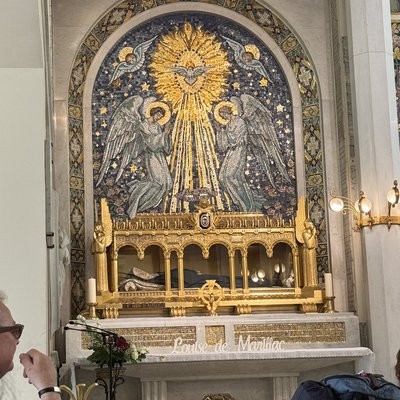
When Catherine Laboure's body was exhumed 56 years after her death, it was found to be perfectly incorrupt. Her hands were flexible, her eyes retained their blue color. Today, her incorrupt body lies in a glass reliquary beneath the side altar in the very chapel where she received the apparitions, clothed in the habit of the Daughters of Charity. She appears to be peacefully asleep. The physical incorruption of her body is one of the Church's most powerful signs: a person so conformed to God in life that even death could not entirely claim her.
Pilgrims who visit the chapel today kneel in the same room where Mary appeared, venerate the very chair in which the Virgin sat, and gaze upon the incorrupt face of the woman to whom heaven spoke. There is no other pilgrimage site quite like it in the world.
Church Recognition
Ecclesiastical Approval of the Medal
The Archbishop of Paris, Monsignor de Quelen, authorized the striking of the medal in 1832 after a canonical inquiry. The speed of that approval, and the extraordinary response of the faithful who received it, confirmed to the Church that something truly supernatural was at work on the Rue du Bac.
The Beatification and Canonization of St. Catherine Laboure
Catherine Laboure was beatified by Pope Pius XII on May 28, 1933. She was canonized by Pope Pius XII on July 27, 1947. Her feast day is celebrated on November 28. She is one of the most beloved saints in the modern era, not because she performed spectacular works before the eyes of the world, but because she obeyed God completely, in hiddenness, for the whole of her life.
Recognition of the Apparitions
The Church has formally recognized the apparitions at the Rue du Bac as worthy of belief. It must always be remembered that Marian apparitions, even those formally approved by the Church, are classified as private revelation. As the Catechism teaches, private revelations do not belong to the deposit of faith. Their role is to help us live more fully the faith already given to us in Scripture and Tradition (CCC 67). The apparitions at the Rue du Bac do not add anything new to the Gospel. They direct the hearts of the faithful back to the center: to Christ, to the Eucharist, to the Immaculate Mother who intercedes without ceasing.
The Conversion of Alphonse Ratisbonne
Among the most celebrated fruits of the Miraculous Medal is the conversion of Alphonse Ratisbonne, a French Jewish banker and virulent anti-Catholic, who agreed, almost mockingly, to wear the medal as part of a wager. On January 20, 1842, in the Church of Sant'Andrea delle Fratte in Rome, the Blessed Virgin appeared to Ratisbonne in exactly the form depicted on the Miraculous Medal. He converted immediately and completely, eventually became a Catholic priest, and dedicated his life to mission work in the Holy Land. The Church formally investigated the conversion and recognized it as miraculous. It remains one of the most dramatic and well-documented conversion stories in modern Catholic history.
Papal Veneration of the Chapel
The chapel at the Rue du Bac has been visited by numerous popes and high-ranking prelates throughout its history. Pope Francis sent a rosary to be placed at the altar of Our Lady of the Miraculous Medal at the Rue du Bac as a sign of his personal devotion to Mary under this title. The chapel remains under the care of the Daughters of Charity of St. Vincent de Paul, the same congregation to which Catherine Laboure belonged, who continue to welcome pilgrims and offer daily Mass and prayer in this sacred space.
Catholic Teaching
The Chapel of Our Lady of the Miraculous Medal is not merely a destination for pious travelers. Every element of this place, its story, its relics, its sacramentals, and its history, is a proclamation of truths the Church has always held.
On Private Revelation: The Catechism teaches that "throughout the ages, there have been so-called private revelations, some of which have been recognized by the authority of the Church. They do not belong, however, to the deposit of faith. It is not their role to improve or complete Christ's definitive revelation, but to help live more fully by it in a certain period of history" (CCC 67). The apparitions at the Rue du Bac are among the most formally recognized of these private revelations. They do not ask the faithful to believe something new. They ask the faithful to return to what is eternally true: that Mary intercedes, that grace is available, and that God desires our salvation more than we desire it ourselves.
On the Use of Sacramentals: The Miraculous Medal is one of the most widely used sacramentals in the history of the Church. The Catechism teaches that "sacramentals are sacred signs which bear a resemblance to the sacraments. They signify effects, particularly of a spiritual nature, which are obtained through the intercession of the Church. By them men are disposed to receive the chief effect of the sacraments, and various occasions in life are rendered holy" (CCC 1667). The medal does not work by magic. It works by faith, by the intercession of the Blessed Mother, and by the grace of God that flows through these outward signs to those who receive them with open and believing hearts.
On the Immaculate Conception: The inscription on the Miraculous Medal, "O Mary, conceived without sin, pray for us who have recourse to thee," is not merely a pious phrase. It is a doctrinal proclamation. The dogma of the Immaculate Conception, formally defined by Pope Pius IX in 1854, was anticipated by the apparitions at the Rue du Bac in 1830, and was confirmed by Mary herself at Lourdes in 1858 when she identified herself to St. Bernadette as "the Immaculate Conception." The chapel of the Rue du Bac stands as one of the earliest physical anchors of this defined truth of the faith.
On Marian Intercession: The Second Vatican Council's Lumen Gentium teaches that Mary "by her manifold intercession continues to bring us the gifts of eternal salvation. Therefore the Blessed Virgin is invoked in the Church under the titles of Advocate, Helper, Benefactress, and Mediatrix" (LG 62). The Miraculous Medal is a physical expression of this theological reality. Every person who wears it around their neck is making a visible act of trust in Mary's intercession, a daily declaration that they belong to her Son and seek her maternal protection.
On Hiddenness and Humility as the Path to Holiness: Catherine Laboure received the greatest private revelation in modern French Catholic history and then disappeared into 46 years of obscurity. She washed floors, cared for the elderly, tended chickens, and answered the convent door. She is a living refutation of the modern assumption that significance requires visibility. God chose the hidden, the quiet, the unremarkable and made her the instrument of a sacramental that has reached every corner of the earth. This is the logic of the Gospel: "God chose what is weak in the world to shame the strong" (1 Corinthians 1:27).
Plan Your Visit
The Pilgrim’s Quick Card
- Ideal stay
- 1/2 Day Allow 2-4 hours to visit the apparition site
- Best months
- April - June Spring and Fall are excellent for Paris
- Nearest airport
- Paris Charles de Gaulle (CDG) Strongest selection of flights from the United States
- Language & currency
- French English is commonly spoken
- Feast day
- November 27
- Accessibility
- Moderate Compact, Historic Chapel Property
Plan the trip
How Long Should I Stay?
This is a much smaller pilgrimage destination than Lourdes or Fátima, but there is a surprising amount to experience.
1–2 hours — Chapel, apparition site and prayer before St. Catherine Labouré.
2–4 hours (recommended) — adds Mass, Confession, Rosary, relics and the Medal Shop.
Full day — combine Rue du Bac with other Catholic sites in central Paris.
Pilgrim Tip: Do not rush in simply to obtain a medal. The real heart of Rue du Bac is prayer before the altar where the apparitions occurred.
Best Time to Visit
Best Overall
April–June & September–October
Comfortable weather makes walking between Paris churches much easier.
November 27
This is the Feast of Our Lady of the Miraculous Medal and commemorates the November 27, 1830 apparition in which Catherine received the design of the medal.
November 28
The following day is the Feast of St. Catherine Labouré.
Tuesdays
Tuesday is a particularly meaningful day at the Chapel. The current schedule includes Marian celebrations and periods of Eucharistic Adoration, and unlike most days the Chapel does not normally close for the midday cleaning period.
January Warning
The Chapel normally closes for approximately three weeks each January beginning the Monday after the Sunday of Epiphany for annual maintenance.
Pilgrim Tip: If Rue du Bac is a major reason for your Paris trip, avoid booking January dates without checking the closure calendar first.
Getting There From the United States
Best Overall: Charles de Gaulle (CDG)
CDG offers extensive nonstop service from the United States.
From the airport, continue into central Paris by:
- RER B
- Taxi
- Private transfer
- Airport transportation followed by Metro
Alternative: Paris Orly (ORY)
Orly is geographically closer to central Paris and can also be convenient depending on your flight itinerary.
Typical U.S. Routing
United States → Paris CDG → central Paris → Sèvres-Babylone
Our recommendation: Choose whichever Paris airport offers the best flight itinerary, but CDG will generally provide the greatest number of U.S. options.
On the ground
Getting Around
The Chapel is in the 7th arrondissement, one of the most walkable areas of central Paris.
Best Metro Station
Use Sèvres-Babylone, served by:
Metro Line 10
Metro Line 12
Take the Rue Velpeau exit. The Chapel specifically warns visitors that the Metro station named Rue du Bac is actually less convenient for reaching the Chapel.
Nearby buses currently include:
39, 63, 70, 84, 87 and 94.
Good to Know: Rue du Bac itself is narrow and one-way in this area, so arriving by Metro is generally much easier than driving.
Where to Stay
Best Areas
Saint-Germain-des-Prés / 6th arrondissement
Excellent restaurants, churches and easy walking access.
Sèvres-Babylone / 6th–7th arrondissement
Best choice for staying close to the Chapel.
Invalides / 7th arrondissement
Quiet, attractive and well connected.
Latin Quarter
Good if your pilgrimage also includes Notre-Dame and Sainte-Chapelle.
The Chapel itself provides no lodging or dining facilities, although there are many restaurants and food options in the surrounding neighborhood.
Pilgrim Tip: Staying near Sèvres-Babylone makes an early-morning visit especially easy.
Accessibility
Unlike a sprawling pilgrimage complex, nearly everything of spiritual importance is contained within the same building.
Pilgrims do not need to walk long distances once inside, but this remains a historic religious complex in central Paris.
For organized groups, coaches can generally drop pilgrims on Rue de Sèvres, avoiding the difficulty of navigating and parking on narrow Rue du Bac.
Pilgrim Tip: If traveling with a wheelchair user or someone requiring assistance, contact the pilgrimage office before arriving so the Sisters can advise you on current access.
What to do
Most Important Things to Do
Build your pilgrimage around the apparition site, Mass, Mary’s message and the saints whose relics remain in the Chapel.
Pray at the Site of the Apparitions
In 1830, the Blessed Virgin Mary appeared to St. Catherine Labouré, a 24-year-old novice of the Daughters of Charity.
The first major apparition took place during the night of July 18–19, 1830. On November 27, Catherine received the vision that became the design of the Miraculous Medal.
Allow: 30–60 minutes
Best time: Early morning before larger pilgrimage groups arrive.
Venerate St. Catherine Labouré
St. Catherine's body is preserved beneath the altar of the Virgin of the Globe.
Her body was exhumed in 1933 at the time of her beatification and transferred to Rue du Bac, where it remains today.
Allow: 15–30 minutes.
See the Apparition Altar
The side altar dedicated to St. Vincent preserves the altar associated with the 1830 apparitions.
An inscription identifies it as the altar before which the apparitions to Catherine occurred.
Venerate St. Louise de Marillac
The Chapel contains the relics of St. Louise de Marillac, co-founder with St. Vincent de Paul of the Daughters of Charity.
See the Heart of St. Vincent de Paul
The Chapel also preserves a relic of the heart of St. Vincent de Paul, making Rue du Bac important not only as a Marian shrine but also as a Vincentian pilgrimage destination.
Attend Mass
Mass is celebrated multiple times each day.
On most weekdays, the current schedule includes Mass at:
8:00 AM
10:30 AM
12:30 PM.
Go to Confession
Confession is available extensively throughout the week, generally during morning and afternoon periods.
Obtain a Miraculous Medal
The Chapel's Espace Médailles offers Miraculous Medals along with books, prayer cards and devotional materials.
It normally operates daily, with extended continuous hours on Tuesdays.
Suggested Pilgrimage Itinerary
Morning Visit
- Arrive shortly after opening
- Spend quiet time before the main altar
- Pray at the site of the apparitions
- Venerate St. Catherine Labouré
- Visit the relics of St. Louise de Marillac
- See the heart of St. Vincent de Paul
- Attend the 10:30 AM or 12:30 PM Mass
- Go to Confession
- Visit the Espace Médailles before leaving
Afternoon Visit
- Arrive after the midday reopening
- Pray before St. Catherine
- Go to Confession
- Participate in the Rosary or scheduled devotion
- Attend Vespers if staying into the evening
Have more time? Walk to the nearby Vincentian church at 95 Rue de Sèvres, historically connected with St. Vincent de Paul, then continue your Catholic pilgrimage through Paris.
Mass, Confession & Prayer
Monday, Wednesday, Thursday & Friday
Mass normally at:
8:00 AM
10:30 AM
12:30 PM
Rosary is normally celebrated at 3:30 PM on Monday, Wednesday and Thursday; Friday features the Stations of the Cross at 3:30 PM.
Tuesday
Tuesday has a special Marian character:
8:00 AM and 10:30 AM Mass
12:30 PM, 3:30 PM and 5:00 PM Marian celebrations
1:15–3:00 PM Eucharistic Adoration
6:15–6:45 PM Eucharistic Adoration.
Sunday
Current Sunday Masses are:
8:00 AM
10:00 AM
11:30 AM
Rosary is normally celebrated in the afternoon.
Confession
Monday through Friday, Confession is generally available:
9:00 AM–1:00 PM
3:00–6:00 PM
Saturday has similar hours with the afternoon period ending somewhat earlier.
Important: Always check the official schedule before traveling because feast days and special pilgrimages can alter regular times.
Practical
What to Bring
Pilgrimage Essentials
- Rosary
- Written prayer intentions
- Small Bible or prayer book
- Journal and pen
- Miraculous Medal you would like blessed, if you already own one
Practical Items
- Comfortable walking shoes
- Small umbrella
- Light rain jacket
- Portable phone charger
- Reusable water bottle
- European Type C/E power adapter
- Modest clothing for the Chapel
- Small amount of euros
Pilgrim Tip: You do not need to purchase a Miraculous Medal before traveling. Obtaining one at the actual apparition site can become a meaningful part of the pilgrimage.
Before You Go
Before leaving:
- Check current Chapel hours
- Check the January closure if traveling in winter
- Consider visiting on a Tuesday
- Write down your prayer intentions
- Plan to attend Mass
- Make time for Confession
- Pray before St. Catherine Labouré
- Visit St. Louise de Marillac and St. Vincent's heart
- Purchase a Miraculous Medal at the Chapel
- Use Sèvres-Babylone Metro rather than assuming Rue du Bac station is closest
- Leave time for quiet prayer before the apparition altar
- Consider continuing to nearby Catholic sites afterward
Most Important: The meaning of Rue du Bac is much deeper than the medal itself. This is the place where Mary appeared to St. Catherine Labouré in 1830 and asked for the medal to be struck, while directing pilgrims toward prayer, trust in God, and the graces obtained through her intercession. The Chapel remains centered on exactly that experience: Mass, Confession, Eucharistic Adoration, Marian prayer and quiet time before the altar.
Additional Information
Official Information
Use the official Chapelle Notre-Dame de la Médaille Miraculeuse website for:
- Opening hours
- Mass
- Confession
- Marian celebrations
- Eucharistic Adoration
- Group pilgrimage reservations
- Feast-day schedules
- Prayer intentions.
Useful Paris Apps
There is no dedicated Chapel app that I would rely on for pilgrimage planning.
For transportation, use:
Bonjour RATP
Île-de-France Mobilités
Both provide route planning and real-time Paris public-transit information.
Espace Médailles
The official medal area sells:
- Miraculous Medals
- Prayer cards
- Books
- Brochures
- Postcards
- DVDs and devotional material in several languages.
The Chapel states that medals are not sold or mailed online through this service.
Plenary Indulgence
The Apostolic Penitentiary permanently granted the possibility of a plenary indulgence for pilgrims visiting the Chapel under specified conditions, including Marian solemnities, November 27, November 28, organized devotional pilgrimages, and once annually on a date chosen by an individual pilgrim. Normal Church conditions also apply.
Saints & Relics
Within one chapel you can encounter:
St. Catherine Labouré — body preserved beneath her altar
St. Louise de Marillac — relics preserved in a side shrine
St. Vincent de Paul — relic of his heart.
Currency
France uses the Euro (€).
Cards are widely accepted throughout Paris, but keeping some cash is useful for offerings and small purchases.
Local Language
French
Useful phrases:
- Hello / Good morning — Bonjour
- Thank you — Merci
- Please — S'il vous plaît
- Where is the Chapel? — Où est la chapelle ?
- What time is Mass? — À quelle heure est la messe ?
- Where are confessions? — Où sont les confessions ?
- A Miraculous Medal, please — Une Médaille Miraculeuse, s'il vous plaît
- Do you speak English? — Parlez-vous anglais ?
Go Deeper
Visit the chapel's official website for visitor information. René Laurentin's biography of St. Catherine Labouré and the Catechism on the Immaculate Conception (CCC 490-493) offer further depth on the medal's meaning.
Location
Visit the official website ↗ See it on the interactive map →Pilgrim Photos
In the Area
Other sacred sites within 40 miles.