St. Carlo Acutis: His Life, His Tomb and Why Pilgrims Are Traveling to Assisi
For more than 800 years, pilgrims have traveled to Assisi to walk in the footsteps of St. Francis and St. Clare.
Today, many are arriving for someone very different.
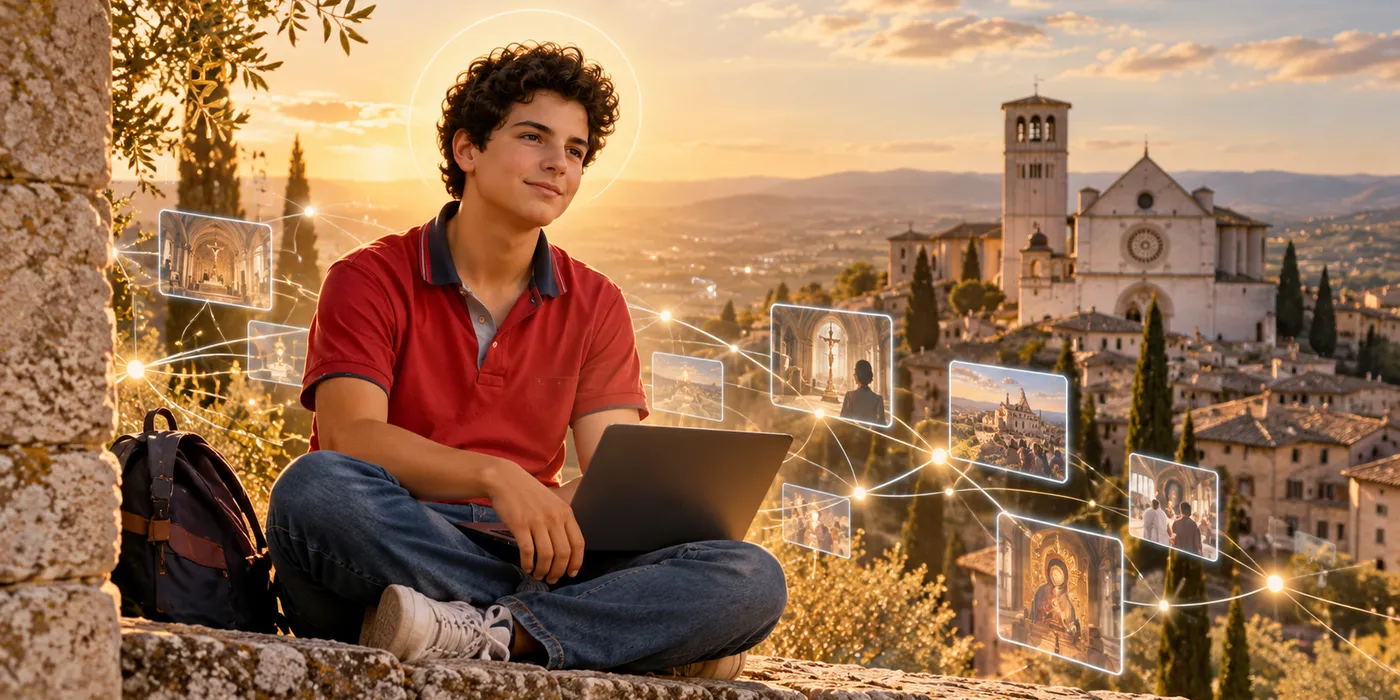
He wore jeans and sneakers. He enjoyed video games, soccer, computers, and spending time with friends. He built websites and understood technology better than many adults around him.
He also attended Mass frequently, prayed the Rosary, spent time in Eucharistic Adoration, cared for the poor, and developed a deep devotion to the Eucharist.
His name was Carlo Acutis.
Carlo died from leukemia in 2006 at just 15 years old. Less than twenty years later, on September 7, 2025, Pope Leo XIV declared him a saint of the Catholic Church alongside St. Pier Giorgio Frassati.
Today, Carlo's tomb in Assisi has become one of the city's most visited places of prayer, especially for young Catholics and families.
What draws so many people to a teenager who lived such a short life?
Perhaps part of the answer is that Carlo does not feel very far away.
A Saint From Our Own Time
Carlo Acutis was born in London on May 3, 1991, to Italian parents. His family returned to Milan while he was still young, and it was there that Carlo grew up.
His childhood looked surprisingly ordinary.
He went to school. He played sports. He liked animals. He enjoyed computers and technology. He spent time with friends.
But something else was developing alongside those ordinary interests.
Carlo had an unusually strong attraction to the Catholic faith, particularly to the Eucharist.
After receiving his First Communion at age seven, his devotion continued to grow. He attended Mass daily when possible and spent time praying before the Blessed Sacrament. The phrase most closely associated with him would eventually become famous among Catholics:
"The Eucharist is my highway to heaven."
The Vatican's official biography for his canonization describes a young person who naturally combined prayer, school, sports, charity, and everyday life. His faith was not something separate from the rest of his life. It shaped the way he lived it. Vatican
That may be one reason Carlo resonates so strongly with young Catholics today.
He does not belong to some distant century.
There are photographs of him.
There are people alive who knew him.
He used the internet.
He played video games.
He understood websites.
His world looked much more like ours than the world of many saints Catholics grew up learning about.
Carlo and the Internet
Carlo's interest in technology eventually became one of the most recognizable parts of his story.
He learned how to design websites and used those abilities for Catholic projects, including work connected to his parish.
Most famously, Carlo researched Eucharistic miracles from around the world and helped create an online exhibition documenting them.
The project brought together photographs, historical information, and stories of Eucharistic miracles associated with places throughout the world.
For Carlo, technology was a tool.
He understood that the internet could distract people, but he also saw that it could be used to lead them toward something good.
Instead of separating his interest in computers from his faith, he brought the two together.
That feels remarkably relevant today.
Many Catholics are trying to understand how faith fits into a world of smartphones, social media, streaming, gaming, and constant connection.
Carlo lived in that world at its beginning.
His answer was not to reject technology.
It was to decide what technology should be used for.
His exhibition on Eucharistic miracles continues to travel internationally, and the Sanctuary of the Spoliation in Assisi currently displays material connected with his work. assisisantuariospogliazione.it
His Love for the Eucharist
Technology may be the part of Carlo's story that first gets people's attention, but it was not the center of his life.
The Eucharist was.
Carlo believed deeply in the Real Presence of Jesus Christ in the Eucharist.
Mass and Eucharistic Adoration became part of his normal routine.
Pope Leo XIV highlighted this when Carlo was canonized, pointing to simple practices that shaped his life, including daily Mass, prayer, and Eucharistic Adoration. Vatican
This is important when understanding Carlo.
He was not trying to become famous.
He was not building an online following around himself.
His attention kept returning to Christ.
Even his work documenting Eucharistic miracles was ultimately an attempt to help other people discover the same thing he had discovered.
For Carlo, the Eucharist was not one Catholic devotion among many.
It was the center.
A Short Life
In early October 2006, Carlo became ill.
What initially appeared to be a serious case of the flu was diagnosed as an aggressive form of leukemia.
His condition deteriorated quickly.
According to the Vatican biography, Carlo offered his suffering for the Pope and the Church. He received the Anointing of the Sick at San Gerardo Hospital in Monza.
On October 12, 2006, Carlo died.
He was 15 years old. Vatican
For his family and friends, his earthly life had ended almost before it had begun.
But the story of Carlo Acutis was only beginning to spread.
Why Carlo Is Buried in Assisi
Carlo grew up in Milan, but Assisi held a special place in his life.
His family spent time there, and Carlo developed a strong connection to the spirituality of St. Francis.
He loved the simplicity of Assisi and the example of Francis, particularly his closeness to Christ, concern for the poor, and desire to place God above possessions.
Carlo wanted Assisi to be his final resting place. His remains were moved to the city's cemetery in 2007 in accordance with that wish. In 2019, they were transferred to the Sanctuary of the Spoliation at the Church of Santa Maria Maggiore. Vatican News
The location is deeply symbolic.
The Sanctuary of the Spoliation commemorates one of the defining moments in the life of St. Francis.
It was here that Francis renounced his claim to his father's wealth and possessions, choosing instead to entrust his life completely to God.
Centuries later, the body of a teenager who tried to place Christ at the center of his own life came to rest in that same place.
It connects two saints separated by roughly eight centuries.
Francis lived in medieval Italy.
Carlo lived in the age of the internet.
Yet both challenge pilgrims with a similar question:
What are you willing to let go of in order to follow Christ more completely?
Visiting the Tomb of St. Carlo Acutis
Carlo's tomb is located inside the Church of Santa Maria Maggiore, part of the Sanctuary of the Spoliation in the historic center of Assisi.
His body is visible within a stone and glass tomb in the right side of the church.
He is dressed simply.
There are no royal robes or elaborate vestments.
He looks like the teenager he was.
That visual simplicity is one of the most striking parts of visiting.
A pilgrim may spend the morning looking at medieval frescoes and ancient churches, then walk into Santa Maria Maggiore and find the tomb of a young man wearing ordinary clothing from the twenty-first century.
The contrast makes sainthood suddenly feel much closer.
It is worth clarifying one point that has often been repeated online. Carlo's body was not found incorrupt. The Diocese of Assisi specifically addressed this in 2020, explaining that his remains underwent normal conservation and reconstruction before being presented for public veneration. diocesiassisi.it
The significance of the tomb does not depend on the physical condition of his body.
Pilgrims come because of the life that body represents.
Why Are So Many Pilgrims Coming?
Carlo has changed the pilgrimage landscape of Assisi.
For centuries, St. Francis was the obvious reason most Catholic pilgrims came here.
Now Carlo is becoming a pilgrimage destination in his own right.
The Sanctuary of the Spoliation reported nearly 400,000 visitors during the first four months of 2026. The sanctuary said pilgrims were arriving from across Italy as well as the United States, Spain, South America, France, Poland, Slovakia, and elsewhere. assisisantuariospogliazione.it
By the fall of 2026, the sanctuary reported more than 1.7 million visits since July 2025, while noting that the extraordinary Franciscan anniversary celebrations also contributed significantly to those numbers. Shrine officials nevertheless describe hundreds of pilgrims arriving each day specifically to pray at Carlo's tomb. assisisantuariospogliazione.it
There seems to be something particularly powerful about seeing holiness expressed through someone whose life looks familiar.
Teenagers see someone who went to school.
Parents see someone's son.
Young adults see a person who dealt with technology, friendships, entertainment, and the distractions of modern life.
People interested in computers see someone who understood that technology itself is neither holy nor harmful. What matters is how we choose to use it.
And Catholics struggling to understand the Eucharist encounter someone whose entire spiritual life seemed to point toward it.
Carlo and St. Francis
Visiting Carlo's tomb also creates an interesting way to experience Assisi.
Carlo did not replace St. Francis.
He points back toward him.
Pilgrims can pray at Carlo's tomb and then walk through the same city that shaped Carlo's own spirituality.
The Basilica of St. Francis is nearby.
So is the Basilica of St. Clare.
San Damiano, where Francis believed Christ called him to rebuild the Church, sits below the historic city.
Santa Maria degli Angeli and the Portiuncula are farther down the hill.
A pilgrimage centered on Carlo naturally becomes a pilgrimage through the lives of Francis and Clare as well.
That is part of what makes Assisi so unusual.
You can encounter saints separated by hundreds of years and still see the same Catholic faith running through their lives.
From Beatification to Sainthood
Carlo was declared Venerable in 2018.
After the Church recognized a miracle attributed to his intercession, he was beatified in Assisi on October 10, 2020.
A second recognized miracle later opened the way for canonization.
On September 7, 2025, Pope Leo XIV canonized Carlo Acutis and Pier Giorgio Frassati during Mass at St. Peter's Basilica.
Carlo officially became St. Carlo Acutis. Vatican
His canonization was remarkable in part because of how recently he lived.
Someone born in 1991 now appears on the same calendar of saints as Francis of Assisi, Thérèse of Lisieux, Padre Pio, Augustine, and countless others who lived centuries before him.
The Church did not declare Carlo a saint because he built a website.
It did not declare him a saint because he wore sneakers.
Those details simply make him recognizable to us.
The Church recognized in Carlo something much deeper: a life centered on Christ.
Twenty Years Later
October 12, 2026 marks twenty years since Carlo Acutis died.
The teenager who left this world at 15 could hardly have imagined the number of people who would eventually know his name.
His photograph appears in churches and schools around the world.
His Eucharistic miracle exhibition continues to travel.
His relics have traveled internationally.
Young people gather to learn about him.
And in Assisi, pilgrims quietly line up to stand before his tomb.
Maybe that is the most interesting part of Carlo's story.
His life was short.
It was not filled with grand public accomplishments.
He did not found a religious order.
He was not a priest, bishop, missionary, theologian, or martyr.
He was a Catholic teenager who tried to live his ordinary life close to Jesus.
That ordinary life is exactly what makes his story extraordinary.
A New Reason to Visit Assisi
Assisi has always been one of the great Catholic pilgrimage destinations.
St. Francis and St. Clare alone make it worth the journey.
But Carlo has added another chapter to the city's story.
A medieval saint who gave away everything and a modern teenager who understood computers now rest only a short walk apart.
Their lives looked completely different.
Their destination was the same.
For Catholics who wonder whether holiness is still possible in the modern world, a visit to the tomb of St. Carlo Acutis offers a remarkably simple answer.
Yes.
And it may look far more ordinary than we expect.
Planning a Visit to St. Carlo Acutis in Assisi
The tomb of St. Carlo is located at the Church of Santa Maria Maggiore, Sanctuary of the Spoliation, in the historic center of Assisi. The sanctuary currently lists daily visiting hours, Mass, Rosary, Eucharistic Adoration, and special provisions for groups. Hours can change during liturgies and feast days, so pilgrims should verify the sanctuary's schedule before visiting.
Want to learn more about Saint Carlo Acutis? Below are helpful links to further recourses.