
10 Catholic Pilgrimage Sites Every Catholic Should Know About
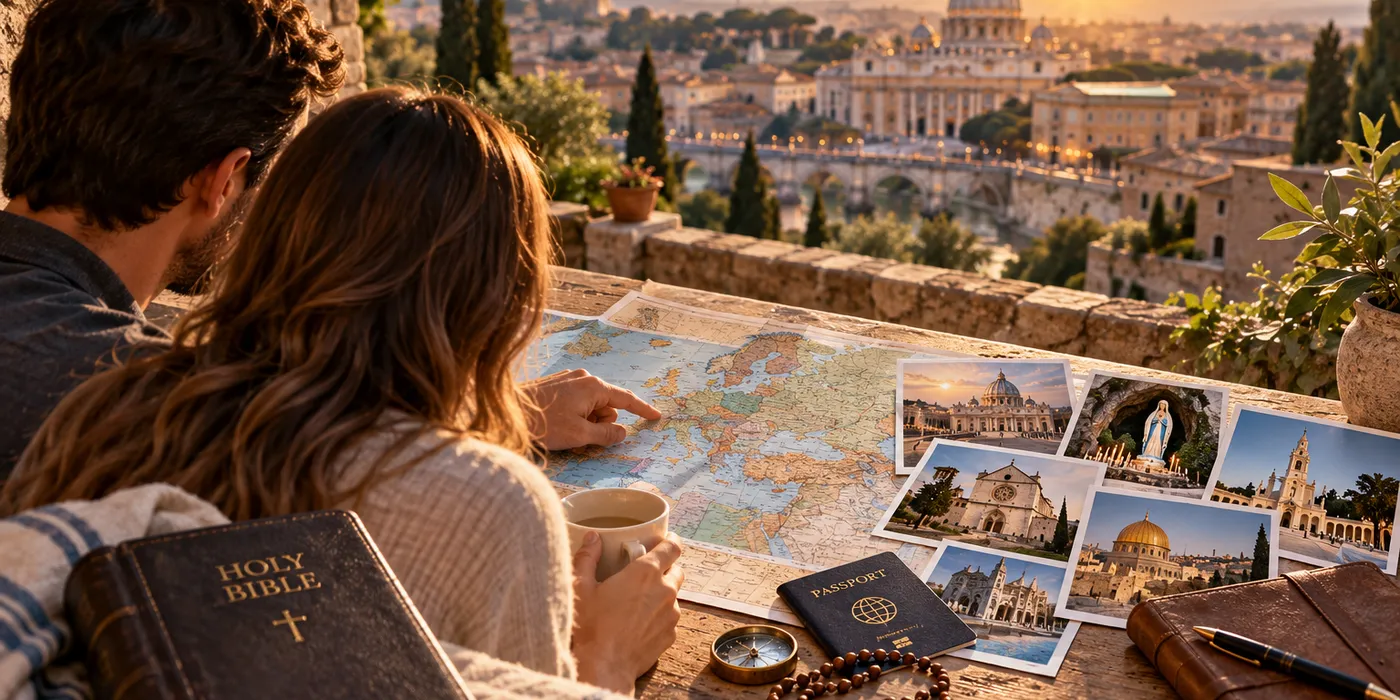
Some pilgrims travel across the world. Others visit a shrine only a few hours from home. The distance is not what makes the journey a pilgrimage. What matters is the purpose behind it.
A pilgrimage gives us an opportunity to step away from our normal routines and intentionally seek God. We carry prayers with us. We ask for guidance, healing, forgiveness, or simply a deeper faith. Sometimes we travel for ourselves. Sometimes we carry the intentions of people we love.
There are thousands of Catholic pilgrimage destinations around the world, but a handful have had an extraordinary influence on Catholic history and devotion.
Here are ten sacred places every Catholic should know about.
1. Jerusalem and the Church of the Holy Sepulchre
There may be no more important Christian pilgrimage destination than Jerusalem.
Within the Old City stands the Church of the Holy Sepulchre, traditionally believed to contain both Calvary, where Jesus was crucified, and the tomb where His body was placed before the Resurrection.
Pilgrims entering the church are not simply visiting an ancient building. They are entering a place associated with the central events of the Christian faith.
Inside, pilgrims can climb the steps to Calvary, kneel near the place traditionally identified with the Crucifixion, and enter the small structure known as the Edicule, which surrounds the traditional site of Christ's tomb.
Jerusalem also allows pilgrims to walk the Via Dolorosa, pray at the Mount of Olives, visit Gethsemane, and see many of the places described throughout the Gospels.
For Catholics who have spent their lives hearing the Passion proclaimed at Mass, standing in Jerusalem can make Scripture feel remarkably tangible.
2. Lourdes, France
In 1858, a fourteen-year-old girl named Bernadette Soubirous reported a series of apparitions of the Blessed Virgin Mary near a rocky grotto outside the small French town of Lourdes.
During the apparitions, Bernadette discovered a spring after being instructed to dig into the ground. The water that emerged from that spot soon became associated with reports of extraordinary healings.
Today, millions of pilgrims visit the Sanctuary of Our Lady of Lourdes each year.
The Grotto of Massabielle remains the heart of the pilgrimage. Pilgrims quietly pass beneath the rock, touch the stone, pray before the statue of Our Lady, light candles, attend Mass, and participate in the famous candlelight Rosary procession.
Lourdes is especially known as a place of prayer for the sick. Volunteers from around the world come to assist pilgrims who are elderly, ill, or living with disabilities.
The Church has officially recognized a small number of healings associated with Lourdes as miraculous after extensive medical and theological investigation. Thousands of other pilgrims simply come seeking peace, strength, or the grace to carry their suffering with greater faith.
Lourdes is one of those places where the Church's care for the sick is visible everywhere you look.
3. Our Lady of Guadalupe, Mexico City
The Basilica of Our Lady of Guadalupe is one of the most visited Catholic pilgrimage sites in the world.
According to Catholic tradition, the Virgin Mary appeared to St. Juan Diego in December 1531 on Tepeyac Hill, near present-day Mexico City.
Mary asked that a church be built at the site. When Church authorities requested a sign, Juan Diego gathered roses that had unexpectedly bloomed on the hillside. He carried them in his tilma, or cloak, to Bishop Juan de Zumárraga.
When Juan Diego opened the tilma, the image now known as Our Lady of Guadalupe appeared on the fabric.
The tilma is still displayed inside the modern basilica.
Visitors can stand beneath the image and look closely at one of the most recognizable images of Mary in the Catholic world. Outside the basilica, pilgrims can also visit Tepeyac Hill, the old basilica, chapels connected with the apparition story, and other important locations throughout the shrine complex.
Our Lady of Guadalupe eventually became deeply connected to the Catholic faith throughout Mexico and the Americas. Her feast is celebrated each year on December 12.
4. Fatima, Portugal
In 1917, three shepherd children named Lucia dos Santos and her cousins Francisco and Jacinta Marto reported seeing the Virgin Mary near the village of Fatima, Portugal.
The apparitions took place over several months and emphasized prayer, conversion, penance, and devotion to the Rosary.
The events culminated on October 13, 1917, when a large crowd gathered after the children said Mary had promised a sign. Many of those present reported witnessing an unusual solar phenomenon that became known as the Miracle of the Sun.
Today, the Sanctuary of Fatima surrounds the area where the apparitions occurred.
The Chapel of the Apparitions marks the heart of the sanctuary. Pilgrims gather there throughout the day to pray the Rosary and attend Mass. The tombs of St. Francisco, St. Jacinta, and Sister Lucia can also be visited within the sanctuary.
Fatima's message remains remarkably simple.
Pray.
Repent.
Offer sacrifices for others.
Return to God.
More than a century later, those words continue to bring pilgrims from nearly every part of the world to this small Portuguese town.
5. Assisi, Italy
Assisi feels different from many other Catholic pilgrimage destinations.
There is no single apparition or miracle that defines the city. Instead, the entire town is connected to the lives of saints.
Most famously, Assisi was the home of St. Francis of Assisi, whose radical embrace of poverty, simplicity, and love for Christ changed the Church.
The Basilica of St. Francis contains his tomb and remains one of the great pilgrimage destinations of Italy. Pilgrims descend beneath the basilica to pray before the simple stone tomb of the saint.
But Francis is only part of Assisi's story.
Pilgrims can visit the Basilica of St. Clare, where St. Clare is buried and the San Damiano Cross is preserved. San Damiano itself recalls the moment when Francis believed Christ spoke to him from the cross and told him to rebuild His Church.
More recently, Assisi has also become closely associated with St. Carlo Acutis, the young Catholic known for his devotion to the Eucharist and his work documenting Eucharistic miracles. His tomb has brought a new generation of young pilgrims to the city.
Few places allow visitors to encounter so many different examples of Catholic holiness within such a small area.
6. Rome and Vatican City
It is difficult to separate the history of the Catholic Church from Rome.
Catholics have traveled to the city for centuries to pray at the tombs of the Apostles, visit the churches of the early martyrs, and encounter the center of the universal Church.
St. Peter's Basilica stands above the traditional burial place of St. Peter the Apostle. Beneath and around the basilica are layers of Christian history dating back to the earliest centuries of the Church.
Across Rome, pilgrims can also visit the Basilica of St. Paul Outside the Walls, the Basilica of St. John Lateran, and the Basilica of St. Mary Major.
Then there are the smaller churches.
Rome is filled with relics, tombs of saints, ancient Christian sites, Eucharistic traditions, Marian images, and churches connected to nearly every period of Catholic history.
A pilgrim could spend a week in Rome and barely scratch the surface.
For many Catholics, walking through Rome provides a powerful reminder that the faith they practice today is connected to generations of Christians who lived, worshiped, suffered, and died there centuries ago.
7. The Chapel of Our Lady of the Miraculous Medal, Paris
Hidden behind a relatively simple entrance on Rue du Bac in Paris is one of the most significant Marian pilgrimage sites in France.
In 1830, St. Catherine Labouré, a young member of the Daughters of Charity, reported apparitions of the Blessed Virgin Mary inside the chapel.
During one apparition, Catherine saw Mary standing upon a globe with rays of light streaming from her hands. Around the image appeared the words:
"O Mary, conceived without sin, pray for us who have recourse to thee."
Catherine was instructed to have a medal made according to what she had seen.
The devotion spread quickly. So many favors were attributed to the medal that people began calling it the Miraculous Medal.
Today, pilgrims can visit the chapel where the apparitions occurred and pray only a short distance from the body of St. Catherine Labouré.
Despite being located in the middle of busy Paris, the chapel often feels surprisingly intimate.
For pilgrims visiting Notre-Dame Cathedral or other Catholic sites throughout Paris, Rue du Bac deserves a place near the top of the itinerary.
8. Santiago de Compostela, Spain
For more than a thousand years, pilgrims have walked across Europe toward the Cathedral of Santiago de Compostela in northwestern Spain.
Tradition holds that the cathedral contains the remains of St. James the Greater, one of the twelve Apostles.
The network of pilgrimage routes leading there became known collectively as the Camino de Santiago, or the Way of St. James.
Unlike many pilgrimage destinations, the journey itself is a major part of the spiritual experience.
Some pilgrims walk hundreds of miles. Others complete shorter sections. Along the way, travelers stay in pilgrim accommodations, attend Mass, visit ancient churches, share meals, endure sore feet, get lost, make friends, pray, and spend long stretches of time simply walking.
That simplicity is part of the Camino's appeal.
Life becomes a backpack, a path, a destination, and the next day's walk.
For many people, the Camino becomes less about reaching Santiago and more about what happens to them along the way.
9. Lanciano, Italy
The small Italian town of Lanciano is associated with one of the oldest reported Eucharistic miracles in Catholic tradition.
The event is traditionally dated to around the eighth century.
According to the account, a monk who was struggling with doubts about the Real Presence of Christ in the Eucharist was celebrating Mass when the consecrated Host visibly appeared as flesh and the wine as blood.
The relics have been preserved in Lanciano for centuries and can still be viewed today in the Church of San Francesco.
For Catholics, the importance of Lanciano goes beyond fascination with the miraculous.
It points directly toward one of the central beliefs of the Catholic faith: that Jesus Christ is truly present in the Eucharist.
Lanciano is not a massive pilgrimage city like Rome or Lourdes. That is part of what makes it interesting. A quiet church in a relatively small Italian town preserves a Eucharistic tradition that has drawn pilgrims for generations.
10. Bethlehem and the Church of the Nativity
Bethlehem brings pilgrims to the beginning of the Gospel story.
The Church of the Nativity stands over the traditional site where Jesus was born.
Pilgrims enter the ancient basilica and descend into the Grotto of the Nativity. A silver star marks the traditional location of Christ's birth.
For Christians accustomed to Nativity scenes, Christmas cards, and familiar Gospel readings, standing inside the grotto can be deeply moving.
The surroundings are simple and ancient.
This is not the peaceful stable scene often portrayed in Christmas decorations. Bethlehem is a real place, shaped by centuries of history, conflict, worship, and pilgrimage.
Nearby, pilgrims can also visit Shepherds' Field, traditionally associated with the shepherds who received the announcement of Christ's birth.
Visiting Bethlehem places the Christmas story back into its physical setting. The people, towns, hills, roads, and distances mentioned in Scripture suddenly become real.
Why Catholics Go on Pilgrimage
Catholics do not travel to sacred places because God can only be found there.
God can be encountered in a parish church, at home, in prayer, in Scripture, and most especially in the sacraments.
Pilgrimage offers something different.
It asks us to move.
Sometimes that movement is physical. We board a plane, climb a hill, walk an old road, or stand in a line outside a shrine.
But the hope is that something also moves within us.
Pilgrimage creates space for prayer and reflection. It connects our faith with real places and real people. It reminds us that Christianity did not begin as an abstract idea. Jesus walked actual roads. The Apostles traveled to real cities. Saints lived in homes, entered churches, crossed mountains, cared for the sick, suffered, prayed, and died.
Those places still exist.
And sometimes visiting them helps us see our own faith differently.
You Do Not Have to Cross an Ocean to Become a Pilgrim
Jerusalem, Rome, Lourdes, Fatima, and Assisi may be among the great pilgrimage destinations of the Catholic world, but pilgrimage does not require an international flight.
There are sacred places much closer to home.
Throughout the United States are shrines, monasteries, missions, cathedrals, apparition sites, historic churches, tombs of saints and blesseds, and places connected to the growth of the Catholic faith in America.
A pilgrimage can last two weeks.
It can also last one afternoon.
The important part is going with intention.
Bring a prayer with you.
Carry the name of someone who needs one.
Turn off the noise for a while.
Attend Mass if possible.
Go to confession.
Sit quietly.
Walk.
Look around.
And allow the place to remind you that countless people before you have made the same journey searching for Christ.
Start Exploring
Sites of Grace was created to help Catholics discover sacred places, understand the stories behind them, and prepare to experience them for themselves.
Explore Marian apparition sites, Eucharistic miracles, saints and their tombs, historic churches, shrines, basilicas, missions, and pilgrimage routes throughout the world.
You may discover that the next place God is inviting you to visit is closer than you think.