
Mission San Diego de Alcalá
Father Junípero Serra founded Mission San Diego de Alcalá on July 16, 1769, the first in the chain of missions which extended from San Diego to Sonoma, a distance of about six hundred miles. It is the anchor of El Camino Real, the southernmost point of the entire California mission system, and the place where Catholic civilization in what is now the United States took its first deep root on the Pacific coast. The first of the projected mission sites was to be on beautiful San Diego Bay. Over one hundred and fifty years previously, Vizcaíno had explored the bay and named it for the saint on whose feast day he landed, St. Didacus, or San Diego de Alcalá. The mission is named for St. Didacus of Alcalá, a fifteenth-century Spanish Franciscan lay brother renowned for his humility, his care for the sick, and his profound mystical life. He is a fitting patron for a mission that would labor to serve the bodily and spiritual needs of the native Kumeyaay people of Southern California.
St. Junipero Serra → Plan a trip here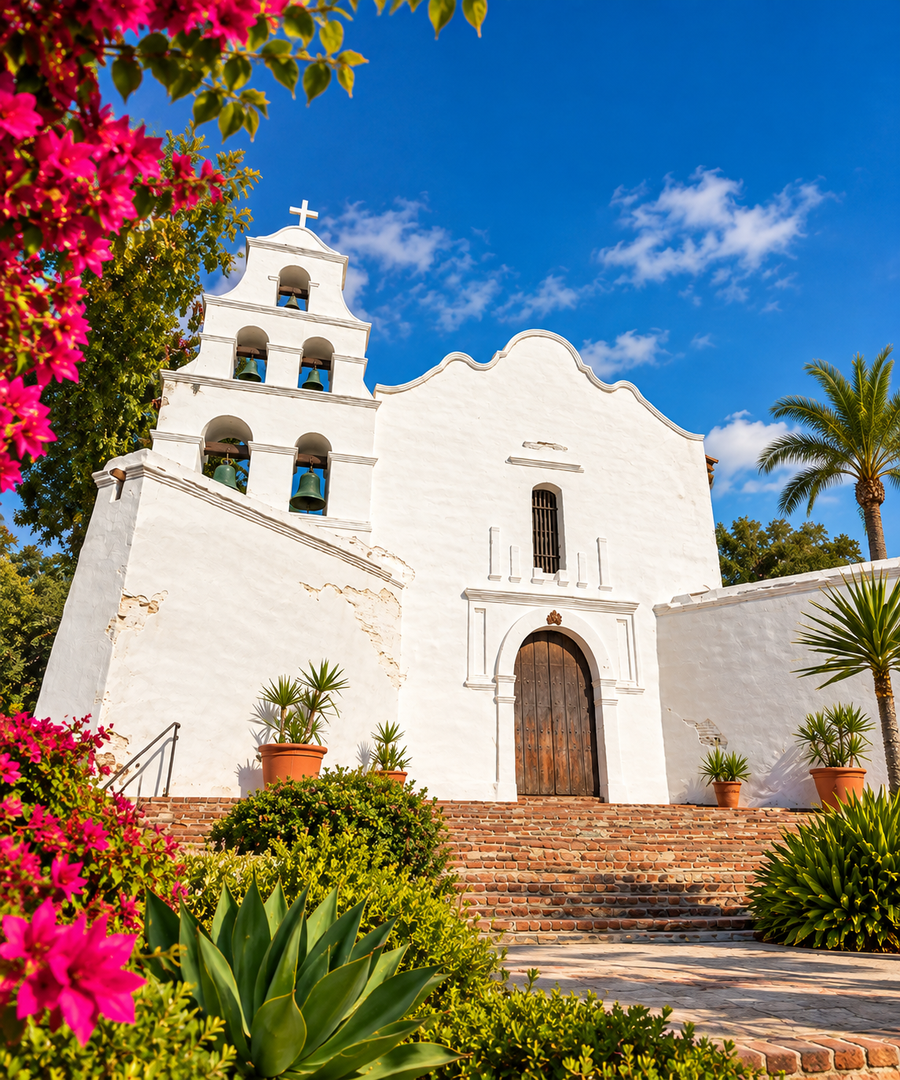
The Story
The Arrival
On March 28, 1769, Serra left the mission at Loreto on mule-back, arriving at San Diego on July 1. En route, he founded his first mission at San Fernando de Velicatá on May 14. Serra kept a diary of his journey during which he suffered greatly from an infirmity in his legs and feet and had to be carried on a stretcher.
That this crippled friar refused to turn back is itself a testimony to the fire of the Gospel burning within him. His motto, which drove him forward in spite of every suffering, was captured simply in the words: "Always forward, never back."
The Founding: July 16, 1769
He arrived at San Diego on July 1, and on July 16 founded the first of the twenty-one California missions, which accomplished the conversions of all the natives on the coast as far as Sonoma in the north. On the feast of Our Lady of Mount Carmel, Serra planted a cross and celebrated the first Mass on California soil. The site's Indian name was Cosoy. The mission was originally situated at what is now Old Town San Diego and was relocated in 1774 to the north bank of the San Diego River, six miles above the present city. The relocation was strategic, moving the mission away from the military presidio to allow the missionaries to build a community centered on the Gospel rather than on military control, and opening access to better farmland and freshwater.
The Revolt and the Protomartyr
The mission's early years were marked by both suffering and heroism. Father Luis Jayme, a trusted companion of Serra and fellow Mallorcan, became the "protomartyr" of the California missions. He went out to meet his attackers crying "Love God, my children!" and was killed on November 4, 1775. He became the first martyr of the California missions, his death a seed planted in the soil of San Diego that bore fruit in the conversions of subsequent generations. Serra, rather than retreating, immediately petitioned for the mission to be rebuilt and begged that the attackers be shown mercy rather than punishment, a powerful witness to the law of charity over the law of retaliation.
Growth and Legacy
Despite violent opposition, the mission grew. By the end of 1784, Indian baptisms at the first nine missions reached the number of 6,736, while 4,646 Christianized Indians were living in them. San Diego was the seedbed of all that followed.
Church Recognition
St. Junípero Serra: Canonized Founder
On September 25, 1988, Serra was beatified by Pope John Paul II. Pope Francis canonized Junípero Serra on September 23, 2015, during a Mass in Washington, D.C. He is known as the Apostle of California.
During the remaining years of his life he visited the missions from San Diego to San Francisco, six hundred miles, in order to confirm all who had been baptized. He suffered intensely from his crippled leg and from his chest, yet he would use no remedies.
The Defense of the True Historical Record
Modern critics attack Spanish missionary efforts in California, arguing their activities resulted in the genocide and cultural extermination of indigenous peoples. This view is rooted in an anti-Catholic myth that Catholic missionaries mistreated, enslaved, and forcibly converted native peoples in the New World. The historical record does not support this narrative.
St. Serra was concerned with both the material well-being and eternal souls of indigenous peoples. The prime motivator for thousands of missionaries throughout Catholic history, including St. Serra, was love. Charity compels the Catholic missionary to spread the Gospel throughout the world even at great personal sacrifice and cost.
Catholic Teaching
Mission San Diego de Alcalá is not merely a historical site. It is a living embodiment of the Church's missionary mandate.
On the Great Commission: Christ commands in Matthew 28:19-20: "Go, therefore, and make disciples of all nations, baptizing them in the name of the Father, and of the Son, and of the Holy Spirit, teaching them to observe all that I have commanded you." San Diego de Alcalá was where that command first took root in California's soil.
On Martyrdom: Father Luis Jayme's death at San Diego is the first witness, in blood, to the truth of the Gospel on California's shores. The Catechism teaches that "the Church has always venerated the martyrs and proposed them as objects of imitation and intercession" (CCC 957). The martyrs do not die in vain. Their blood, as Tertullian wrote, is the seed of the Church.
On the Dignity of Every Person: The entire mission project was grounded in the theological conviction that every soul, regardless of culture or language, is created in the image and likeness of God (Genesis 1:27) and is therefore destined for eternal life in Christ. St. Serra was concerned with both the material well-being and eternal souls of indigenous peoples. This is Catholic anthropology in action.
On the Universality of the Church: The Catechism teaches that the Church is "catholic," that is, universal, precisely because she has received from Christ the fullness of the means of salvation, which she is commissioned to offer to the whole human race (CCC 830-831). The California missions were the Church being the Church: crossing every border, learning every language, planting the cross in every soil.
Plan Your Visit
The Pilgrim’s Quick Card
- Ideal stay
- 1/2 Day Allow 2–4 hours to tour the mission, museum and gardens
- Best months
- March–May Spring and fall are especially comfortable weather
- Nearest airport
- San Diego International Airport (SAN) Approximately 9 miles by road from the Mission
- Language & currency
- English Spanish is also widely spoken
- Feast day
- "Mother of the Missions" — The First of the Twenty-One
- Accessibility
- Fair manageable for visitors with limited mobility
Practical
Additional Information
Visitor Center & Self-Guided Tours
The Visitor Center and Gift Shop is open daily from 9:00 AM–4:00 PM. Self-guided tours of the Mission grounds begin there. Current admission is $8 for adults, with discounted admission for seniors, active military, students, and children. There is no admission fee for those attending Mass.
Go Deeper
St. Didacus of Alcalá: Learn the life of the patron saint for whom this mission was named. A humble Franciscan lay brother, Diego of Alcalá was known for miracles of charity and healing. His life mirrors the missionary spirit of the California Franciscans — poverty, service, joy.
Father Luis Jayme: The protomartyr of the California missions deserves far more attention than he receives. His feast day is November 18. His witness challenges every Catholic to ask whether the faith is worth dying for, and what the answer to that question reveals about how deeply the faith is actually held.
The Representación of St. Junípero Serra: Of Serra's writings, many letters and other documents are extant. The principal ones include his "Diario" of the journey from Loreto to San Diego, and the "Representación." In the Representación, Serra formally appealed to the Viceroy of New Spain on behalf of the rights and dignity of the native peoples under his care. It is one of the most important documents in the history of Catholic missionary advocacy
Location
Visit the official website ↗ See it on the interactive map →Pilgrim Photos
No pilgrim photos yet — be the first to share one from Mission San Diego de Alcalá.
In the Area
Other sacred sites within 40 miles.