
St. Junipero Serra
Apostle of California, Founding Father of the American West
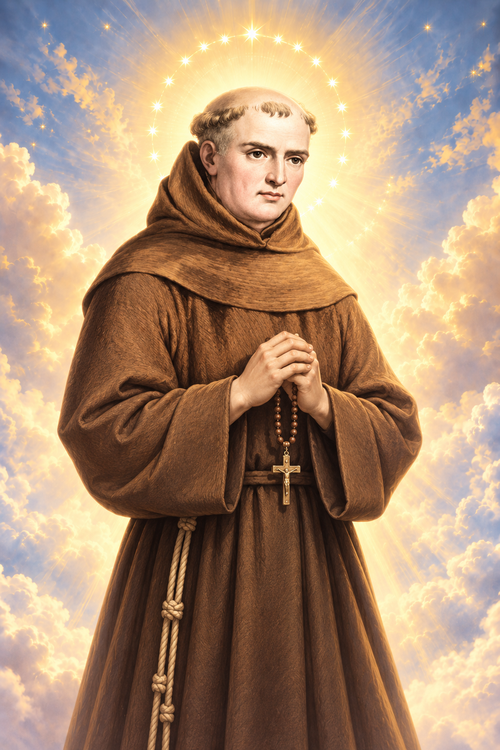
- Born
- 1713, Majorca, Spain
- Died
- 1784, California
- Canonized
- 2015 by Pope Francis (2015-09-23)
- Burial place
- Mission San Carlos Borroméo, Carmel, California
- Patronage
- Patron Saint of California, Patron of the Serra Foundation, Patron of Vocations, Patron of Hispanic Americans, Intercessor for Missionaries
Birth and Early Life
Born at Petra, Majorca, Spain, on November 24, 1713, a son of Antonio Nadal Serra and Margarita Rosa Ferrer who spent their lives as farmers, Junípero Serra was baptized on the same day at St. Peter's Church and was given the name Miguel José.
In Petra, Serra attended the primary school of the Franciscans. At fifteen years old, he was taken by his parents to Palma to be placed in the charge of a cathedral canon, and he began to assist at classes in philosophy held in the Franciscan monastery of San Francisco.
From his earliest years, it was evident that God had placed extraordinary intellectual and spiritual gifts in this farmer's son from a small island town. He was destined for greatness, though no one at the time could have imagined what form that greatness would take.
Entry into the Franciscan Order
Serra was admitted as a novice at the Convento de Jesús outside the walls of Palma on September 14, 1730, and made his profession on September 15, the following year. He chose the name Junípero in memory of the brother companion of St. Francis. It was a name that told a story before his life had fully begun: Juniper was the friar of St. Francis known for his radical humility, his simplicity, and his holy foolishness for God. Serra chose that model deliberately.
Serra obtained his doctorate in theology in 1742 from the Lullian University, Palma. He became a professor of philosophy and theology, recognized throughout Majorca as a man of first-rate intellectual gifts and deep spiritual life. He was, by any measure, at the summit of what a Franciscan academic career could offer.
And then God called him elsewhere.
The Decision to Go to the New World
Although a gifted teacher, St. Serra felt called to more challenging work and, at the age of thirty-five, volunteered for the New World missions. This was not an impulsive act. It was the culmination of years of prayer, of reading the lives of the missionary martyrs, of a burning desire to pour his life out for souls who had never heard the name of Jesus Christ. He gave up his academic career, his homeland, his family, and every comfort of European life, and he never went back.
On April 13, 1749, with Francisco Palóu, Serra sailed for America. He landed in Vera Cruz, Mexico on December 7, 1749. Although horses were supplied for the friars, Serra elected to walk the 250 miles between Vera Cruz and Mexico City.
The Wound That Never Healed
He reached Veracruz in 1749 and, on the way to Mexico City, was stung by a scorpion. Despite the wound, the holy friar continued his journey on foot. The wound never properly healed and left him with a limp for the rest of his life. This detail is not incidental. It is the emblem of the man. Serra walked in pain for the rest of his ministry, and he refused every remedy and every excuse to stop. His crippled leg became his sermon: that the love of Christ compels us forward regardless of the cost.
The Sierra Gorda Missions
During his apostolate in Sierra Gorda with the Pame Indians between 1750 and 1758, Serra not only oversaw construction of a church, which is still in use, but developed his mission in both religious and economic directions. Under his presidency of the missions from 1751 to 1754, the missionaries of the other four towns also built mission churches. Serra learned the Otomí language and used a visual method of teaching religion. Zealous in preaching and in promoting both liturgical and popular devotions, he succeeded in bringing the Pame people to practice the faith in an exemplary way. Economically his mission prospered through the introduction of domestic animals, the fostering of agriculture, and the development of commerce.
He also defended Indian rights against non-native settlers in a protracted contest over the valley of Tancama. This pattern of advocacy for native peoples against colonial abusers would define his entire ministry in the New World.
The Call to California
In 1767, Serra was appointed president of the former Jesuit missions of Baja California. Then came the call that would define his place in history: the Spanish Crown, concerned about Russian expansion down the Pacific coast, ordered expeditions into Upper California. What the Crown intended as a geopolitical maneuver, God was already shaping into something eternal.
Serra enthusiastically volunteered in 1768 to join expeditions to Upper California. What the Spanish Crown intended as a geopolitical maneuver to counter Russian expansion southward from Alaska, God was already shaping into something eternal: a chain of chapels, baptisms, and transformed lives stretching six hundred miles up a wild coastline.
In 1767 he was appointed superior of a band of fifteen Franciscans for the Indian missions of Lower California. Early in 1769 he accompanied Portola's land expedition to Upper California.
The Journey North: Always Forward, Never Back
On March 28, 1769, Serra left the mission at Loreto on mule-back, arriving at San Diego on July 1. En route, he founded his first mission at San Fernando de Velicatá on May 14. Serra kept a diary of his journey during which he suffered greatly from an infirmity in his legs and feet and had to be carried on a stretcher. That this crippled friar refused to turn back is itself a testimony to the fire of the Gospel burning within him. For the rest of his life he worked tirelessly as a preacher and a missionary in Mexico and California, his motto being "Always forward, never back."
The Founding of the Nine California Missions
He arrived at San Diego on July 1, and on July 16 founded the first of the twenty-one California missions, which accomplished the conversions of all the natives on the coast as far as Sonoma in the north.
Serra devoted the next fifteen years of his life to evangelical work in Upper California. During that period he founded nine missions: San Diego, July 16, 1769; San Carlos, Monterey-Carmel, June 3, 1770; San Antonio, July 14, 1771; San Gabriel, September 8, 1771; San Luis Obispo, September 1, 1772; San Francisco, October 9, 1776; San Juan Capistrano, November 1, 1776; Santa Clara. And finally, San Buenaventura on March 31, 1782.
Many of the missions would form the cores of what are today the state's biggest cities, such as San Diego, San Francisco, and Los Angeles.
His Advocacy for the Native Peoples: The Representación
Throughout his ministry in California, Serra was in constant tension with military authorities over the treatment of the indigenous peoples. Difficulties with Pedro Fages, the military commander, compelled Father Serra in 1773 to lay the case before Viceroy Bucareli. At the capital of Mexico, by order of the viceroy, he drew up his "Representación" in thirty-two articles. Everything save two minor points was decided in his favor; he then returned to California, late in 1774.
Serra himself penned his Representación, which Pope Saint John Paul II called a "bill of rights" for California's natives.
In fact, Serra was the Indians' chief defender against unscrupulous and cruel soldiers and politicians. He came to give, not take. He exhausted his body to bring the people of California the thing they needed most: baptism.
The Faculty to Confirm and the Final Journey
In 1778 he received the faculty to administer the Sacrament of Confirmation. This was a gift he used with extraordinary zeal.
During the remaining three years of his life he once more visited the missions from San Diego to San Francisco, six hundred miles, in order to confirm all who had been baptized. He suffered intensely from his crippled leg and from his chest, yet he would use no remedies. He confirmed 5,309 persons, who with but few exceptions were Indians converted during the fourteen years from 1770.
He baptized several thousand individuals and, when granted the faculty to confirm in 1778, he administered the sacrament of confirmation to over five thousand Native Americans.
His Support for American Independence
In one of the least-known chapters of his life, Serra demonstrated not only Catholic charity but genuine political solidarity with the cause of liberty. When Spain entered the war against Britain, he rallied the citizens of California's missions to pray for American victory. The Spanish Crown levied a war tax, but this Serra paid from the Mass stipends. The natives were never assessed. From the opposite shore, from impoverished adobe churches and struggling settlements, came aid for a fight for liberty, the fruits of which Serra would not live to see.
A Holy Death
He had received Viaticum in the church, returned to his cell and recited his office, then asked Father Palóu to recite the prayers for the dying. After he received the plenary indulgence, he asked to be left alone. In the early afternoon he was found on his bed, his mission cross clasped in his hands, and as Father Palóu says, "with no signs of any death agony on his peaceful countenance."
Serra died at Mission San Carlos, August 28, 1784, at the age of 70 and is buried in the floor of the sanctuary of the church he had built. By the end of 1784, Indian baptisms at the first nine missions reached the number 6,736, while 4,646 Christianized Indians were living in them.
His Physical Appearance and Character
Serra was small of stature, five feet two inches in height. He had a sonorous voice, swarthy skin, dark hair and eyes. Though it appears that he had a fundamentally robust constitution, he suffered a great deal during the latter part of his life.
Besides extraordinary fortitude, his most conspicuous virtues were insatiable zeal, love of mortification, self-denial, and absolute confidence in God. His executive ability has been especially noticed by non-Catholic writers.
His Legacy in Stone and Statute
A century after his death, the California legislature declared August 29 a legal state holiday, and in 1931 California gave his statue to the National Statuary Hall Collection in the U.S. Capitol Building in Washington, D.C.
As one of the pioneers who created the United States of America, his larger-than-life-size statue stands in the hall of the U.S. Capitol.