
Mission San Gabriel Arcángel
Mission San Gabriel Arcángel was founded by St. Junípero Serra on September 8, 1771, the fourth of the nine missions he personally established along El Camino Real. Its Indian name was Sibagna, or Tobiscagna, and it was situated on the San Gabriel River, about ten miles east of what is today Los Angeles, in Los Angeles County. San Gabriel would go on to be one of the most successful and productive of all the 21 California missions. It became the agricultural and economic powerhouse of the entire mission system, the gateway through which the great city of Los Angeles would be born, and the spiritual mother of the vast Gabrieleño Tongva people of Southern California. "Mission San Gabriel will always be the true spiritual heart of Los Angeles," as Archbishop Jose Gomez of Los Angeles declared. "The mission marks the birthplace of the Christian faith here and, 10 years after the mission was established, the city itself was founded by men and women who came from the mission." The mission is named for St. Gabriel the Archangel, whose very name means "Fortitudo Dei" — the Strength of God. The final mention of Gabriel in Scripture is found in Luke 1, where he goes to the Blessed Virgin Mary with the tidings that she is to be the Mother of the Messiah, and thus we see that Gabriel comes as the bearer of good tidings and as the comforter and helper of men. The mission bearing his name was sent on a similar errand: to bring the Good News to a people who had not yet heard it.
St. Junipero Serra → Plan a trip here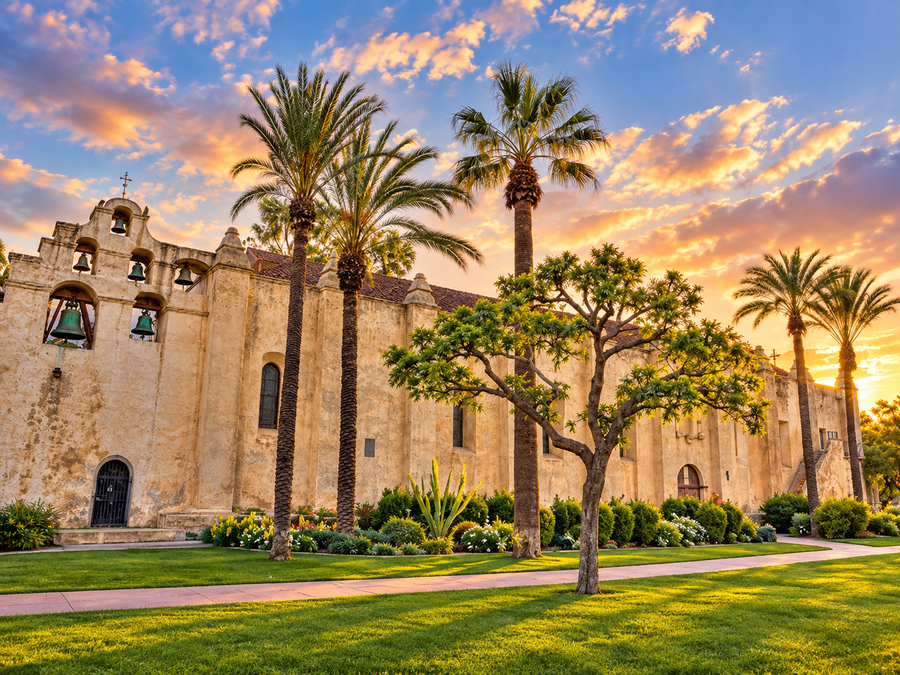
The Story
The Founding: September 8, 1771
The date of the founding is the Feast of the Nativity of the Blessed Virgin Mary — the birth of the one to whom Gabriel himself had been sent with heaven's most decisive message. That God would choose this day as the birthday of San Gabriel is itself a quiet act of divine poetry. The Gospel came to the Tongva people on the day the Church remembers the birth of the woman who said yes to God for all of us.
Archbishop Gomez emphasized the "gift of faith" that Serra and other Franciscans brought, which many indigenous Americans accepted and made their own. The Tongva people did not receive the Gospel as passive objects of colonial conquest. They received it, embraced it, built it, and in many cases died for it.
The People: The Gabrieleño Tongva
The Tongva language was spoken in slightly different dialects at San Fernando (Fernandeno) and San Gabriel, and the names Kij, Kizh, and Tobikhar have all been used to designate the same group. The Franciscans, faithful to their calling, studied these languages and served the Tongva in their own tongue. The mission's very name today reflects the Tongva legacy: they are called the Gabrieleño, the people of San Gabriel, a name they bear still.
Archbishop Gomez described the mission as "built by and for the Tongva natives, the first peoples of this land."
Growth and Agricultural Prosperity
San Gabriel became the most agriculturally productive mission in all of California. Its vast vineyards, olive groves, orchards, and cattle herds fed not only the local neophyte community but missions and presidios throughout the region. The Franciscan missionaries did not only baptize — they taught. They brought the Tongva people into the fullness of what Catholic civilization had to offer: skilled trades, literacy, music, architecture, and the rhythms of a life ordered around the liturgical year.
The founder St. Junípero Serra's famous motto, "Always Forward!" became the animating spirit of everything the mission built.
The Record of Souls
Among the new features of the restored mission museum is a white wall inscribed with the names of the 7,054 Native Americans baptized at the mission from 1771 to 1848, which Archbishop Gomez called "a striking visual testimony to the truth that every soul is precious in the eyes of our loving God." These are not statistics. These are souls. Each name on that wall is a person reborn in baptismal water, welcomed into the family of God, and destined for eternity.
Secularization and Decline
The founding Spanish Franciscan missionaries were meticulous record-keepers, tracking everything from baptisms and weddings to crop yields, but after they were expelled in the 1830s, the newly privatized mission largely fell into decay under Mexican rule. What generations of Franciscans built with prayer, labor, and sacrifice was stripped away in a matter of years. The Tongva neophyte community was scattered, the agricultural system dismantled, and the great spiritual enterprise of San Gabriel left to erode.
The Arson Fire of 2020 and the Restoration
The mission, founded by St. Junipero Serra in 1771, suffered a devastating fire during the early morning hours of July 11, 2020, which destroyed the roof and interior of the mission church, which is today the home of a Catholic parish.
The alleged arsonist, John David Corey, was charged with the crime in May 2021. He was known at the mission and had a history of conflicts with mission staff. Corey had already been arrested and sentenced to prison for an unrelated incident when investigators named him as a person of interest.
Yet even in destruction, God drew good. For Father Parker Sandoval, the San Gabriel fire and the devastating consequences of the pandemic on parishes were signs that the church in Los Angeles was being called to a "new beginning," and the timing of the mission's 250th jubilee was nothing short of "providential."
Mission San Gabriel has reopened to the public, and at a June 27 ceremony attended by area Catholics and others, Archbishop Jose Gomez of Los Angeles blessed the renovated mission more than 250 years after its founding.
Church Recognition
Mission San Gabriel Arcángel was founded on September 8, 1771 by Frs. Pedro Benito Cambón and Ángel Fernández de la Somera, under St. Junípero Serra as father president. It is the fourth of the twenty-one missions of Alta California, and today it is active parish church and museum.
The mission was built by Native Californians, and the Church has publicly acknowledged the coercion and harm that mission life involved. That history is told in full on the California Mission Trail page, and it belongs to this place as much as its founding date does.
Catholic Teaching
Serra was beatified by Pope John Paul II on September 25, 1988, and canonized by Pope Francis on September 23, 2015, during a Mass in Washington, D.C. He is known as the Apostle of California. The mission was the fourth founded by St. Junípero Serra, a Franciscan priest who founded a series of missions across California. Serra helped to convert thousands of native Californians to Christianity and taught them new agricultural technologies.
The Mission as Birthplace of Los Angeles
The mission is "a sign of the Christian beginnings, not only of our city, but of our nation," as Archbishop Gomez declared. The archbishop noted that St. Junípero Serra's feast day falls on July 1, just before the United States celebrates Independence Day, seeing this as a providential reminder from God "that the missionaries were here first" and "that the people of this country were called Christians long before they were called Americans."
Plan Your Visit
The Pilgrim’s Quick Card
- Ideal stay
- 1/2 Day Allow about 2–4 hours to visit the Historic Mission
- Best months
- March–May Spring and fall generally offer the most comfortable weather
- Nearest airport
- Hollywood Burbank Airport (BUR) BUR is the closest major airport, roughly 19 miles away
- Language & currency
- English Masses are celebrated in English, Spanish and Vietnamese
- Accessibility
- Fair some older surfaces may be less convenient
Practical
Additional Information
Historic Mission & Museum
Mission San Gabriel was founded on September 8, 1771, making it the fourth of California's historic missions. The Mission describes its church as the oldest church in Los Angeles County and maintains historic grounds, gardens and a museum.
The Mission suffered major damage in a deliberately set fire in July 2020, but the historic church was restored and reopened to visitors.
The Mission's published visitor information lists self-guided tours Tuesday through Sunday, 8:00 AM–4:00 PM, with last admission at 3:00 PM. Because visitor hours can change, I would confirm them shortly before arriving.
Old Mission Church
Do not experience San Gabriel only as a museum.
The restored Old Mission Church remains an active Catholic worship space. Sunday Mass is currently celebrated there at 7:00 AM and 10:00 AM.
This makes San Gabriel particularly good for pilgrims who want to combine California Mission history with Mass in the historic church itself.
Mass
The parish currently celebrates Mass throughout the week in multiple languages.
Regular Masses include:
- English
- Spanish
- Vietnamese
Weekday English Mass is currently celebrated at 12:00 PM Monday through Friday, with Spanish Mass at 6:00 PM and Vietnamese Mass Tuesday through Friday at 8:30 AM.
Pilgrim Tip: If possible, plan your visit around Mass rather than simply fitting Mass around the sightseeing.
Confession
Confession is currently offered:
Saturday, 4:00–5:00 PM
Chapel of the Annunciation
Additional arrangements can be made through the parish office.
Eucharistic Adoration & Holy Hour
The Mission offers a bilingual English/Spanish Holy Hour and Eucharistic Adoration following the 6:00 PM Mass on First Fridays.
The Vietnamese community also celebrates a First Friday Mass in the Old Mission at 7:00 PM followed by Holy Hour.
For a pilgrimage-focused visit, First Friday can therefore be an especially meaningful time to come.
Historic Cemetery
The Mission cemetery is another worthwhile part of the grounds and is currently open:
Daily: 8:00 AM–4:00 PM.
Allow a few quiet minutes here rather than treating it simply as another historic feature.
Connection to Los Angeles
Mission San Gabriel has an especially important relationship with the development of Los Angeles.
In 1781, settlers associated with the San Gabriel area traveled west and established the pueblo that became Los Angeles. The Mission therefore describes itself as the Mother Church of Los Angeles County.
That history makes San Gabriel an important stop for anyone following the broader story of Catholicism in Southern California.
2026–2027 Pilgrimage Significance
Mission San Gabriel has been designated by the Archdiocese of Los Angeles as a pilgrimage site during the Jubilee Year of St. Francis of Assisi, running from January 10, 2026 through January 10, 2027.
That gives Catholic pilgrims an additional reason to visit during this period.
Parking
Parking is available around the parish and Mission campus. Because the property also hosts an active parish, school and community events, parking conditions can change during large Masses, festivals and special celebrations.
Go Deeper
The mission Los Angeles grew out of, with a church modeled on the cathedral of Córdoba, Spain.
This mission is one of the twenty-one on the California Mission Trail, the fourth to be founded. The trail page carries the history of the chain as a whole, including the Church's own reckoning with it.
Location
Visit the official website ↗ See it on the interactive map →Pilgrim Photos
No pilgrim photos yet — be the first to share one from Mission San Gabriel Arcángel.
In the Area
Other sacred sites within 40 miles.