
Mission Basilica San Juan Capistrano
In 1776 in Southern California, Father Junípero Serra founded the Mission of San Juan Capistrano, named for St. John, for mission work to the Indians. In 1776, when the American Revolution was beginning in the east, another part of the future United States was being born in California. San Juan was the seventh of nine missions established under the direction of this indomitable Spaniard. The mission was founded by Serra in November 1776, its Indian name being Sajirit or Quanis-savit, at present San Juan in Orange County. It became one of the most beloved and visited mission sites in all of California, renowned for its gardens, its ancient chapel, the ruins of its great stone church, and the legendary return of its swallows each year on the feast of St. Joseph. The mission is a historical site, and has both a Catholic Basilica and the original smaller chapel that are still used for Catholic liturgy. The mission is named for St. John of Capistrano, a fifteenth-century Franciscan friar, preacher, lawyer, soldier, and saint whose life was itself a drama of conversion and radical apostolic courage. The mission bearing his name would carry that same spirit of total surrender to Christ into the service of the Acagchemem people of coastal Southern California.
St. Junipero Serra → Plan a trip here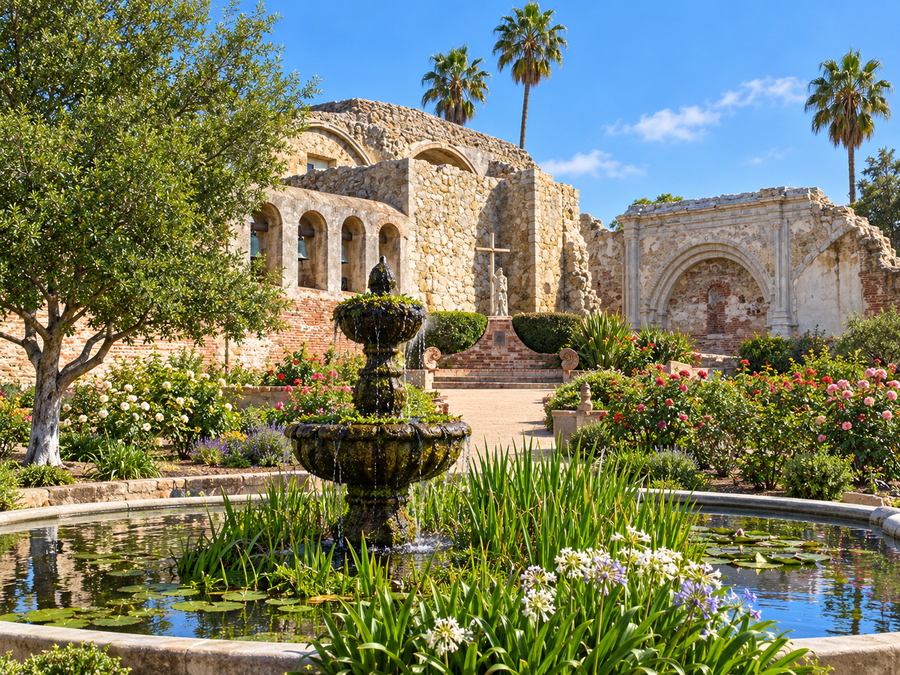
The Story
Enter politics: the threat of a Russian invasion south from Alaska. Charles III of Spain ordered an expedition to beat Russia to the territory. The last two conquistadores, one military and one spiritual, began their quest. Jose de Galvez persuaded Junípero to set out with him for present-day Monterey, California. What the Spanish Crown planned as a political and military maneuver, God was already shaping into something eternal: a chain of chapels, baptisms, and transformed lives stretching six hundred miles up a wild coastline.
The Founding: November 1, 1776
Upon his return to California, Father Serra founded Mission San Juan Capistrano and Mission San Francisco de Asís in 1776, and Santa Clara de Asís in 1777. The date of founding, November 1, is the Feast of All Saints, a fitting beginning for a mission whose story would be marked by sacrifice, beauty, and the quiet heroism of ordinary faithful men and women laboring for extraordinary ends.
The People: The Acagchemem and Their Languages
The five missions of San Fernando, San Gabriel, San Juan Capistrano, San Luis Rey, and its branch mission of San Antonio de Pala were all in Shoshonean territory, and the great majority of the Mission Indians of today are of this stock. The language was spoken in slightly different dialects at the missions of San Luis Rey (Luiseño, Kechi) and San Juan Capistrano (Juaneño, Gaitchim, Netela, Acagchemem). The Franciscans studied these languages and served these communities in their own tongue, a labor of humility and love that demanded years of patient, dedicated effort.
The Great Stone Church and the Earthquake of 1812
Among the most moving chapters in the life of San Juan Capistrano is the story of its great stone church. Construction of a magnificent domed cruciform stone church began in 1797 and was completed in 1806, making it the grandest structure in all of California at the time. On December 8, 1812, the Feast of the Immaculate Conception, a powerful earthquake struck while the congregation was gathered for Mass. The church collapsed. Forty neophytes who were attending Mass that morning perished in the ruins. The ruins of the Great Stone Church remain standing to this day, a sacred and sobering reminder that the Church is not built of stone alone, but of the living stones of the faithful who have gone before us.
Serra Memorial Chapel, the original smaller adobe church, is the only building still standing in California where St. Junípero Serra himself is known to have celebrated Mass. It is also regarded as the oldest continuously used building in the state of California.
The Return of the Swallows
There is also a tradition of the swallows returning to the Mission of San Juan Capistrano every March 19, the feast of St. Joseph. The cliff swallows, small migratory birds who make their mud nests in the ancient stone ruins of the Great Stone Church, have returned to Capistrano each spring for generations beyond counting. They depart each year around the feast of San Juan, October 23, and return on St. Joseph's Day. This annual return became famous across the world as a symbol of faithfulness, of created things pointing beyond themselves to the God who ordered them. Providence written in feathers and mud.
Growth, Legacy, and Secularization
Serra's vision bore extraordinary fruit at Capistrano. He baptized several thousand individuals and, when granted the faculty to confirm in 1778, he administered the Sacrament of Confirmation to over five thousand Native Americans. San Juan Capistrano was among the missions that fed into that great harvest.
Junípero made the long trip to Mexico City to settle great differences with the military commander. He arrived at the point of death. The outcome was substantially what Junípero sought: the famous "Regulation" protecting the Indians and the missions. It was the basis for the first significant legislation in California, a "Bill of Rights" for Native Americans.
Like all the California missions, San Juan Capistrano suffered under the secularization decrees of the Mexican government in 1834, which scattered the neophyte community and dismantled the civilization the Franciscans had built. The mission fell into partial ruin before eventually being restored and returned to the care of the Church.
Church Recognition
The mission's parish church was raised to the rank of minor basilica in 2000, and the mission's founder, St. Junipero Serra, was canonized by Pope Francis in 2015; the Serra Chapel remains a consecrated place of Catholic worship within the Diocese of Orange.
Catholic Teaching
On September 25, 1988, Serra was beatified by Pope John Paul II. Pope Francis canonized Junipero Serra on September 23, 2015, during a Mass in Washington, D.C. He is known as the Apostle of California.
He frequently clashed with the Spanish military and civil authorities over the treatment of native peoples and journeyed long distances on foot to plead their cause, even before the viceroy. St. Serra was concerned with both the material well-being and eternal souls of indigenous peoples.
Elevation to a Minor Basilica
The mission church at San Juan Capistrano has been elevated to the status of a Minor Basilica by the Holy See, a recognition reserved for churches of particular historical, spiritual, and architectural significance within the universal life of the Church. The mission is a historical site, and has both a Catholic Basilica and the original smaller chapel that are still used for Catholic liturgy. The designation as a basilica is not merely a title of honor. It is the Church's formal declaration that this place is a living center of Catholic life, pilgrimage, and prayer.
Plan Your Visit
The Pilgrim’s Quick Card
- Ideal stay
- 1/2 Day Allow 3–4 hours to explore the Historic Mission
- Best months
- March–May Spring and fall provide comfortable weather
- Nearest airport
- John Wayne Airport (SNA) John Wayne Airport is approximately 21 miles away
- Language & currency
- English Mission Basilica offers regular Spanish-language Masses
- Feast day
- October 23
- Accessibility
- Fair Most areas can be experienced with limited mobility
Practical
Additional Information
Historic Mission vs. Mission Basilica
This distinction is useful for first-time visitors.
The Historic Mission San Juan Capistrano contains the original mission grounds, gardens, museum, ruins of the Great Stone Church and historic Serra Chapel.
The neighboring Mission Basilica San Juan Capistrano is the active parish church completed in 1986. It was modeled after the Great Stone Church and was designated a minor basilica by Pope St. John Paul II in 2000.
For a complete pilgrimage, visit both.
Museum & Historic Mission
The Historic Mission is currently open:
Tuesday–Sunday: 9:00 AM–5:00 PM
Hours can change for holidays and special events.
Current general admission ranges from $11–$19, depending on age/category. Advance tickets are encouraged but not required.
Audio Tours
A complimentary audio tour is included with paid admission.
Languages currently include:
- English
- Spanish
- French
- German
- Italian
- Mandarin
There are separate history and garden tours, and the Mission also offers the tour online for use on a phone or computer.
Pilgrim Tip: You do not need a dedicated app. The Mission's online audio tour and provided audio equipment work well for a self-guided visit.
Guided Tours
Weekend VIP Guided Tours currently last about 90 minutes and include areas not normally accessible on a standard visit, such as the private Sacristy of the Great Stone Church ruins and historic Mission bells.
For someone especially interested in California Mission history, this is worth considering.
Mass
The historic Serra Chapel remains an active place of worship and is especially significant because St. Junípero Serra celebrated Mass there.
The parish's current schedule includes:
Weekdays: 6:30 AM Mass in Serra Chapel
Weekends: Multiple Masses in the Mission Basilica, including Spanish-language Masses.
Check the parish calendar before visiting because schedules can change.
Confession
Confession is currently offered at the Mission Basilica on Saturdays at 8:00 AM, with additional opportunities by appointment.
Eucharistic Adoration
The Mission Basilica offers daily Eucharistic Adoration beginning at 5:30 AM, together with the Liturgy of the Hours and Rosary.
There is also 24-hour Eucharistic Adoration on the second Monday of each month, beginning after the 6:30 AM Mass and continuing until the following morning.
For a SitesOfGrace visitor, I would highlight this because it allows the visit to become much more than a historical tour.
Serra Chapel
Do not miss the Serra Chapel inside the Historic Mission.
It is the Mission's original surviving church and one of the most spiritually significant places on the property. Unlike the museum portions of the Mission, it remains an active Catholic chapel.
I would encourage pilgrims to spend at least a few quiet minutes here even if they cannot attend Mass.
Great Stone Church Ruins
The dramatic ruins are remnants of the large stone church completed in the early 1800s and destroyed during the 1812 earthquake.
The modern Mission Basilica was later designed with inspiration from this lost church.
St. Joseph’s Day & the Swallows
One of the best-known traditions at San Juan Capistrano takes place annually on March 19, the Feast of St. Joseph.
The Return of the Swallows celebration traditionally includes:
- Ringing of the historic Mission bells
- St. Joseph's traditions
- Music and cultural performances
- Native American storytelling
- Mission history programs
The tradition has been celebrated at the Mission since the 1920s.
Pilgrim Tip: March 19 is a memorable day to visit, but choose another weekday if your priority is quiet prayer.
Parking
There is public parking throughout historic downtown San Juan Capistrano.
Designated accessible spaces are available near Ortega Highway and El Camino Real, and the Mission also provides a drop-off/loading area for visitors with mobility needs.
Train Access
San Juan Capistrano is one of the easiest California missions to reach without a car.
The San Juan Capistrano train station serves both Metrolink and Amtrak Pacific Surfliner, and the station is only about one block from the historic Mission.
This makes it particularly easy to combine with other Southern California destinations.
Go Deeper
The Mission Basilica parish website (https://www.missionparish.org) provides history and worship information, and the mission's museum interprets the historic grounds; see also the Catechism on the Church's missionary nature (CCC 849-856).
Location
Visit the official website ↗ See it on the interactive map →Pilgrim Photos
No pilgrim photos yet — be the first to share one from Mission Basilica San Juan Capistrano.
In the Area
Other sacred sites within 40 miles.