
Mission San Luis Rey de Francia
Mission San Luis Rey de Francia was founded by Father Fermín Francisco de Lasuén in 1798. Its Indian name was Tacayme, and it was situated four miles up the San Luis Rey River, on the south side, in San Diego County. It became not merely the eighteenth link in the chain of El Camino Real, but one of the most prosperous and populous missions in all of California, earning the title "King of the Missions" for the breadth of its reach, its architecture, and the number of souls it gathered into the fold of Christ. The mission is named for St. Louis IX of France, a canonized thirteenth-century king whose life was a living testimony that holiness is not reserved for cloisters. He was king, warrior, father, husband, and saint, and the mission bearing his name would carry that same spirit of royal generosity into the service of the Luiseño people of Southern California.
St. Junipero Serra → Plan a trip here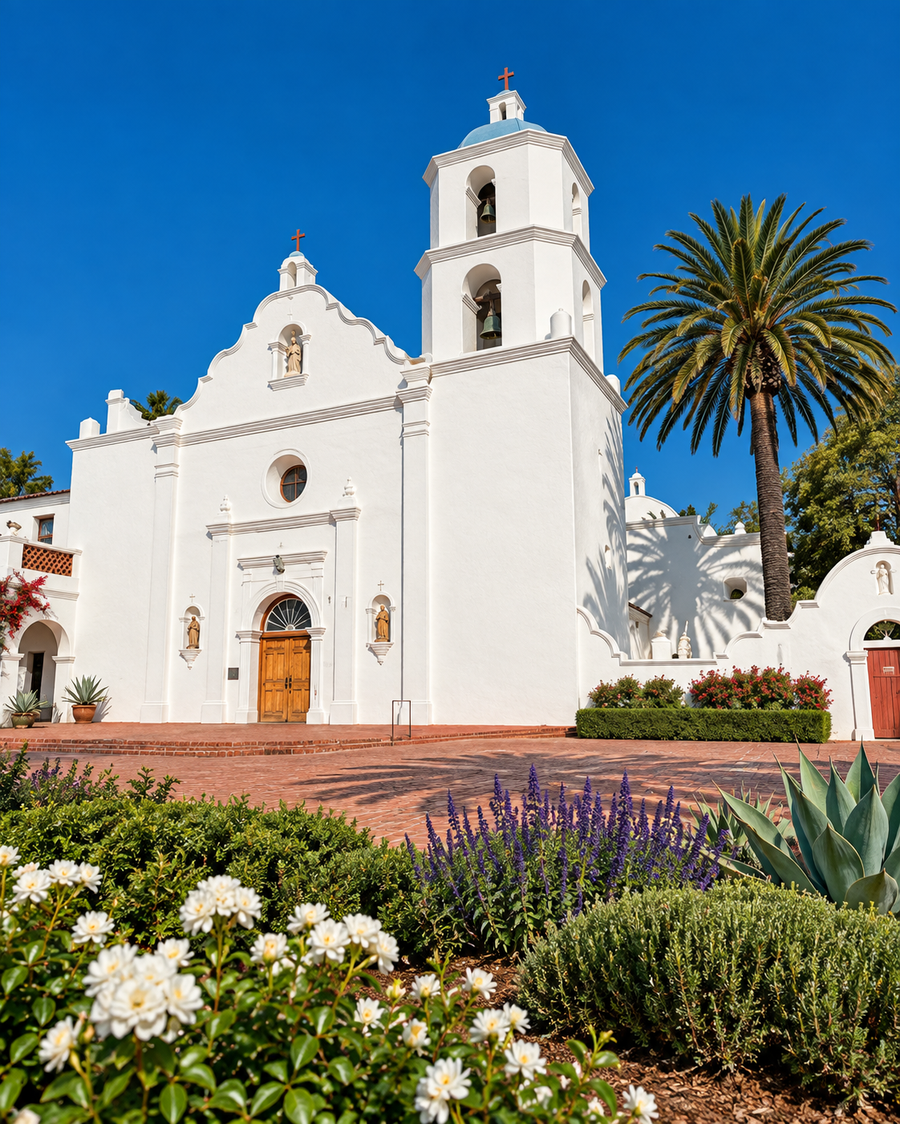
The Story
The Founder: Father Fermín Francisco de Lasuén
Where St. Junípero Serra planted the first nine missions, it was his successor, Father Fermín Francisco de Lasuén, who carried the work forward. The map of California reads like a Litany of the Saints because of the names bestowed by the friars upon their early missions in the wilderness, around which the cities grew. Lasuén served as Father President of the California Missions from 1785 until his death in 1803, and his administrative genius and pastoral zeal were the direct continuation of Serra's apostolic fire.
The Founding: June 13, 1798
The mission was established and grew with extraordinary speed. The Luiseño people responded to the Gospel in remarkable numbers. Within just a few decades, San Luis Rey became the largest and most populous of all the California missions, with a neophyte population that exceeded any other mission community along El Camino Real.
The Branch Mission of San Antonio de Pala
San Luis Rey also established the branch mission of San Antonio de Pala, founded by Father Antonio Peyrá in 1816, located about twenty miles above on the north side of the San Luis Rey River, in the same county. This branch mission extended the reach of the Church deeper into the inland regions, serving native communities that the main mission could not easily access. Remarkably, the Chapel of San Antonio de Pala remains active to this day as a living parish serving the indigenous community, one of the only remaining California asistencias still in use.
The People: The Luiseño and Their Languages
The five missions of San Fernando, San Gabriel, San Juan Capistrano, San Luis Rey, and its branch mission of San Antonio de Pala were all in Shoshonean territory, and the great majority of the Mission Indians of today are of this stock. The Luiseño people occupied territory from the Gabrielino border along the coast to the Yuman frontier beyond Escondido, including the lower San Luis Rey River, Temecula, Santa Rosa, and San Jacinto. Their language was spoken in slightly different dialects at the missions of San Luis Rey and San Juan Capistrano. The Franciscans, faithful to the missionary calling, learned these languages and served these communities in their own tongue, a labor of charity that demanded years of patient study and total dedication.
Secularization and Decline
The Indians were given charge of the spiritual affairs only, to the amazement of those who had been accustomed to receiving food, clothing, and presents as well as religious instruction from their missionaries. The Mexican government's secularization in 1834 scattered the neophyte community, collapsed the mission's vast agricultural system, and dramatically reduced the Church's presence. What thriving Catholic civilization had built over decades was dismantled in years.
Restoration
The mission was eventually returned to the Franciscans and has since been restored as both an active parish and a place of pilgrimage. Its grand church remains one of the finest examples of Spanish Colonial mission architecture in all of North America.
Church Recognition
St. Junípero Serra: The Apostolic Vision Behind the Mission
Though Serra himself did not found San Luis Rey, every mission built after his death was the direct fruit of the system he established. The Franciscans left a long record of tireless labor and heroism, much of which played an important part in spreading civilization over territory which was later to become the United States of America, with the cities of California growing around these missions. San Luis Rey stands squarely within that legacy.
The Franciscan Witness
The Franciscans transformed the native peoples into masons, carpenters, plasterers, soapmakers, tanners, shoemakers, blacksmiths, millers, bakers, cooks, brickmakers, weavers, spinners, saddlers, shepherds, agriculturalists, and vintagers, filling the laborious occupations of civilized society. San Luis Rey was among the most productive of these communities. The mission's agricultural output, its vast herds, and the skilled trades practiced within its walls were a testament to the dignity the Franciscans believed every human person possessed by virtue of being created in the image of God.
Catholic Teaching
Mission San Luis Rey de Francia is not merely a monument of California history. It is a proclamation, in stone and sacrifice, of truths the Church has always held.
On the Sanctification of Temporal Life: The patron of this mission, St. Louis IX of France, lived his holiness not in a monastery but on a throne. He fed the poor from his own table, washed the feet of beggars, ministered to lepers, and built chapels, hospitals, and universities, understanding that faith must transform culture rather than retreat from it. The mission bearing his name embodied that same spirit: the Franciscans did not merely save souls for heaven; they served bodies in time.
On the Universal Call to Holiness: The Second Vatican Council's Lumen Gentium teaches that all the faithful, kings, friars, farmers, and converts alike, are called to the fullness of holiness proper to their state of life. A king who built chapels and institutions of learning is a saint who understood that every dimension of human existence belongs to God.
On Evangelization and Human Dignity: The Catechism teaches that "the missionary mandate is not merely a matter of geography, but of the very nature of the Church" (CCC 849-850). The missionaries of San Luis Rey crossed oceans, learned foreign tongues, and built entire civilizations, not for conquest, but for Christ and the eternal salvation of every soul they encountered.
On Secularization as a Warning: Secularization and plunder of the California missions by the Mexican Government in 1834 brought ruin. This is not a footnote; it is a parable. When the Church is removed from the center of civil life, what follows is not liberation but collapse. The history of San Luis Rey stands as a perennial warning against the illusion that human flourishing can be achieved apart from God.
Plan Your Visit
The Pilgrim’s Quick Card
- Ideal stay
- 1/2 Day Allow about 2–4 hours to visit the Historic Mission
- Best months
- March–May Spring and fall generally offer the most comfortable weather
- Nearest airport
- San Diego International Airport (SAN) SAN is the most practical major airport for travelers
- Language & currency
- English Spanish is also widely spoken
- Feast day
- King of the Missions: The Eighteenth of the Twenty-One
- Accessibility
- Fair Cautions that some historic grounds and pathways are uneven.
Practical
Additional Information
Download the free King of the Missions app before visiting.
It includes a self-guided tour with 8 stops around the Mission grounds. Most stops are free; museum admission is separate. The Historic Church audio tour is also available through the app, with Spanish audio available.
Museum
The Mission Museum covers more than 225 years of history, including Native American, Spanish, Mexican and American periods.
Current hours: 10:00 AM–4:00 PM daily
Adult admission: $8
Discounted rates are available for seniors, youth, active military families and Museums for All participants.
Mass & Eucharistic Adoration
The Historic Mission Church currently celebrates weekday Mass at noon Monday through Friday.
The adjoining parish campus also offers daily Mass and regular Eucharistic Adoration, including Thursday Adoration and overnight First Friday Adoration.
Retreat Center
Mission San Luis Rey also operates a Franciscan Retreat Center for personal retreats, quiet days and organized spiritual retreats.
Pilgrims interested in turning a short Mission visit into a more substantial spiritual retreat can stay on the grounds and participate in the Mission's prayer life.
Parking
Daytime parking is free and handicapped-accessible spaces are available. Overnight parking is not permitted.
Coffee & Gift Shop
The Mission has an on-site gift shop and Mission Grounds Coffee Shop, making it easy to spend several hours on the property without leaving for food or refreshments. The coffee shop currently operates during daytime hours, while the gift shop is generally open 10:00 AM–5:00 PM.
Go Deeper
St. Louis IX of France: His feast day is August 25. Study his life to understand what it means to be a Catholic statesman: a man who governed a kingdom while practicing heroic personal virtue. He is a model for Catholic engagement in public life and a rebuke to the modern assumption that faith must remain private.
Father Fermín Francisco de Lasuén: Often overshadowed by Serra, Lasuén founded nine missions of his own and governed the mission system for nearly two decades with remarkable pastoral wisdom. His legacy deserves to be far better known.
The Chapel of San Antonio de Pala: One of the only original asistencias still serving an active indigenous Catholic community, Pala stands as a living witness that the fruit of the California missions did not die with secularization. It is worth visiting, worth studying, and worth supporting.
The California Mission Documentary by Ken Burns is secular and should be set aside. Instead, turn to "The California Missions: A Pictorial History" by Sunset Books or the writings of Fr. Zephyrin Engelhardt, O.F.M., whose encyclopedic histories of each individual California mission remain among the best information out there.
Location
Visit the official website ↗ See it on the interactive map →Pilgrim Photos
No pilgrim photos yet — be the first to share one from Mission San Luis Rey de Francia.
In the Area
Other sacred sites within 40 miles.