
The California Mission Trail
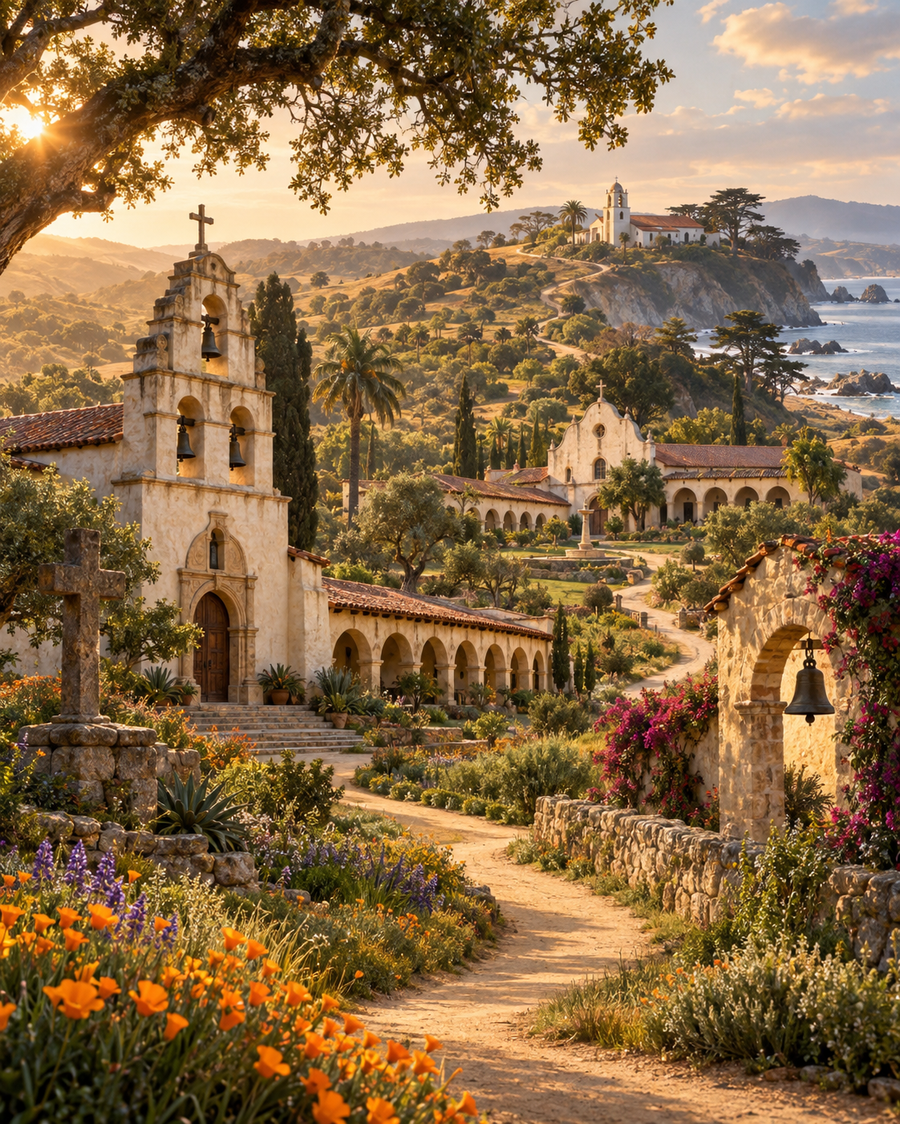
The California Missions are the name given to the chain of mission stations established among the American Indians of California by Franciscan missionaries in the latter part of the eighteenth and early part of the nineteenth centuries, beginning in 1769. The historic California missions were twenty-one in number, excluding branch foundations, extending along the coast or at a short distance inland from San Diego in the south to Sonoma, beyond San Francisco Bay, in the north. Father Junipero Serra founded, on July 16, 1769, the first in the chain of missions which extended from San Diego to Sonoma, a distance of about six hundred miles. This chain of missions, linked by the royal road known as El Camino Real ("The Royal Road"), became the spiritual and civilizational backbone of what is now the state of California.
Official route website ↗The Pilgrim’s Quick Card
- Length
- About 600 miles / 965 km
- Time to drive
- 1-2 weeks for all 21
- Best season
- Year-round; spring and fall are mildest
- Starts
- Mission San Diego de Alcala, San Diego
- Ends
- Mission San Francisco Solano, Sonoma
- Waymarking
- Cast-iron mission bells on U.S. 101
The Route
Numbered markers are the stops, in order. Click one to read about it. See it beside every other sacred site →
The Story
The Founder: St. Junípero Serra
This humble Spanish Franciscan friar is one of America's Founding Fathers, California's Founding Father, the first United States Latino Saint, and the first saint canonized on American soil.
His real missionary work did not begin until he was 56 years old, after spending nine years among the Toltec Indians and seven years as an itinerant preacher from San Fernando College in Mexico City. Learning of California and the needs of its Indians moved him. He then received permission to begin mission work there.
He carried on a most heroic conquest of America for Christ from 1750 until his death in 1784, with no other weapon than a crucifix and the love of God.
This canonized Spanish Franciscan missionary founded the first 9 of the 21 California missions, baptized over 6,000 Native Americans, and dedicated his life to loving, caring for, teaching, and evangelizing them. His successors founded twelve more.
Shortly after landing in Mexico, a reaction to an insect bite caused problems with his leg for the rest of his life, manifesting into swelling, pain, itching, and varicose ulcers, leaving him crippled. This affliction stayed with him the entire time he worked as a missionary until his death at age 70.
His motto, which drove him forward despite every suffering, was: "Always forward, never back."
Canonization
On September 25, 1988, he was beatified by Pope John Paul II. Pope Francis canonized Junipero Serra on September 23, 2015, during a Mass in Washington, DC. He is known as the Apostle of California.
El Camino Real — The Royal Road
Interstate 5 in Southern Californian essentially traces the path of the Camino Real. The road connected each mission, spaced roughly a day's journey apart, so that a traveler was never more than one day's walk from food, shelter, and the sacraments. It is one of the most remarkable feats of Catholic missionary infrastructure in the history of the New World.
As St. John Paul II declared when he visited the Mission of San Carlos in Carmel: "All the missions of El Camino Real bear witness to the challenges and heroism of an earlier time, but not a time forgotten or without significance for the California of today and the Church of today. These buildings and the men who gave them life, especially their spiritual father, Junípero Serra, are reminders of an age of discovery and exploration. The missions are the result of a conscious moral decision made by people of faith in a situation that presented many human possibilities, both good and bad, with respect to the future of this land and its native peoples. It was a decision rooted in a love of God and neighbor."
Church Recognition
While the missionaries exercised independent control, which was the case to the end of 1834, the neophyte community was like one great family, at the head of which stood the padre, under which title the missionary was universally known. To him the Indians looked for everything concerning their bodies as well as their souls.
Not satisfied with simple conversion to the Catholic faith, Serra taught the Indians a better life by teaching them how to sow and harvest. He led in the development of farmlands and wine presses and helped build, with his own hands, forges, mills, and slaughter houses.
The missions were not merely churches, they were complete communities of formation, agricultural education, sacramental life, and human flourishing. The California Missions were, in fact, life camps, where human life could flourish in pursuit of the common good, the natural common good undergirded by the supernatural.
Nowhere in North or South America was there a greater diversity of languages and dialects than in California. Of forty-six native linguistic stocks recognized within the limits of the United States by philologists, twenty-two or practically one-half were represented in California, of which only six extended beyond its borders. The Franciscans navigated this extraordinary linguistic diversity in their tireless work of evangelization.
Catholic Teaching
A mission church teaches the same thing every parish church teaches: that God chose to meet people in a particular place, through the sacraments, in the company of a community. What makes the chain worth walking as a whole is what it says about time. These twenty-one churches have kept the same Mass through Spanish rule, Mexican rule, secularization, ruin, earthquake, fire, and restoration.
The missions also ask something harder of the Church: to tell the truth about its own past. The Catechism teaches that the Church is holy and always in need of purification, and that repentance is not weakness but honesty. A pilgrimage along El Camino Real that skips that part is not a pilgrimage; it is a sightseeing tour.
Walking the Route
This is a driving route, not a walking one. The full chain runs about 600 miles from San Diego north to Sonoma, largely along U.S. 101 and older highway alignments, and most pilgrims take one to two weeks to do all twenty-one, or a long weekend for a region. Southern California (San Diego to San Fernando), the Central Coast (San Buenaventura to Carmel), and the Bay Area and north (Santa Clara to Sonoma) each make a natural leg.
The missions are not all the same kind of place. Most are active parishes with daily or Sunday Mass; La Purisima, Santa Cruz, and San Francisco Solano are California state historic parks with admission fees and park hours; Santa Clara is a university chapel on the Santa Clara University campus; San Antonio de Padua sits inside Fort Hunter Liggett, an active Army installation, and reaching it can require an ID check. Check hours and Mass times for each mission before you go -- several close for weddings and funerals with no notice.
A note on the bells: the cast-iron mission bells on their shepherd's-crook posts are a 1906 commemorative marker, not a colonial artifact. About 450 were placed originally, and a restoration program has been replacing missing ones from the original molds since 1996.
Stops Along the Way
-
The first of the 21 missions and the burial place of Father Luis Jayme, California's first Christian martyr.
-
Mission San Luis Rey de Francia
The King of the Missions: the largest of the 21 and the only one with a cruciform church.
-
Mission Basilica San Juan Capistrano
The Serra Chapel: the oldest standing church in California and the only one left where St. Junípero Serra said Mass.
-
The mission Los Angeles grew out of, with a church modeled on the cathedral of Córdoba, Spain.
-
Mission San Fernando Rey de España
Its Convento, the largest freestanding adobe building in California, with nineteen arches.
-
The last mission St. Junípero Serra founded, and the keeper of the chain's only wooden bells.
-
The Queen of the Missions, with twin bell towers and an unbroken Franciscan presence since 1786.
-
Its collection of mission-era vestments, among the finest in California.
-
Mission La Purísima Concepción
The only fully restored mission complex in California, rebuilt by the Civilian Conservation Corps in the 1930s.
-
Mission San Luis Obispo de Tolosa
Its L-shaped church and belfry, and the tradition that mission clay roof tiles began here.
-
The only mission church whose original interior murals have never been repainted.
-
The only mission with no modern town around it, still surrounded by open ranch land.
-
Mission Nuestra Señora de la Soledad
Its name, Our Lady of Solitude, and the friar who died at its altar serving the last of his flock.
-
Mission San Carlos Borromeo de Carmelo (Carmel Mission)
St. Junípero Serra's burial place and the former headquarters of the entire mission chain.
-
The largest mission church and the only one with three aisles, standing on the San Andreas Fault.
-
A rare surviving adobe row where mission-era Native families lived, preserved a block from the chapel.
-
The only California mission that serves as a university chapel, at Santa Clara University.
-
The thirty-piece Native orchestra trained here by Father Narciso Durán.
-
Mission San Francisco de Asís (Mission Dolores)
The oldest intact building in San Francisco, which survived the 1906 earthquake and fire.
-
The only mission founded as a hospital, built to help people recover from the damp of San Francisco.
-
The last and northernmost mission, and the only one founded after Mexican independence.
Go Deeper
The California Missions Foundation (californiamissionsfoundation.org) is the best single starting point, with a page for every mission and current visiting information.
Each mission's own website carries its Mass schedule; those links are on the individual mission pages here. Several missions have museums with collections documenting the Native communities who built them, and a number of California tribal nations publish their own histories of the mission period -- worth reading alongside the mission's account of itself.